Claude Haiku 5.5 cuts prices 90% below Haiku 4.5
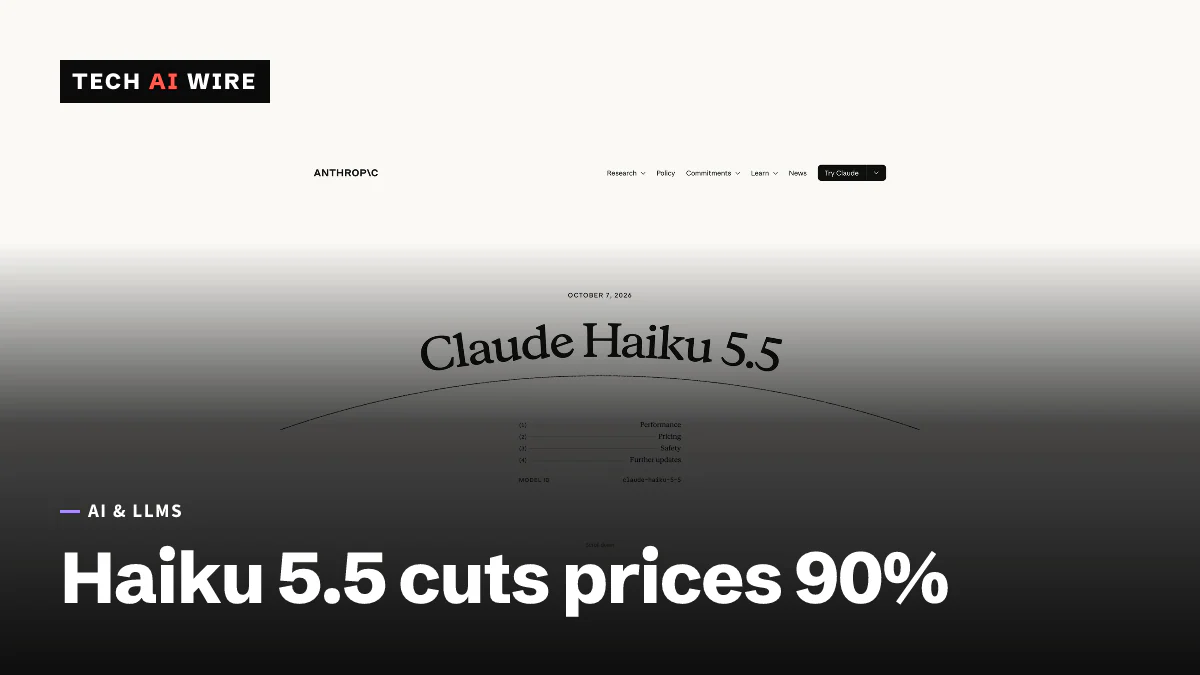
Claude Haiku 5.5 costs $0.10 per million input tokens and $0.50 output, 90% below Haiku 4.5, and scores 39.2% on Terminal-Bench 4.0, up from 0%.
4 min read
By the numbers
- per million input / output tokens, prompts up to 100K
- $0.10 / $0.50
- lower base price than Haiku 4.5 on those prompts
- 90%
- lower average running cost than Haiku 4.5, per Anthropic
- 75%
- Terminal-Bench 4.0, up from 0.0% for Haiku 4.5
- 39.2%
- Haiku 5.5
- 72.4%
- GPT-6 Luna
- 48.9%
- Haiku 4.5
- 15.7%
Anthropic released Claude Haiku 5.5 on October 7, 2026, its newest small model, at a tenth of Haiku 4.5's price for most requests. It costs $0.10 per million input tokens and $0.50 per million output tokens on prompts up to 100,000 tokens. Haiku 4.5 costs $1 and $5. For teams that make many small model calls, such as subagents, routing and summaries, that part of the bill can drop sharply.
What Anthropic released
Haiku is Anthropic's smallest and cheapest model line, below Sonnet and Opus. Anthropic's announcement gives the model ID claude-haiku-5-5. It is available on the Claude Platform, Amazon Web Services, Google Cloud and Microsoft Azure.
Pricing now depends on prompt length. Prompts up to 100,000 tokens get the low rate, and longer prompts cost five times as much. VentureBeat reports that 90% of Haiku 4.5 requests would fall in the cheaper tier.
| Price per million tokens | Haiku 5.5, up to 100K | Haiku 5.5, over 100K | Haiku 4.5 |
|---|---|---|---|
| Input | $0.10 | $0.50 | $1 |
| Output | $0.50 | $2.50 | $5 |
| Cache reads | $0.01 | $0.05 | $0.10 |
| 5-minute cache writes | $0.125 | $0.625 | $1.25 |
| 1-hour cache writes | $0.20 | $1 | $2 |
Anthropic says Haiku 5.5 costs about 75% less to run on average than Haiku 4.5. Unite.AI reports that it is the first Haiku model with an adjustable effort setting. That setting trades cost against answer quality. Unite.AI also lists a June 2026 knowledge cutoff.
How it scores
The biggest gains are on agent tasks, where a model operates a computer or a terminal on its own. On Terminal-Bench 4.0, a test of agents working on the command line, Haiku 4.5 scored 0.0%. Haiku 5.5 scores 39.2%.
| Benchmark | Haiku 5.5 | Haiku 4.5 | GPT-6 Luna |
|---|---|---|---|
| OSWorld 2.1 (offline) | 72.4% | 15.7% | 48.9% |
| Terminal-Bench 4.0 | 39.2% | 0.0% | 16.4% |
| FrontierCode 1.1 (Main) | 46.4% | not given | 42.4% |
| Chartography (no tools) | 46.4% | 6.4% | 29.1% |
| Humanity's Last Exam (with tools) | 57.4% | 18.7% | not given |
| GDPval-AA v2.1 (score) | 1,620 | 735 | 1,437 |
VentureBeat reports that Haiku 5.5's base rates match OpenAI's GPT-6 Luna. In Anthropic's table, Haiku 5.5 is ahead of Luna on every test where both have a score.
The larger models still lead on hard coding work. Sonnet 5.5 scores 70.6% on Terminal-Bench 4.0, as Tech AI Wire reported when Anthropic released Sonnet 5.5 on September 28.
The tokenizer catch
A tokenizer splits text into the tokens a model reads and bills by. Anthropic says Haiku 5.5 uses slightly more tokens per task than Haiku 4.5 because of an updated tokenizer. Anthropic's pricing docs say Claude 4.7 and later models use a newer tokenizer that produces about 30% more tokens for the same text. Even with that overhead, a 90% lower price per token leaves the cost per task well below Haiku 4.5's.
Where developers can use it
GitHub made Haiku 5.5 generally available in GitHub Copilot the same day, according to the GitHub changelog. It is on the Pro, Pro+, Max, Business and Enterprise plans. It works in VS Code, Visual Studio, GitHub.com, JetBrains IDEs and mobile, among others. GitHub says it matched Claude Sonnet 5 on many coding tasks while using significantly fewer tokens. GitHub aims it at subagents, quick edits and terminal tasks.
Early customers point to speed. Asana's Aaron Vinh reported "over a 30% reduction in latency" for task completions, Anthropic's announcement says. Box's Yashodha Bhavnani said it scored 11 points higher than Haiku 4.5 at about half the latency. Rogo's Alex Wang told VentureBeat it is "fast and cheap enough that we can run it a lot."
What this means for developers
Re-price your high-volume calls first. Classification, routing, extraction and summaries that run thousands of times a day are where a 90% cut shows up. Take your current Haiku 4.5 token counts, add some overhead for the new tokenizer, and compare the totals.
Watch the 100,000-token line. Above it, input costs five times as much. If you put long documents into prompts, trim them or cache them. A cache read costs $0.01 per million tokens on prompts under the line.
Try it as your subagent model. Terminal-Bench went from 0.0% to 39.2%, so Haiku can now handle simple agent steps it could not do before. Keep Sonnet 5.5 or Opus 5.5 for the hard steps, since the gap on that test is still wide.
Move off Haiku 4.5 on your own schedule. Anthropic's deprecations page still lists Haiku 4.5 as active, with no deprecation date set. That leaves time to run your own evals before you switch the model ID.
Sources
- Introducing Claude Haiku 5.5 - Anthropic
- Anthropic launches Claude Haiku 5.5 with 90% API price reduction, matching GPT-6 Luna - VentureBeat
- Anthropic Releases Claude Haiku 5.5, Cutting Small-Model API Prices - Unite.AI
- Claude Haiku 5.5 in GitHub Copilot - GitHub Changelog
- Pricing - Claude Platform Docs
Related articles
Claude Sonnet 5.5 nears Opus 5.5 at half the price
Claude Sonnet 5.5 scores 70.6% on Terminal-Bench 4.0 at $2/$10 per million tokens, half Opus 5.5's price. Sonnet 4.5 retires on November 30, 2026.
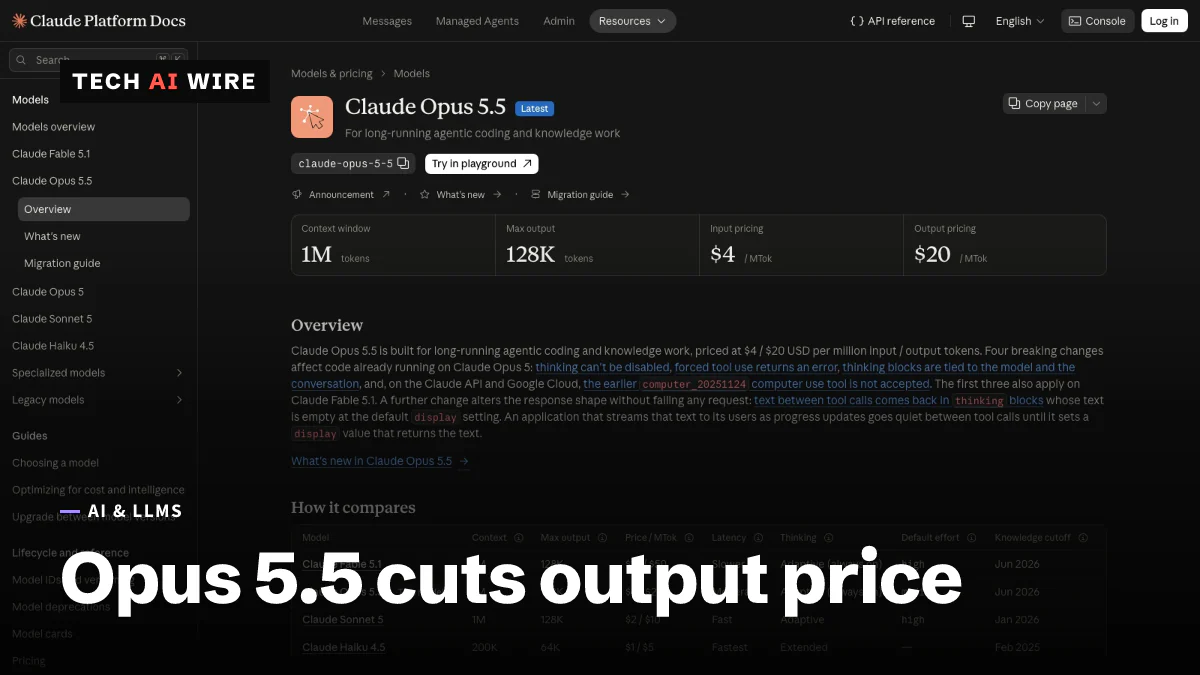
Claude Opus 5.5 cuts output price to $20 per million
Anthropic released Claude Opus 5.5 on September 22, 2026, at $4 input and $20 output per million tokens, with thinking always switched on.
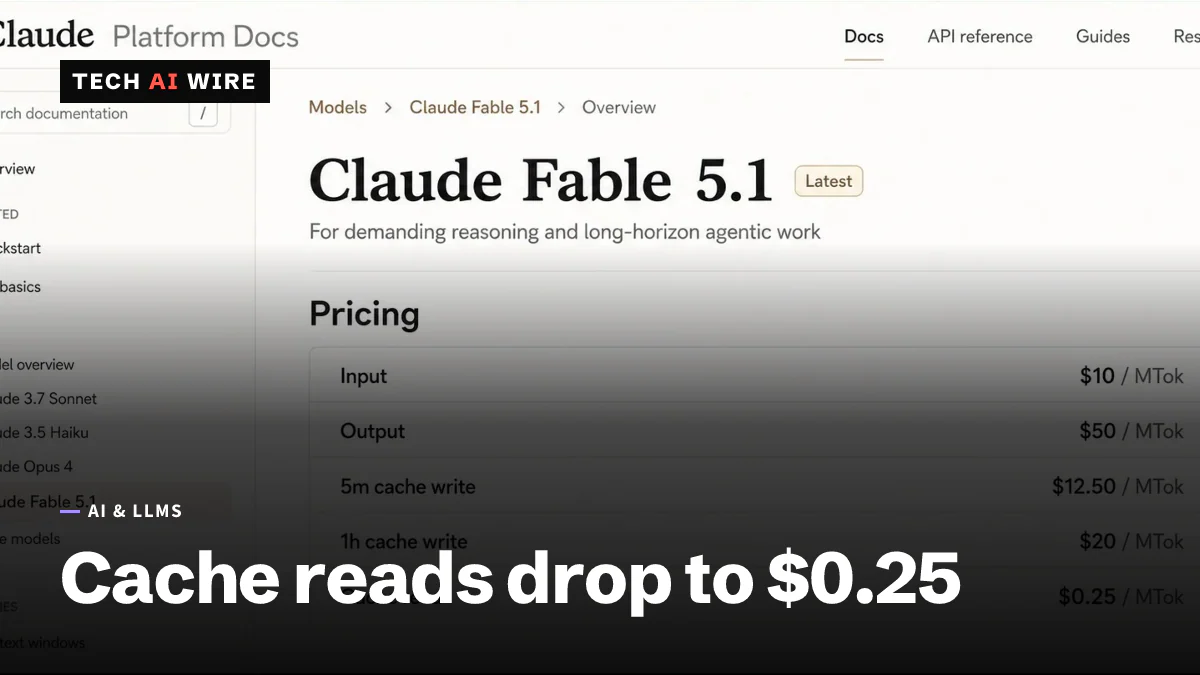
Claude Fable 5.1 cuts cache reads 75% and keeps token prices flat
Anthropic's Fable 5.1 holds input and output prices at $10 and $50 per million tokens, and drops cache reads from $1.00 to $0.25. Mythos 5.1 stays invitation-only.
The weekly digest
One email every Friday with the week's top stories from all six desks: AI, dev tools, coding, the tech industry, startups and what's next. Free, no spam.