Claude Fable 5.1 cuts cache reads 75% and keeps token prices flat
Anthropic's Fable 5.1 holds input and output prices at $10 and $50 per million tokens, and drops cache reads from $1.00 to $0.25. Mythos 5.1 stays invitation-only.
4 min read
By the numbers
- per million tokens for cache reads, down from $1.00
- $0.25
- token context window, with 128K maximum output
- 1M
- cost cut Anthropic claims for highly agentic workloads
- 45%
- Mythos 5.1
- 60.9%
- Fable 5.1
- 55.8%
- Opus 5
- 52.3%
- Fable 5
- 42%
- GPT-5.6 Sol
- 37.3%
Anthropic released Claude Fable 5.1 and Claude Mythos 5.1 on September 1, 2026. Input and output prices did not move. What fell is the cost of reading from cache, down 75%, and for anyone running agents over long contexts that is the change that matters.
Fable 5.1 is generally available. Mythos 5.1 is invitation only.
What changed in the price list
The headline rates stayed where they were.
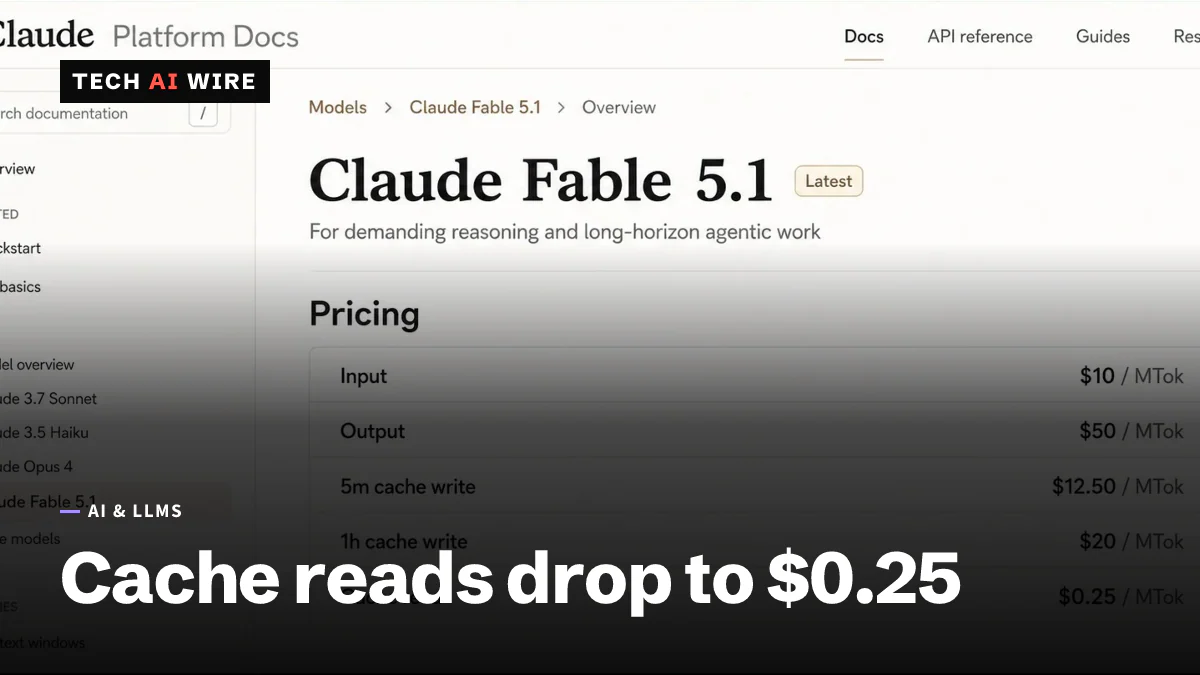
Anthropic's documentation lists Fable 5.1 at $10 per million input tokens and $50 per million output tokens. Both match Fable 5. Cache reads dropped from $1.00 per million tokens to $0.25.
A cache read is what you pay when the model re-reads context you already sent. Agents do this constantly. An agent working through a long task resends its history at every step, so the same tokens get charged again and again.
| Item | Price per million tokens |
|---|---|
| Input | $10.00 |
| Output | $50.00 |
| Cache read | $0.25, down from $1.00 |
| Cache write, 5-minute | $12.50 |
| Cache write, 1-hour | $20.00 |
The batch API takes 50% off input and output, according to the documentation.
Anthropic puts the practical effect at roughly 25% lower cost for typical workloads and roughly 45% for highly agentic ones. Those are the company's own figures. They depend entirely on how much of your traffic is cached.
The context window is 1 million tokens, with a maximum output of 128,000 tokens. The knowledge cutoff is June 2026.
The benchmark numbers, and who produced them
Anthropic published these scores. No independent laboratory has verified them.
With that caveat, the reported gains on agentic and terminal tasks are large. On Terminal-Bench-Science 0.1, Anthropic reports Fable 5.1 at 52.6%, against 24.7% for Fable 5 and 29.0% for Opus 5. On AutomationBench it reports 31.4%, against 17.1% for Fable 5. Mythos 5.1 scores higher than Fable 5.1 on Terminal-Bench 4.0, at 60.9% against 55.8%.
VentureBeat covered the launch the same day and repeated the cost figures. Its report adds no independent measurement of its own.
Anthropic's announcement also carries a long list of testimonials from companies that tested the models before release. Read those as early impressions, not as evaluation. Miguel Gonzalez, technical lead at Browserbase, is quoted saying the model "completed 82% of tasks in ~10 minutes vs 74% for Opus 5."
Mythos 5.1 and the restricted programs
The second model is the more unusual release.
Mythos 5.1 has the same capabilities as Fable 5.1, according to Anthropic's documentation. It is available by invitation only, through a scheme Anthropic calls Project Glasswing. Access runs through two verification programs. The Cyber Verification Program covers defensive security work. The Life Sciences Verification Program was developed with a United States government partner and is currently limited to selected US organizations.
Anthropic also introduced Enterprise Frontier Safeguards. It lets a company detect and prevent misuse of the model while keeping zero data retention. Monitoring data sits on the customer's own Amazon Web Services, Google Cloud or Azure infrastructure, under customer-controlled encryption. Anthropic says human review defaults to the customer rather than to Anthropic. The feature rolls out in phases from fall 2026, across Claude Code, Claude Enterprise, Claude Platform, Amazon Bedrock, Google Agent Platform and Microsoft Foundry.
What this means for developers
Read the breaking changes before pointing a running agent at this model. Anthropic's documentation lists three. Forced tool use now returns an error. Earlier models cannot read Fable 5.1's thinking blocks. Editing an earlier turn invalidates the thinking blocks that follow it.
That third one deserves real attention. Many agent frameworks trim or rewrite old turns to keep context under control. If yours does that, the thinking blocks after the edit stop being valid, and you need to find out what your framework does next.
Work out your own cache ratio before believing the savings. The 25% and 45% figures assume heavy cache reuse. Pull a week of billing, find what share of your spend is cache reads, and cut that share by three quarters. That is your real saving. For a workload with little caching it rounds to nothing.
Adaptive thinking changes how you tune. It is always on, and the model decides how much to think, with depth steered by an effort parameter. You no longer set a reasoning budget directly. If you wrote prompts that suppress or force reasoning, retest them.
Treat the benchmark table as a hypothesis, not a result. Anthropic ran these tests and chose which to publish. The number that should decide anything is the one from your own evaluation set. The cache price cut makes running that evaluation cheaper than it was last week.
Anthropic has since released Claude Opus 5.5, which cuts the output price to $20 per million tokens and makes adaptive thinking permanent.
Sources
- Anthropic's Claude Fable 5.1 and Mythos 5.1 arrive with a 75% cost reduction for Fable cache reads - VentureBeat
- Claude Fable and Mythos 5.1 - Anthropic
- Claude Fable 5.1 overview - Claude Platform Docs
Related articles
Claude Haiku 5.5 cuts prices 90% below Haiku 4.5
Claude Haiku 5.5 costs $0.10 per million input tokens and $0.50 output, 90% below Haiku 4.5, and scores 39.2% on Terminal-Bench 4.0, up from 0%.
Claude Sonnet 5.5 nears Opus 5.5 at half the price
Claude Sonnet 5.5 scores 70.6% on Terminal-Bench 4.0 at $2/$10 per million tokens, half Opus 5.5's price. Sonnet 4.5 retires on November 30, 2026.
Claude for Government reaches GA under FedRAMP High
Anthropic's Claude for Government is generally available to U.S. federal and state agencies under FedRAMP High, with no seat fees and hard spending caps.
The weekly digest
One email every Friday with the week's top stories from all six desks: AI, dev tools, coding, the tech industry, startups and what's next. Free, no spam.