Claude Sonnet 5.5 nears Opus 5.5 at half the price
Claude Sonnet 5.5 scores 70.6% on Terminal-Bench 4.0 at $2/$10 per million tokens, half Opus 5.5's price. Sonnet 4.5 retires on November 30, 2026.
4 min read
By the numbers
- per million input / output tokens, unchanged
- $2 / $10
- Terminal-Bench 4.0, ahead of Opus 5.5
- 70.6%
- faster output than Sonnet 5, per Anthropic
- 30%+
- retirement date for Claude Sonnet 4.5
- Nov 30
- Sonnet 5.5
- 70.6%
- Opus 5.5
- 66.4%
- Sonnet 5
- 10.3%
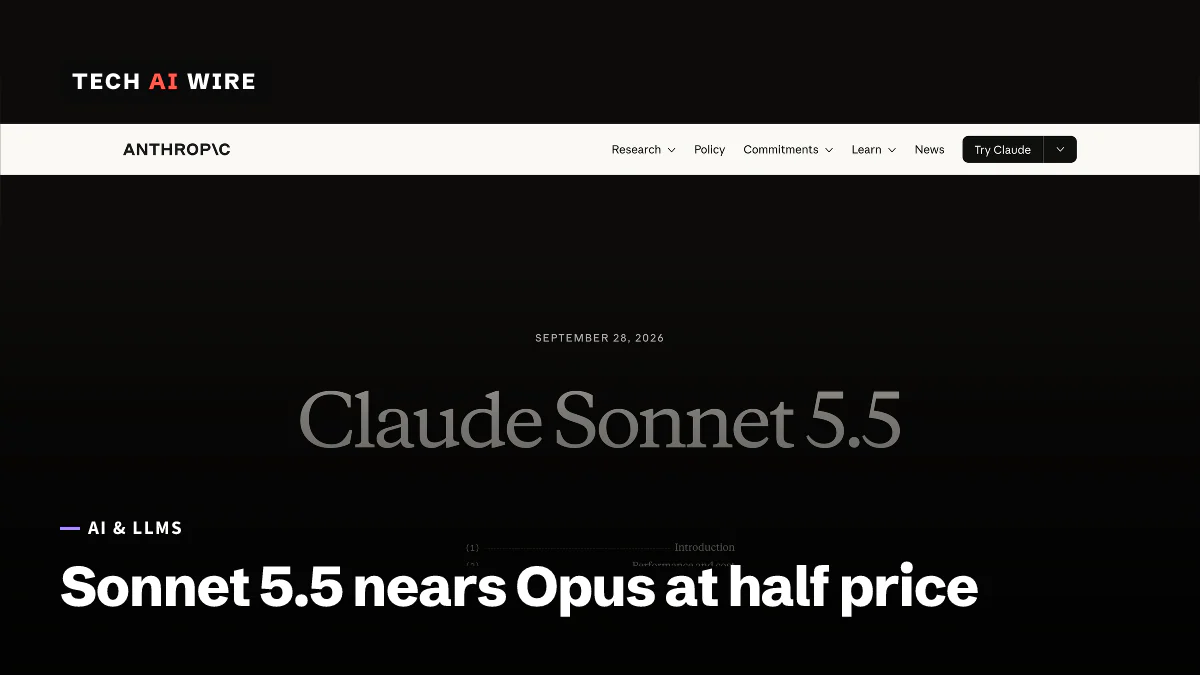
Anthropic released Claude Sonnet 5.5 on September 28, 2026, a faster model that comes close to its flagship Opus 5.5 at half the price. It costs $2 per million input tokens and $10 per million output tokens, the same as Sonnet 5. On one agentic coding test, Terminal-Bench 4.0, it scores 70.6%, ahead of Opus 5.5. For teams paying for AI coding and agent work, it is a cheaper option for most everyday tasks.
What Anthropic released
Sonnet is Anthropic's mid-priced model line, below the top-end Opus. Anthropic's announcement says Sonnet 5.5 generates output more than 30% faster than Sonnet 5. It also needs fewer tokens for the same work, so a task can cost up to 30% less.
Developers call it with the model ID claude-sonnet-5-5. It is available on the Claude Platform, Amazon Web Services, Google Cloud and Microsoft Azure, as well as in the Claude apps.
| Claude Sonnet 5.5 | |
|---|---|
| Input price | $2 per million tokens |
| Output price | $10 per million tokens |
| Cache reads | $0.20 per million tokens |
| Cache writes | $2.50 per million tokens |
| Context window | 1 million tokens, per MarkTechPost |
| Maximum output | 128,000 tokens, per MarkTechPost |
| Knowledge cutoff | June 2026, per MarkTechPost |
Opus 5.5 costs $4 per million input tokens and $20 per million output tokens, as Tech AI Wire reported when Anthropic released Opus 5.5 on September 22. Sonnet 5.5 is exactly half that on both.
How it scores
Anthropic published results for Sonnet 5.5 next to Sonnet 5 and Opus 5.5. Sonnet 5.5 beats Opus 5.5 on Terminal-Bench 4.0, a test of agents working on the command line. On most other tests, Opus 5.5 stays slightly ahead.
| Benchmark | Sonnet 5.5 | Sonnet 5 | Opus 5.5 |
|---|---|---|---|
| Terminal-Bench 4.0 | 70.6% | 10.3% | 66.4% |
| CursorBench 4.0 | 55.5% | 34.1% | 57.8% |
| FrontierCode 1.1 (Main) | 46.2% | 42.4% | 54.4% |
| OSWorld 2.1 | 80.1% | 57.0% | 81.8% |
| Humanity's Last Exam | 64.5% | 54.9% | 67.7% |
| Chartography | 61.6% | 15.6% | 64.4% |
| GDPval-AA v2.1 (score) | 1844 | 1449 | 1846 |
The jump over Sonnet 5 is largest on agent tasks. Sonnet 5 scored 10.3% on Terminal-Bench 4.0, so the gain on command-line agent work is the biggest in the table.
What Anthropic says it is for
Anthropic positions the two models for different work. Sonnet 5.5 is strongest at well-scoped everyday tasks, fixing bugs, creating documents and fast iteration on simpler problems, the company says. Opus 5.5 is meant for complex work that needs careful judgment and sustained reasoning.
Early customers report gains in speed and cost. A Slack principal engineer, Curtis Allen, said that "without changing prompts, Sonnet 5.5 performed better on nearly all evals with about 14% fewer output tokens." App builder Base44 measured 3.6 iterations per build with Sonnet 5.5, against 7.7 for Opus 5, according to Unite.AI. Atlassian said teams can run its Rovo Agents up to 30% faster than with Sonnet 5.
New safety limits
Anthropic says Sonnet 5.5 is the first Sonnet model with safety classifiers that block attempts to extract its reasoning. For higher-risk cybersecurity tasks, requests will visibly fall back to Sonnet 5. Security researchers can apply for wider access through Anthropic's Cyber Verification Program.
Sonnet 4.5 is being retired
The release starts a clock for older models. Anthropic's deprecation page says Claude Sonnet 4.5 (claude-sonnet-4-5-20250929) was deprecated on September 30, 2026. It retires on November 30, 2026, and Anthropic names claude-sonnet-5-5 as the replacement. Amazon Bedrock and Google Cloud set their own retirement dates.
What this means for developers
Run your own evals before switching. Anthropic's numbers show Sonnet 5.5 close to Opus 5.5 on most tests, but your prompts and tasks are what count. Test it on a sample of real jobs and compare quality, tokens used and time taken.
Consider routing work between the two models. Send well-defined coding, bug fixing and document tasks to Sonnet 5.5 at half the price. Keep Opus 5.5 for open-ended work that needs deeper reasoning. Anthropic's own split of the two models points to this setup.
If you still call Sonnet 4.5, plan the move now. You have until November 30 on Anthropic's own platform. Check Bedrock or Google Cloud separately if you use them, since they set their own dates.
Watch for the cybersecurity fallback. If your product does security work, some requests may come back from Sonnet 5 instead of Sonnet 5.5. Log which model answered each request, so a drop in quality on security tasks does not surprise you.
Sources
- Introducing Claude Sonnet 5.5 - Anthropic
- Anthropic Releases Claude Sonnet 5.5: 70.6% on Terminal-Bench 4.0 at the Same $2/$10 Price - MarkTechPost
- Anthropic Releases Claude Sonnet 5.5 at Unchanged Sonnet 5 Pricing - Unite.AI
- Model deprecations - Claude Platform Docs
Related articles
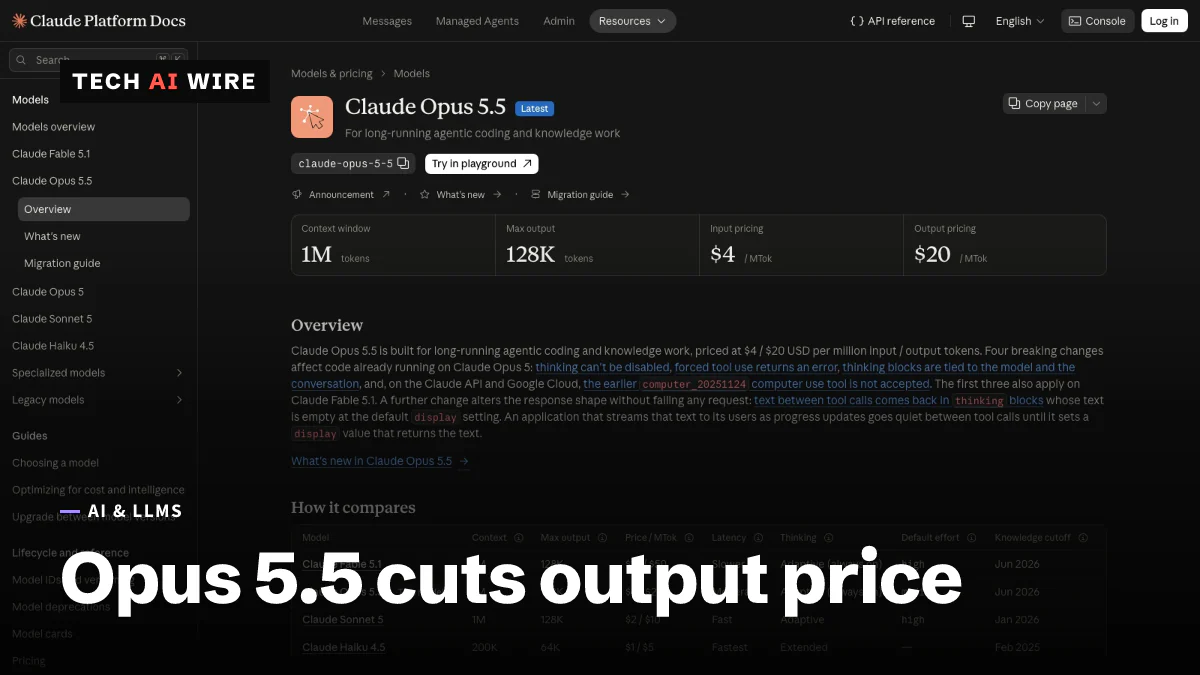
Claude Opus 5.5 cuts output price to $20 per million
Anthropic released Claude Opus 5.5 on September 22, 2026, at $4 input and $20 output per million tokens, with thinking always switched on.
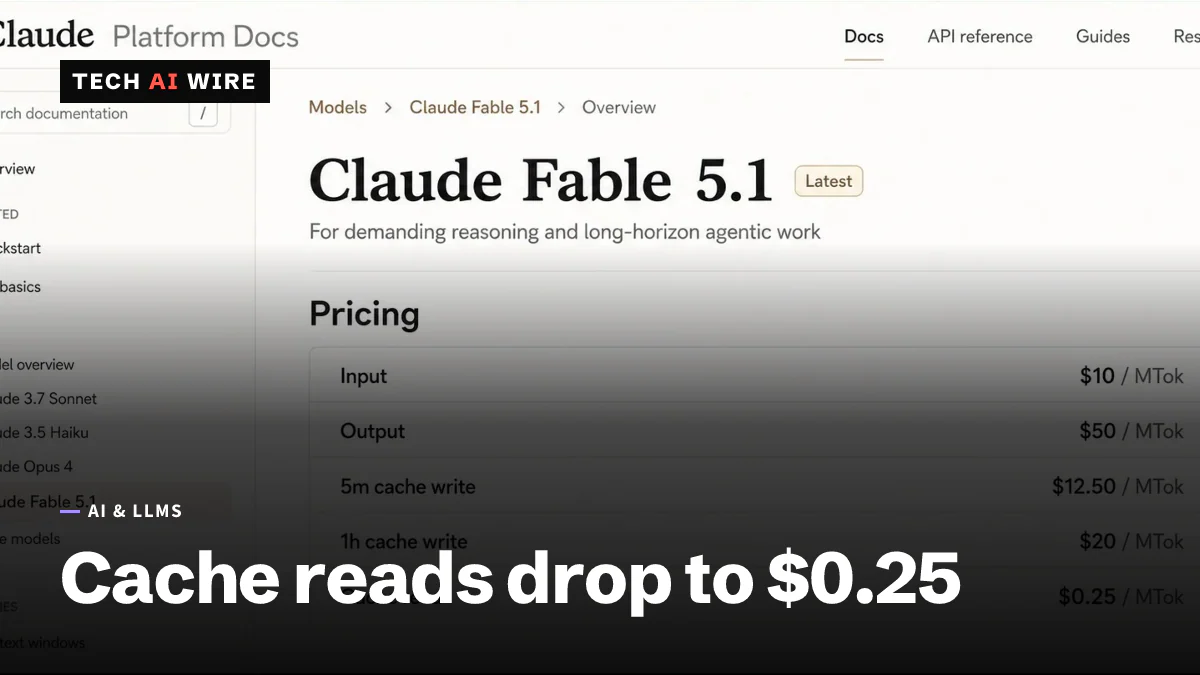
Claude Fable 5.1 cuts cache reads 75% and keeps token prices flat
Anthropic's Fable 5.1 holds input and output prices at $10 and $50 per million tokens, and drops cache reads from $1.00 to $0.25. Mythos 5.1 stays invitation-only.
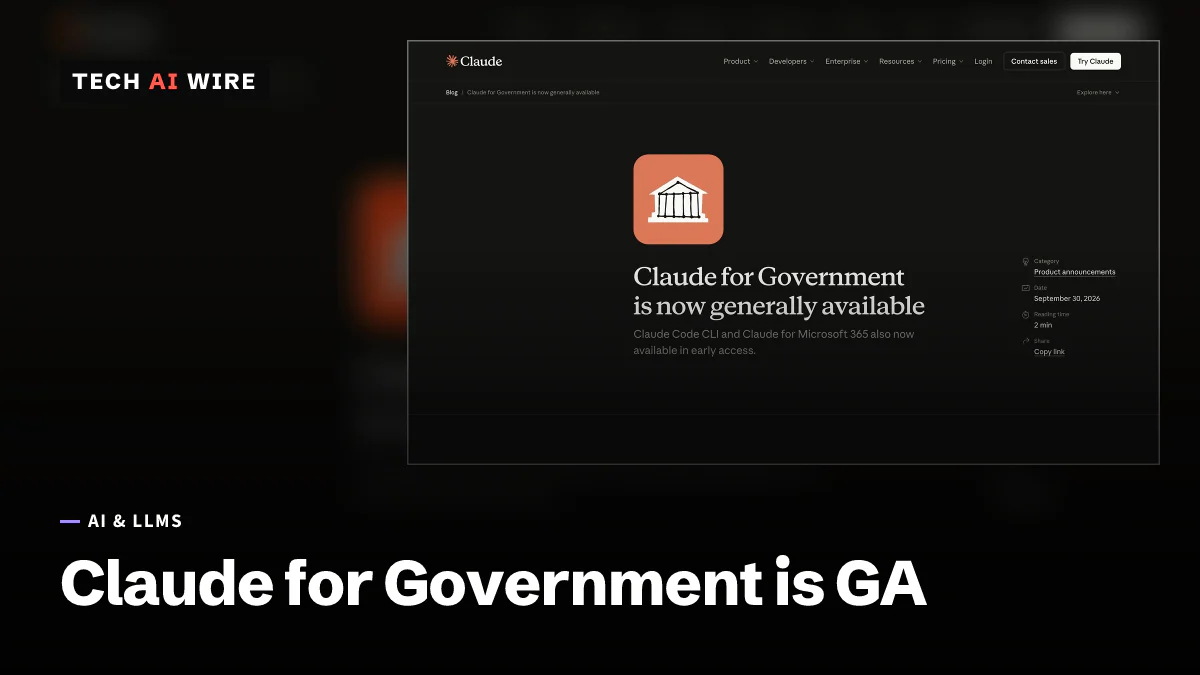
Claude for Government reaches GA under FedRAMP High
Anthropic's Claude for Government is generally available to U.S. federal and state agencies under FedRAMP High, with no seat fees and hard spending caps.
The daily brief
Three to five stories a day, and what each one means for the people who build software. Free, no spam.