Claude Opus 5.5 cuts output price to $20 per million
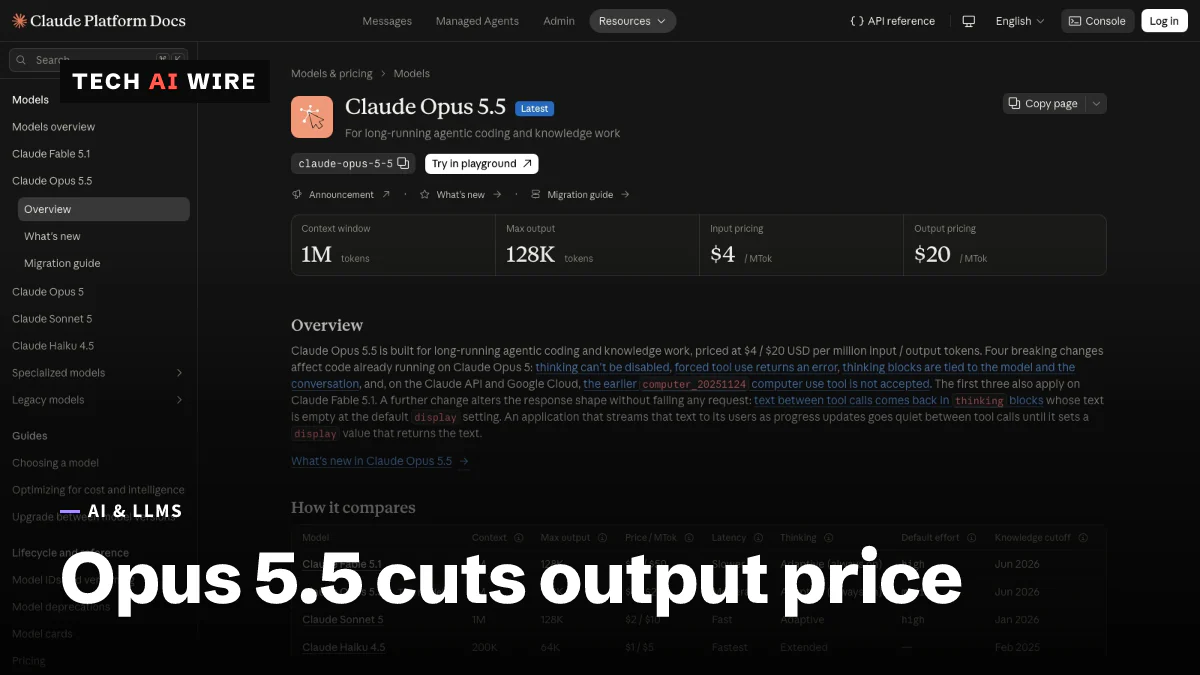
Anthropic released Claude Opus 5.5 on September 22, 2026, at $4 input and $20 output per million tokens, with thinking always switched on.
3 min read
Drafted with AI from the sources linked in this article, then fact-checked and edited by Claire Whitmore before publishing. How we work
By the numbers
- output price per million tokens, down from $25
- $20
- less to run than Opus 5, Anthropic says
- 40%
- tokens in the context window
- 1M
Anthropic released Claude Opus 5.5 on September 22, 2026. The model costs $4 per million input tokens and $20 per million output tokens. Anthropic's newsroom says it "performs at the level of Claude Fable 5.1 on most work and costs 40% less to run than Opus 5." For teams that run coding agents for hours, output tokens are the line on the bill that grows, so the price is the news.
TechCrunch reported that the $20 output price is down from $25 on the previous version. TechCrunch also said the model runs faster and needs less compute to do it.
What Opus 5.5 costs
| Item | Price per million tokens |
|---|---|
| Input | $4 |
| Output | $20 |
| Cache write, 5 minutes | $5 |
| Cache write, 1 hour | $8 |
| Cache read | $0.20 |
Prompt caching stores part of a request so it is not sent and billed in full every time. A cache read here costs $0.20 per million tokens. The Batch API takes 50% off both input and output, in exchange for slower replies.
What the model card says
Anthropic's platform documentation gives the model identifier as claude-opus-5-5. On Amazon Bedrock it is anthropic.claude-opus-5-5. The model is available through the Claude API, Amazon Bedrock, Google Cloud, Microsoft Foundry, and the Claude Platform on AWS.
The context window holds 1 million tokens. That is everything the model can read and write in one conversation. A single synchronous reply can reach 128,000 tokens. Through the Batch API, with a beta header, that ceiling rises to 300,000 tokens.
The documentation lists a knowledge cutoff of June 2026. It also says the model will not retire sooner than September 22, 2027. That second date matters to anyone who pins a model identifier in production code.
Four changes that can break working code
The documentation lists four differences from Opus 5 that are not backward compatible.
- Extended thinking is always on and cannot be turned off. Thinking is the model working a problem through before it answers.
- Forced tool use now returns an error instead of being accepted.
- Thinking blocks are tied to the model and the conversation that produced them.
- The earlier
computer_20251124tool version is no longer accepted.
The default effort setting is medium. On Claude Fable 5.1 it is high. Effort controls how hard the model works on a reply, so an unchanged prompt can behave differently.
What this means for developers
Read those four changes before you swap a model identifier in a running service. The always-on thinking is the trap. Code that passes a flag to disable thinking, or that moves thinking blocks between models, has to change first. A price cut is not worth an outage.
Re-run your own evaluations rather than trusting the comparison with Fable 5.1. Anthropic's claim covers most work, and your workload is not most work. TechCrunch reported the model outpaced Fable on many benchmarks for informal task completion, and placed it near Mythos on biology and cybersecurity. Those are broad categories, not your test suite.
Check the effort default if you are moving across from Fable 5.1. Going from high to medium changes cost and answer quality together, which makes a regression easy to misread.
If repeated context dominates your bill, read the cache rows before the token rows. Anthropic made a similar move on cache pricing for Claude Fable 5.1 earlier this month. Teams that send the same long system prompt on every call feel a cache change more than a token change.
One reason to wait exists. TechCrunch reported that Sonnet 5.5 and Haiku 5.5 are due in the coming weeks. Most production traffic does not need the largest model, so a cheaper tier may fit your workload better within the month. Haiku 5.5 has since arrived: Anthropic released Claude Haiku 5.5 on October 7, with prices up to 90% below Haiku 4.5.
Sources
- Anthropic releases Opus 5.5 with lower prices and Fable-level performance - TechCrunch
- Claude Opus 5.5 overview - Claude Platform Docs
- Anthropic newsroom - Anthropic
Related articles
Claude Fable 5.2 cuts token prices 20% from Fable 5.1
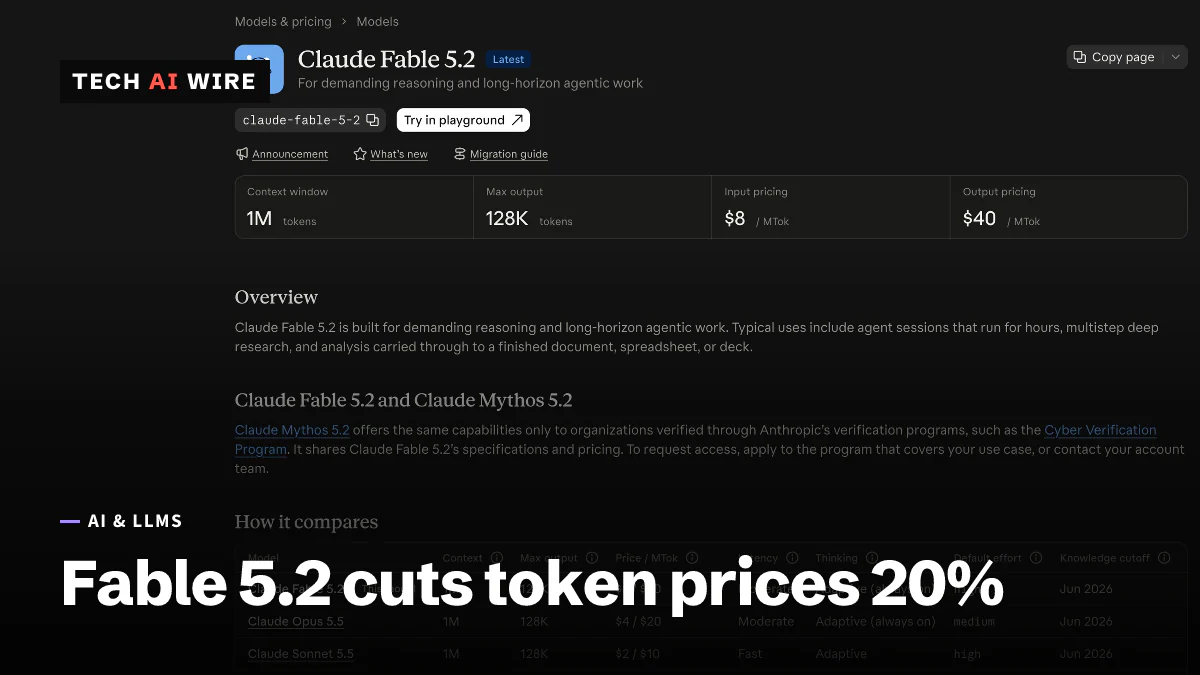
Fable 5.2 costs $8 and $40 per million tokens, 20% under Fable 5.1. A table built from Anthropic's own docs compares each rate, limit and switch path.

GPT-6.1 Terra halves OpenAI's mid-tier API price
OpenAI released GPT-6.1 Terra on October 26 at $1 per million input tokens and $5 per million output, half GPT-5.6 Terra's price, with computer use.
Claude API 2026-10-21 drops temperature, top_p and top_k
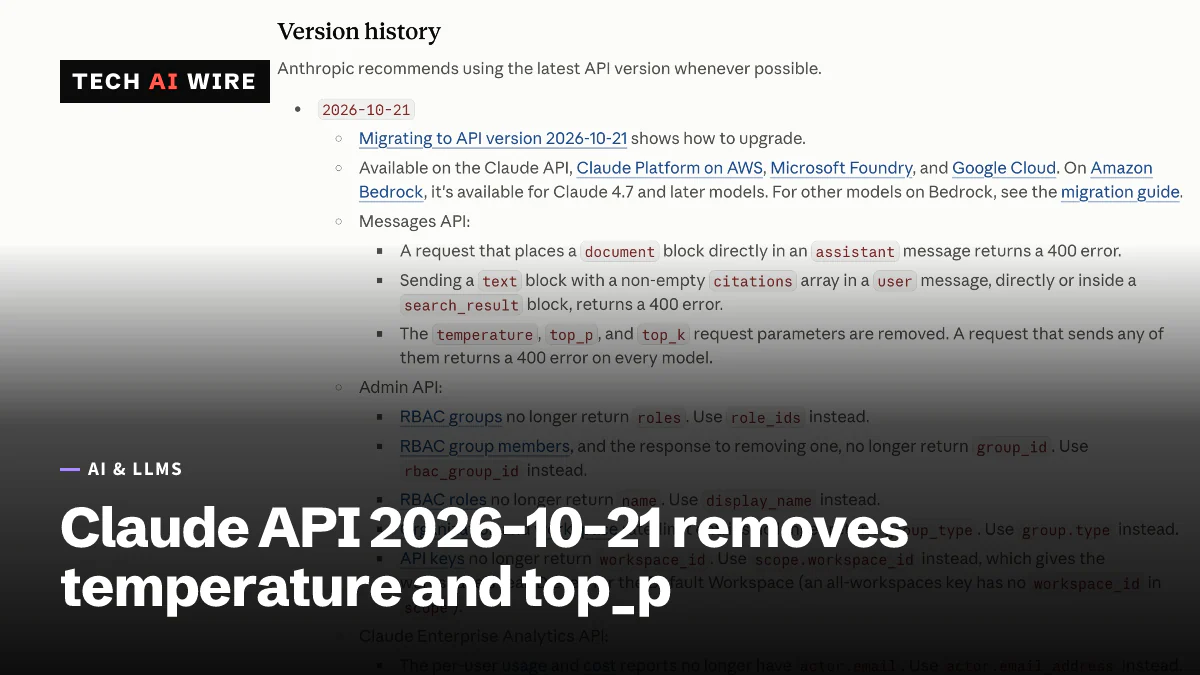
Anthropic released Claude API version 2026-10-21 on October 21, 2026. Sending temperature, top_p or top_k now returns a 400 error, and seven SDKs get majors.
The weekly digest
One email every Friday with the week's top stories from all six desks: AI, dev tools, coding, the tech industry, startups and what's next. Free, no spam.