SourceHut bans LLM-assisted code and tickets from 10 September
SourceHut will prohibit LLM-written code, tickets and emails from 10 September 2026. Enforcement is honour-based, with no automated AI detection tools at all.
4 min read

- Agreed
- 358 votes
- Disagreed
- 144 votes
- Abstained
- 14 votes
SourceHut announced on 27 August 2026 that it will ban content made with large language models. The rule takes effect on 10 September 2026. A large language model, or LLM, is the kind of AI behind tools like ChatGPT and GitHub Copilot. This matters because the ban covers contributions, not just training data. SourceHut is now the second well-known code host in about five weeks to draw a line like this.
A code host of this kind is called a forge. It is the service that stores your repository, tickets, and patches. Codeberg went first, on 23 July 2026. SourceHut's post says it had been weighing the same move for some time, and that Codeberg's late-July announcement preceded its own.
What the new terms actually ban
SourceHut's post says the prohibition covers original content written with, or facilitating the use of, LLMs and other generative AI. It names source code, assets, tickets, and emails. Emails matter on SourceHut specifically, because patches and discussion arrive by mailing list there rather than through pull requests.
A second, separate rule concerns data going out rather than code coming in. The SourceHut terms of service allow automated data collection only for search indexing, open-access research, or archival purposes. Scraping the site to build a training set is not on that list.
| Activity | Status under the new terms |
|---|---|
| Code written with an AI assistant | Prohibited |
| Tickets or patch emails drafted by an LLM | Prohibited |
| Crawling sr.ht for a training dataset | Not among the permitted uses |
| Crawling for search indexing, research, or archival | Permitted |
How SourceHut says it will enforce this
Enforcement is deliberately light. SourceHut's post describes a light-touch policy that relies on user honesty, with no automated detection tools. There is no AI-detector scanning commits, in other words, so the rule works on disclosure and reports rather than on machine judgment.
SourceHut also says it will help affected projects move elsewhere, naming Forgejo and proprietary platforms as destinations. Its own terms of service require two weeks of advance notice before terms change, which matches the gap between the 27 August post and the 10 September start date.
Why SourceHut says it is doing this
The post gives environmental, labour, and engineering reasons. It argues that building AI infrastructure will create electricity demand comparable to India's national consumption, and will delay decarbonisation. It also argues that AI companies pay very low wages in poor countries while their models displace workers in rich ones.
The engineering complaint is narrower and closer to home. SourceHut says AI-assisted projects produce wasteful continuous integration setups, larger codebases, and heavier resource use on its servers. Its conclusion is blunt: "vibe coding does not deliver benefits which, in the view of SourceHut and our community, outweigh the costs."
How Codeberg's rule differs
The two forges banned different things, which is easy to miss. Codeberg's July post prohibits using project data to train LLMs, and restricts what it calls vibe-coded projects. Those are single-developer repositories generated by an LLM that consume disproportionate resources.
Codeberg is explicit about what it still tolerates. Projects with an active community, projects with a history predating LLMs, and projects that unknowingly accept LLM contributions all remain acceptable. Like SourceHut, Codeberg says it uses human judgment in context rather than automated scanning. The change followed a members' vote over 14 days, with roughly half of eligible voters taking part.
What this means for developers
If you host on SourceHut, audit your workflow before 10 September. The question to answer is narrow: does any AI assistant touch code, commit messages, tickets, or patch emails you send there? If the answer is yes, you have two weeks to either stop or move, and SourceHut has said it will help with the move.
Do not read honour-based enforcement as no enforcement. Without detection tools, the practical risk is not a scanner flagging you. It is a maintainer or user reporting a project after the fact, judged by a human. That makes disclosure the safe habit, and it makes the rule harder to argue your way out of than a detector would be.
Maintainers on any forge should write down a policy now. Two significant hosts have moved in five weeks, and contributors will start asking where you stand. The useful detail to copy from Codeberg is its carve-out for contributions accepted unknowingly. A policy that punishes maintainers for what they could not have known will not survive contact with a real project.
One clause deserves attention even from teams with no AI in their stack. The SourceHut terms permit automated collection only for indexing, open-access research, and archival. If you run a crawler that gathers public repositories for any other purpose, including a dataset, that use is outside the permitted list.
Sources
- Changes to SourceHut's terms of service regarding LLMs - SourceHut
- Terms of Service - man.sr.ht
- Protecting our FLOSS commons from LLMs - Codeberg
Related articles
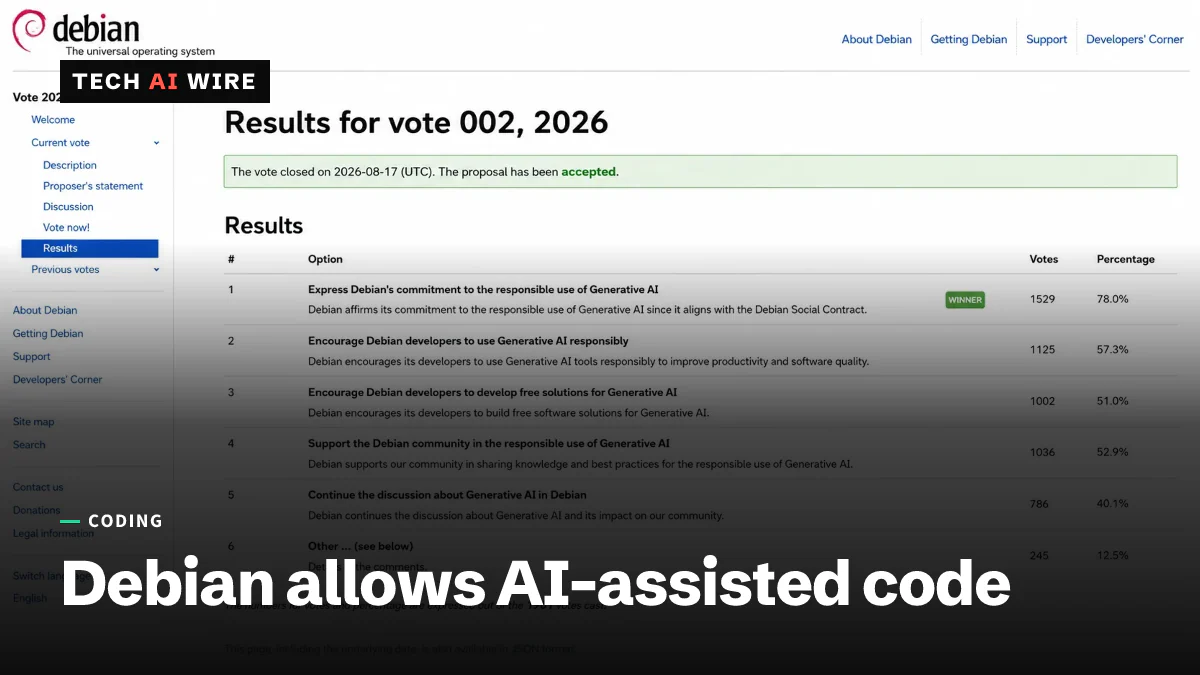
Debian votes to allow AI-assisted contributions, with conditions
Debian developers picked the 'Responsible Use of Generative AI' option in a vote that closed on August 28, 2026. AI help is allowed, and disclosure stays optional.
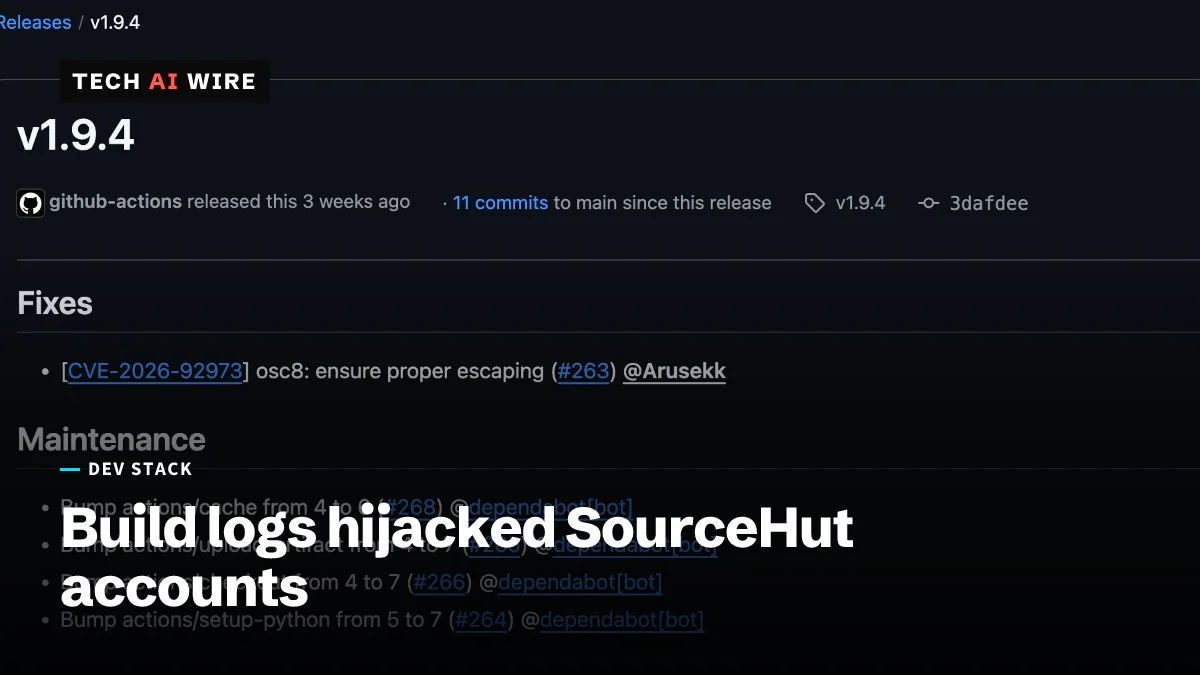
SourceHut build log XSS let attackers take over accounts
A crafted build log could run script in a SourceHut user's browser. ansi2html 1.9.4 fixes the bug, CVE-2026-92973, which hit versions 1.7.0 to 1.9.3.
Cloudflare splits AI training from search indexing
A Disallow AI Training toggle lets a site refuse training crawlers and stay in search. Mixed-use crawlers are 36.6% of verified crawler traffic.
The weekly digest
One email every Friday with the week's top stories from all six desks: AI, dev tools, coding, the tech industry, startups and what's next. Free, no spam.