Debian votes to allow AI-assisted contributions, with conditions
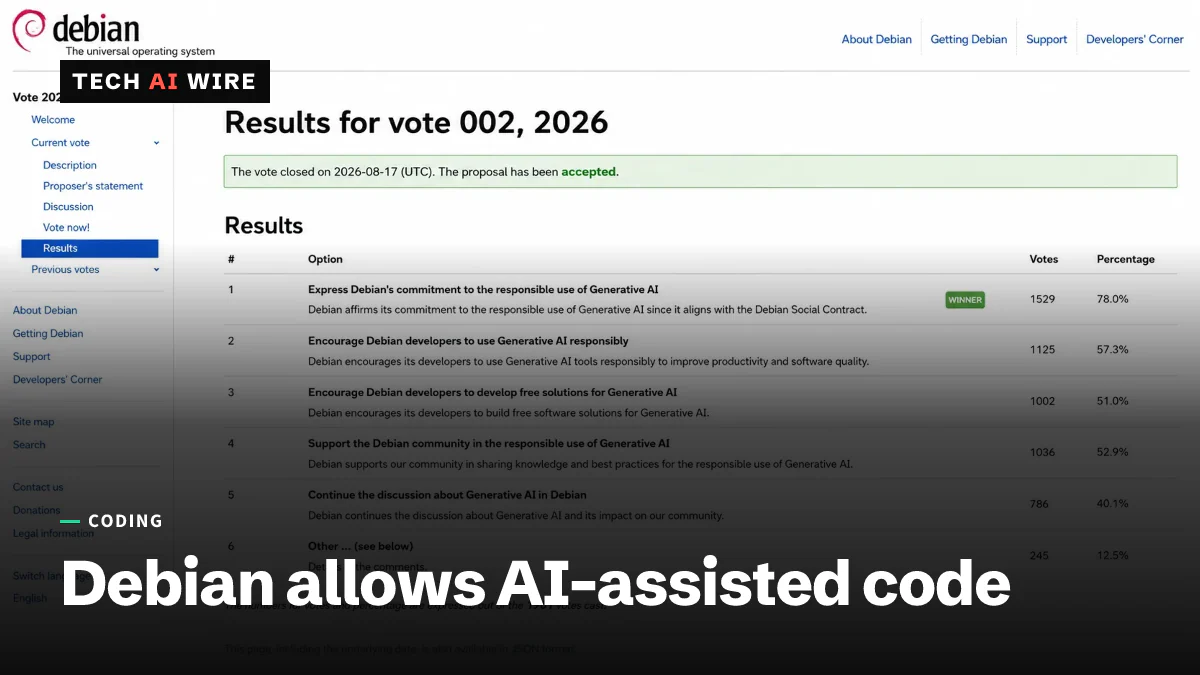
Debian developers picked the 'Responsible Use of Generative AI' option in a vote that closed on August 28, 2026. AI help is allowed, and disclosure stays optional.
3 min read
By the numbers
- votes counted in the general resolution
- 425
- options on the ballot
- 8
- vote margin over the runner-up proposal
- 55
Debian's developers have voted to allow contributions made with help from generative AI tools. The vote closed on August 28, 2026, and the project published the result the next day. The decision matters outside Debian too, because Debian's packaging work is reused widely and its rules get copied.
Debian is a Linux distribution built by volunteers. Generative AI here means tools such as large language models, which produce code or text on request. The winning option is called "Responsible Use of Generative AI." It was proposed by Debian developer Marc Haber.
How the vote worked
Debian settles project-wide questions with a general resolution, which is a ranked ballot open to its developers. This ballot carried eight options. Debian's results page says 425 votes were counted. The quorum, the minimum support an option needed to stay in the running, was 48.49 votes. All eight options cleared it.
Ballots are counted with the Condorcet method. Voters rank the options, and every pair of options is then compared head to head. Debian's results page says options 1 and 3 were dropped during the majority phase. Option 5, the responsible-use text, beat the second-place proposal by 55 votes in their direct comparison.
The timeline was public throughout. Debian's ballot page says discussion ran from July 23 to August 13, 2026. Voting ran from August 15 to August 28.
What the policy actually says
The policy neither endorses nor bans these tools. Instead it moves the burden onto the person pressing send. According to Phoronix's report on the outcome, contributors must understand, review, and test AI-generated output before they submit it. They remain fully accountable for its quality and correctness.
Debian's ballot page makes the same point from the other direction. The project's existing quality standards apply uniformly, whatever produced the code.
Phoronix reports three further conditions in the adopted text:
- Disclosure is voluntary. A contributor is not required to say that a tool helped.
- Confidential project information must be kept out of third-party AI services.
- Large-scale or automated submissions need community discussion first, plus human oversight.
The policy also declines to settle the hard legal questions. Phoronix reports that it takes no position on the copyright status of AI-generated content or of training data. Those questions stay open, and so does the risk attached to them.
The proposals it beat
Debian's ballot page names four of the eight options and their authors. The spread shows how far apart the project's developers started.
| Option | Proposed by | Position |
|---|---|---|
| 1 | Matthias Geiger | Ban AI-assisted contributions |
| 4 | Pierre-Elliott Bécue | Allow AI, limited to Debian-specific work |
| 5 | Marc Haber | Responsible use, contributor stays accountable (adopted) |
| 7 | Gard Spreemann | Ban AI-assisted contributions |
Two of the four named options were outright bans. The adopted text sits between a ban and a free pass, and it won on ranked preferences rather than a landslide.
What this means for developers
If you contribute to Debian, the practical rule is short: you may use an assistant, and you own every line it wrote. Read the diff yourself before sending it. Build it, test it, and be ready to defend it in review, because "the model wrote it" is not a defense under this policy.
You do not have to disclose that you used a tool. Expect some maintainers to ask anyway, and answering plainly is cheaper than an argument.
Two rules can catch you out even when your code is fine. First, do not paste confidential project material into a hosted assistant. Embargoed security details and private reports are exactly what the policy means. Second, if you plan a sweep across many packages with a tool's help, start the discussion before the patches. Mass submissions now require that step.
The unresolved part deserves your attention. Debian chose not to rule on copyright or training data, so that exposure has not gone away. It sits with the contributor and with downstream users. If you ship Debian packages inside a product, your license review is unchanged by this vote.
Maintainers of other projects now have a worked example to copy. A large, argumentative, volunteer project ran a public vote on this and landed on accountability rather than prohibition. That is a more defensible starting point than a rule invented in a hurry after the first AI-written pull request arrives.
Sources
Related articles
SourceHut bans LLM-assisted code and tickets from 10 September
SourceHut will prohibit LLM-written code, tickets and emails from 10 September 2026. Enforcement is honour-based, with no automated AI detection tools at all.
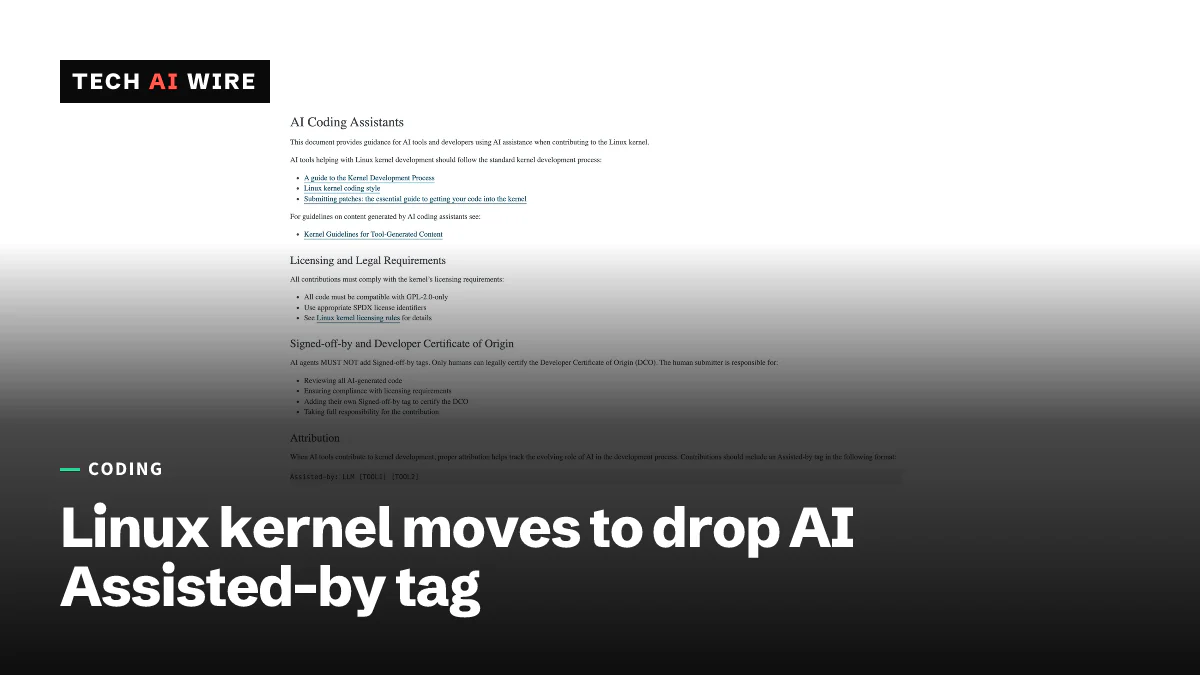
Linux kernel moves to drop its AI Assisted-by tag
Only about 10% of Linux 7.3 commits carried the AI Assisted-by tag, so kernel maintainers agreed to drop it. Torvalds backs the change; critics want a replacement.
Linux 7.3-rc4 arrives with LLM-caught error path fixes
Linux 7.3-rc4 landed on September 20, 2026, its fixes split in thirds across drivers, filesystems and architecture code. Torvalds credits LLMs.
The weekly digest
One email every Friday with the week's top stories from all six desks: AI, dev tools, coding, the tech industry, startups and what's next. Free, no spam.