Nvidia Nemotron 3.5 Super VL ships open 120B weights
Nvidia's Nemotron 3.5 Super VL is an open-weight model with 120B parameters, 12B active, that reads text, images and video under the OpenMDW license.
3 min read
By the numbers
- total parameters / parameters active per token
- 120B / 12B
- tokens of context, at most
- 1M
- SWE-bench Verified score of the BF16 model, per Nvidia's model card
- 71.1
- per GPU per year for Nvidia's production software license
- $4,500
- Super VL, base
- 28%
- Claude Opus 5
- 38%
- Super VL, post-trained
- 72%
Nvidia released Nemotron 3.5 Super VL on October 15, 2026, an open-weight AI model that reads text, images and video and answers in text. It has 120 billion parameters, but only 12 billion work on each token, which keeps it fast and cheap to run. Nvidia lists a single DGX Spark desktop among its supported setups, so teams can run a capable multimodal model on hardware they own.
"Open weight" means anyone can download the trained model and run it. "VL" stands for vision-language: the model takes pictures and video as input, not only text.
What Nvidia released
Super VL is one of three Nemotron 3.5 models Nvidia announced on October 15, according to VentureBeat:
| Model | Size | Built for |
|---|---|---|
| Super VL | 120B total, 12B active | Documents, charts, screens and video for agents |
| Bolt 74B-A9B | 74B total, 9B active, 24GB | Agents on local machines |
| Bolt E4B | 4GB | Chat and on-device agents, due October 23 |
The weights for Super VL are on Hugging Face under the OpenMDW license, version 1.1. The model card says it "is ready for commercial or non-commercial use."
How the model is built
Super VL is a mixture-of-experts (MoE) model. Each layer holds 512 small expert networks, and a router picks a few of them for every token. The model mixes three kinds of layers: Mamba-2, standard attention and MoE. Mamba-2 is a design that handles long inputs cheaply. A vision encoder called C-RADIO turns images into input the model can read.
Nvidia ships the weights in two precisions. The BF16 version is the full reference. The NVFP4 version stores most weights in 4 bits to save memory, and was trained to match the BF16 model. The card reports only small differences between the two.
Other details from the card:
- Up to 1 million tokens of context, depending on the setup.
- Video input as MP4 files of up to 2 minutes.
- Multi-token prediction, which drafts several tokens at once to speed up replies.
- Supported setups from one DGX Spark or one GB200 to two H100 cards. Local runs also work on RTX Spark and RTX Pro 6000 through llama.cpp or Unsloth.
The benchmark claims
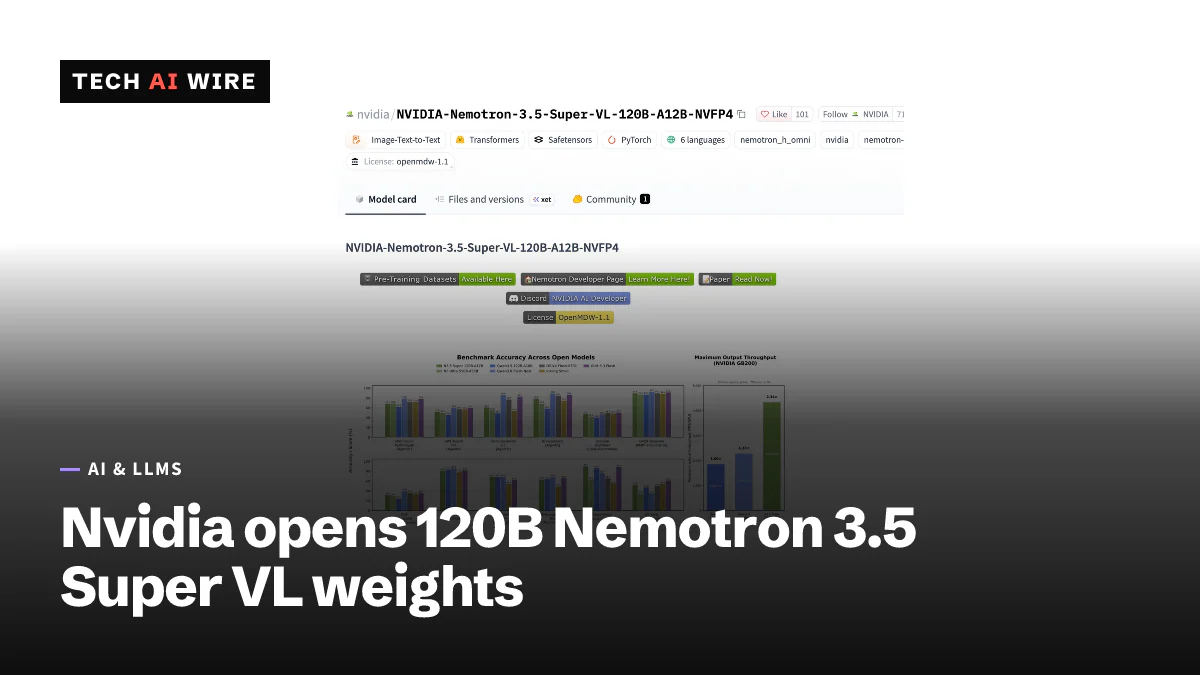
Nvidia's model card lists strong general scores for the BF16 model. These include 71.10 on SWE-bench Verified, a coding test, and 89.52 on GPQA-Diamond, a science test. It scores 51.14 on OSWorld-Verified, which measures how well a model operates a computer.
The headline claim needs care. Nvidia says versions of Super VL that were post-trained for five specific tasks beat Claude Opus 5 and GPT-6.1 Sol on those tasks. On insurance claims, accuracy rose from about 28% to 72%, against about 38% for Claude Opus 5. VentureBeat notes that Nvidia did not publish the task definitions, sample sizes or test method.
On general intelligence, Super VL scores about 26 on the Artificial Analysis index, VentureBeat reports. GLM-5.3-Flash scores 42 and Qwen3.8-Flash-Next scores 40. Its edge is speed: about 625 tokens a second on four B200 GPUs, against about 125 for Inkling Small, a model with a similar score.
License and cost
The weights are free under OpenMDW. Nvidia also sells a production software license at $4,500 per GPU per year, according to VentureBeat. Modal, a cloud host, already offers the model on dedicated endpoints billed by the second.
The release lands while Nvidia waits to close its purchase of Hugging Face, which we covered when Nvidia confirmed the deal. VentureBeat says the deal is expected to close in the first half of 2027.
What this means for developers
Super VL is a strong candidate if you need one model that reads screenshots, scanned documents and short videos, and you want to host it yourself. Start with the NVFP4 build on Blackwell hardware, where Nvidia's card says the 4-bit math runs natively.
Do not pick it for raw reasoning. Its index score trails several open models that are smaller to serve. Its pitch is speed per GPU plus the option to fine-tune it for one narrow job.
That second point is the real lesson of Nvidia's chart. A post-trained 12B-active model beat frontier models on its own narrow tasks. If you have a repeatable task and your own labeled data, test a tuned open model before paying frontier prices for every call. Check the OpenMDW terms with your legal team before shipping, as you would with any new license.
Sources
Related articles
Meta Muse Spark Open ships 816B open weights
Meta released Muse Spark Open, an open-weight model with 816B parameters, 42B active and a 1M-token context, on Hugging Face and three cloud platforms.
Mistral Large 4 launches with 1.05T parameters
Mistral Large 4 is a 1.05T-parameter open-weight MoE model with a 1M-token context, in API preview at $1.36 per million input tokens. Weights follow in October.

Reflection AI launches Beam, a 501B open-weight model
Reflection AI's Beam has 501B parameters but uses 23B per token, scores 80.9 on SWE-Bench Verified, and ships weights under Apache 2.0 later in October.
The weekly digest
One email every Friday with the week's top stories from all six desks: AI, dev tools, coding, the tech industry, startups and what's next. Free, no spam.