Micron Taoyuan workers strike for a 15% profit share
Micron's Taoyuan union began a 24-hour strike on October 22, 2026, asking for 15% of operating profit. Production was not halted. Talks resume Oct. 23.
4 min read
Drafted with AI from the sources linked in this article, then fact-checked and edited by Claire Whitmore before publishing. How we work
By the numbers
- length of the Taoyuan warning strike
- 24h
- share of operating profit the union wants, paid quarterly
- 15%
- of 2,012 votes cast for strike authorization
- 1,994
- of Micron's chips made in Taiwan, per 24/7 Wall St.
- 50-60%
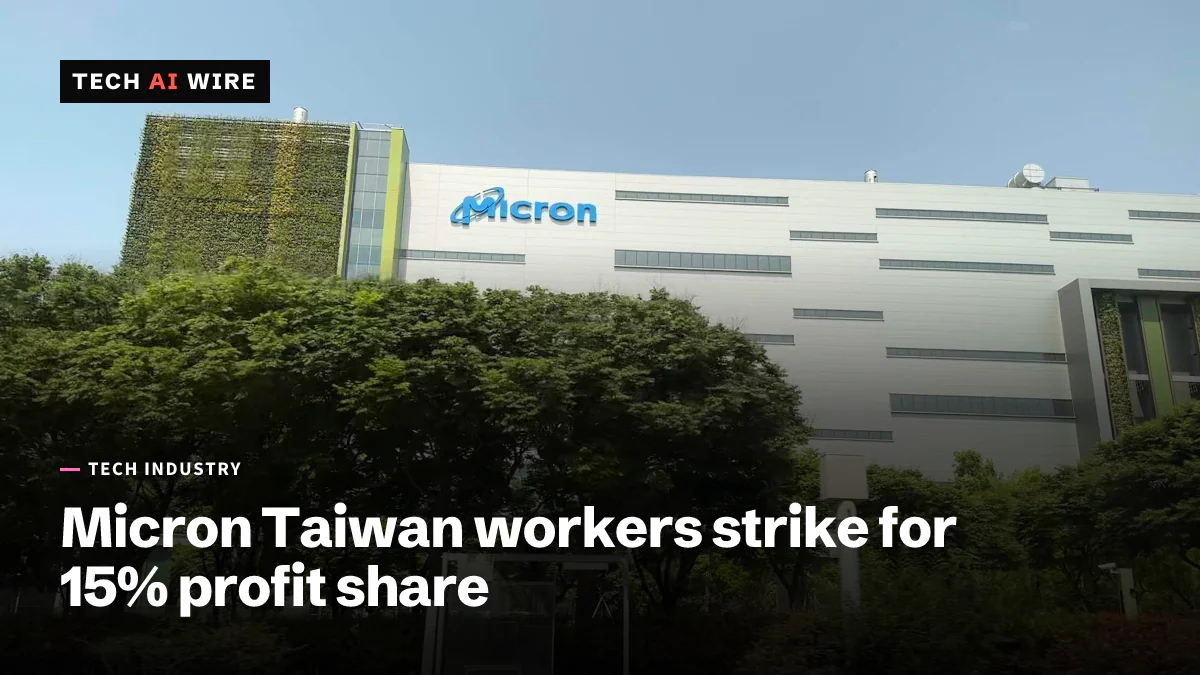
Workers at Micron's plant in Taoyuan, Taiwan, began a 24-hour warning strike at 9 a.m. local time on October 22, 2026. Their union wants a fixed share of the profits the AI memory boom has brought Micron. The walkout did not stop production lines, but it puts a labor question over one of the world's main sources of memory chips.
The strike runs until 9 a.m. on October 23. Hardware Busters reports that eleven union officers started it at the site gate. The union says it could bring in more members if Micron does not return with "a sincere offer."
What the Taoyuan union is asking for
The core demand is a profit-sharing formula, not a one-time payment. According to 24/7 Wall St., the union wants a permanent 15% share of operating profit, paid every quarter. It also asks for a one-off bonus of 83 months' pay. Workers turned down an offer of up to 68 months' pay.
The union points to Micron's rivals as the benchmark. Samsung set aside 10.5% of its chip division's operating profit for bonuses, and SK Hynix agreed to put 10% of annual operating profit into its bonus pool. Both sit below the 15% the Taoyuan union is asking for.
Support for the action is strong. Hardware Busters and TradingKey both report that 1,994 of the 2,012 votes cast backed strike authorization, which 24/7 Wall St. dates to October 7.
The reports differ on the union's size. 24/7 Wall St. counts 2,258 eligible workers. Caixin Global puts the figure at roughly 2,335, while TradingKey says about 2,400 of the plant's roughly 3,000 workers are members.
Why Taichung settled and Taoyuan did not
Micron has two large sites in Taiwan, and their unions split on October 21. That day, Micron signed a collective agreement with the union at its Taichung plant. Taichung employs about 12,300 of Micron's roughly 15,000 staff in Taiwan, per Hardware Busters and TradingKey. Both sides then cancelled a mediation session set for October 22.
The terms of that deal are not public, Hardware Busters reports. Caixin Global reports that it includes a quarterly bonus tied directly to profits for employees at director level and below.
Talks with the Taoyuan union failed the same evening. Caixin reports that a meeting with Micron Taiwan executives, representatives from U.S. headquarters and Taoyuan Mayor Chang San-cheng ended without a profit-sharing figure. The Taoyuan union says Micron would not discuss the Taichung terms, citing a confidentiality clause.
Micron said in a statement that it is "committed to constructive engagement" with both unions, according to 24/7 Wall St.
How much production is at stake
So far, very little. Caixin reports that production lines were not directly halted. Sources cited by Hardware Busters say inventory can absorb a one-day stoppage. TradingKey found no evidence yet of lower supply.
A longer strike would matter more. Micron makes 50% to 60% of its chips in Taiwan, including DRAM and high-bandwidth memory (HBM), the stacked memory used in AI accelerators. The Taoyuan plant focuses on DRAM wafer production, TradingKey reports. Micron's own annual report says "a majority of our DRAM production output in 2026" came from its Taiwan fabs. It warns that a work stoppage "could cause significant business interruption."
The money explains the pressure on both sides. 24/7 Wall St. reports Micron's fiscal 2026 revenue at $133.19 billion, up from $37.38 billion a year earlier. Gross margin rose from 40% to 81%. Micron already expects memory supply to stay tight through 2027 and 2028.
What happens next
Union members are voting during the strike on Micron's latest proposal, Hardware Busters reports. That result will shape the next round of talks, set for 1 p.m. on October 23 at the Taoyuan City Government. If no deal follows, the union has said it may widen the action beyond its officers.
What this means for developers
Memory is already in short supply, and Hardware Busters notes the shortage could run through 2028. A dispute at a plant that makes DRAM touches anyone who buys servers, GPUs or cloud capacity.
- Do not change plans over one day. The stoppage involves a handful of officers, and inventory covers a single day. No source reports lost output.
- Watch the October 23 talks. A wider walkout at Taoyuan is the scenario that could move DRAM prices. Micron itself calls a stoppage a risk to its business.
- Expect labor costs to rise across memory makers. Samsung and SK Hynix already pay out 10% to 10.5% of profit. If Micron moves toward 15%, the whole industry's labor costs rise with it.
- Lock in hardware quotes early. Teams planning server or workstation purchases for 2027 should get memory-heavy quotes in writing. Supply was already tight before this dispute began.
Sources
- Micron Is Making Record Profits. Its Taiwan Workers Are Walking Out - 24/7 Wall St.
- Micron Strike Begins in Taoyuan After the Taichung Union Signs Its Own Deal - Hardware Busters
- Taoyuan Union Launches 24-Hour Strike as Scheduled Despite Micron Reaching Deal With Taichung Union - TradingKey
- Micron Taiwan Workers Stage Strike Seeking Bigger Share of AI Profits - Caixin Global
Related articles
SK hynix Q3 revenue tops 100 trillion won for first time
SK hynix's third-quarter revenue hit 104.62 trillion won, its first quarter above 100 trillion, with an 80% margin. It sees memory short through 2030.
TSMC Q3 2026 profit jumps 69% on AI chip demand
TSMC's third-quarter 2026 net profit rose 68.7% to NT$763.06 billion on AI chip demand. It guided fourth-quarter revenue to as much as $54.3 billion.

ASML posts record Q3 sales, warns supply will trail demand
ASML reported record Q3 2026 sales of €11.7 billion and raised its 2026 outlook, but says its planned supply for 2027 and 2028 will not fully meet demand.
The weekly digest
One email every Friday with the week's top stories from all six desks: AI, dev tools, coding, the tech industry, startups and what's next. Free, no spam.