ASML posts record Q3 sales, warns supply will trail demand
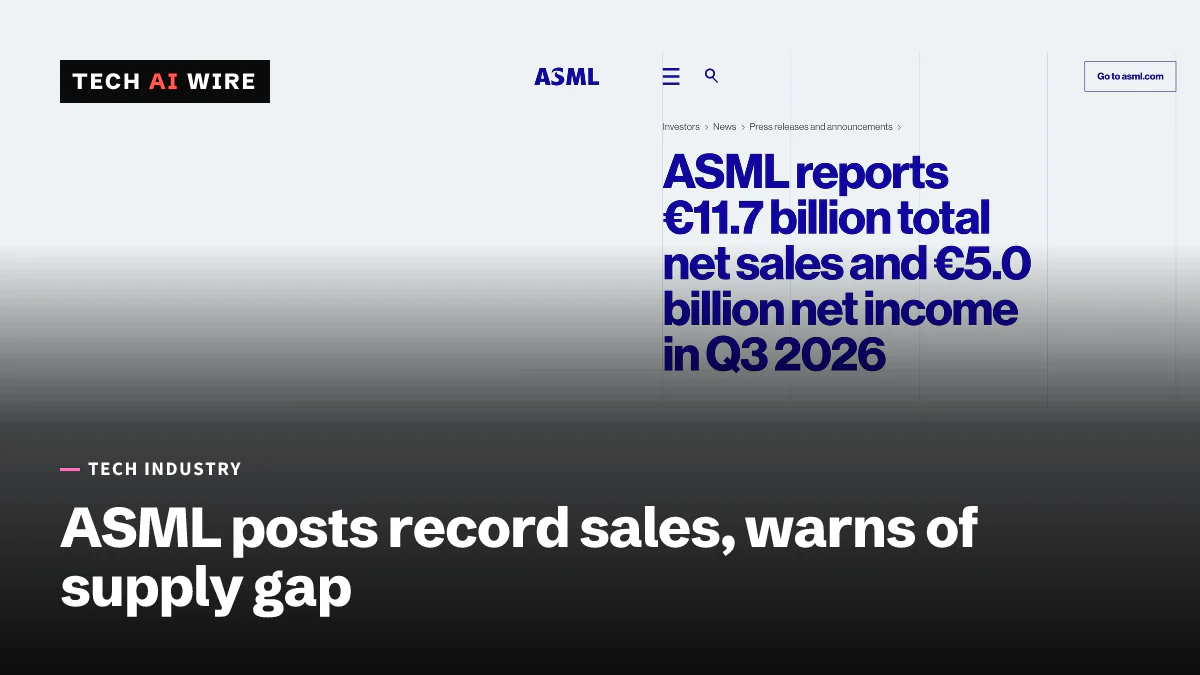
ASML reported record Q3 2026 sales of €11.7 billion and raised its 2026 outlook, but says its planned supply for 2027 and 2028 will not fully meet demand.
3 min read
By the numbers
- Q3 2026 total net sales, a record
- €11.7B
- Q3 2026 net income
- €5.0B
- full-year 2026 sales outlook, raised from €43-45 billion
- €44-45B
- new lithography systems sold in Q3
- 113
ASML, the Dutch company that builds the machines used to print the most advanced computer chips, reported record sales on October 14, 2026. Its third-quarter net sales reached €11.7 billion, and net income was €5.0 billion. It also raised its outlook for the year. But chief executive Christophe Fouquet warned that ASML's planned supply for 2027 and 2028 "will not fully meet the demand of our customers." The squeeze in AI hardware now reaches the tools that make the chips.
The quarter
ASML sells lithography systems. These machines use light to print circuit patterns onto silicon wafers. It also earns money from servicing and upgrading machines already at customer sites, which it calls Installed Base Management.
According to ASML's results release, the quarter compares with the one before like this:
| Measure | Q3 2026 | Q2 2026 |
|---|---|---|
| Total net sales | €11.66 billion | €9.33 billion |
| Installed Base Management sales | €3.29 billion | €2.76 billion |
| Gross margin | 57.5% | 54.0% |
| Net income | €4.96 billion | €2.92 billion |
| New lithography systems sold | 113 | 86 |
| Used lithography systems sold | 8 | 5 |
A year earlier, ASML's third-quarter sales were €7.52 billion, TipRanks reports. Fouquet called the result "record total net sales of €11.7 billion, towards the high end of our guidance." Service sales beat ASML's own forecast, driven by customers buying productivity upgrades.
The outlook
ASML expects fourth-quarter sales of €14.2 billion to €15.2 billion, with a gross margin of about 57%. For the full year, it now expects €44 billion to €45 billion in sales and a gross margin of about 56%.
That full-year range is up from €43 billion to €45 billion, Investing.com reports.
ASML will pay an interim dividend of €1.88 per share on November 4. TipRanks reports that is up from €1.60. The company also bought back about €4.1 billion of its own shares in the quarter.
Why supply will fall short
Customers are raising their demand forecasts, mainly because of how big and how long AI investment is expected to be, Fouquet said, according to Investing.com. Some customers have even asked about placing orders for 2029 and 2030, he said.
ASML says it already plans 30% more capacity in 2027 than in 2026 for two kinds of machine. Low-NA EUV systems use extreme ultraviolet light to print the finest chip features. DUV immersion systems use deep ultraviolet light shone through water, for less demanding layers. For 2028, ASML is now studying increases beyond the 30% it had communicated before.
Even so, it expects that capacity to fall short of what customers want in both 2027 and 2028.
What ASML did not say
The release does not split the 113 new systems between EUV and DUV machines. It gives no order bookings and no breakdown of sales by country. It also does not say which customers are asking about orders for 2029 and 2030.
What this means for developers
For people who build, buy or run AI systems:
- Expect AI hardware to stay tight. If ASML cannot ship enough machines, chipmakers cannot add factory capacity as fast as they want. That shortage can flow down to the GPUs and memory in AI servers.
- Plan compute needs early. Teams that rent AI capacity should reserve it well ahead rather than assume prices will fall soon.
- Watch the next quarter. ASML's Q4 forecast of up to €15.2 billion would be its biggest quarter yet. A miss would suggest that AI spending is cooling.
- Read 2029 and 2030 interest carefully. Chipmakers asking about orders that far out shows they expect demand to last. It is interest, not signed orders.
Sources
Related articles
Samsung Q3 2026 profit guidance hits 107.4 trillion won
Samsung guided to about 107.4 trillion won ($80 billion) of Q3 2026 operating profit, nine times a year earlier, as AI demand drives memory prices up.
Micron sees tighter memory supply in 2027 and 2028
Micron posted $54.23 billion in fiscal Q4 revenue and guided to $61.5 billion, then warned memory supply will be tighter in 2027 and 2028 than in 2026.

Nvidia posts $96.2B quarter and guides to $108B for Q3
Nvidia reported $96.2 billion in revenue, up 106% in a year, with data centre sales at $89 billion. Its own release guides to $108 billion for this quarter.
The weekly digest
One email every Friday with the week's top stories from all six desks: AI, dev tools, coding, the tech industry, startups and what's next. Free, no spam.