Linux kernel moves to drop its AI Assisted-by tag
Only about 10% of Linux 7.3 commits carried the AI Assisted-by tag, so kernel maintainers agreed to drop it. Torvalds backs the change; critics want a replacement.
3 min read
By the numbers
- of 18,533 Linux 7.3 commits, up to -rc7, carried an Assisted-by tag
- ~10%
- developers at the Maintainers Summit in Prague on October 8
- ~30
- kernel version where the AI coding assistants policy took effect
- 7.0
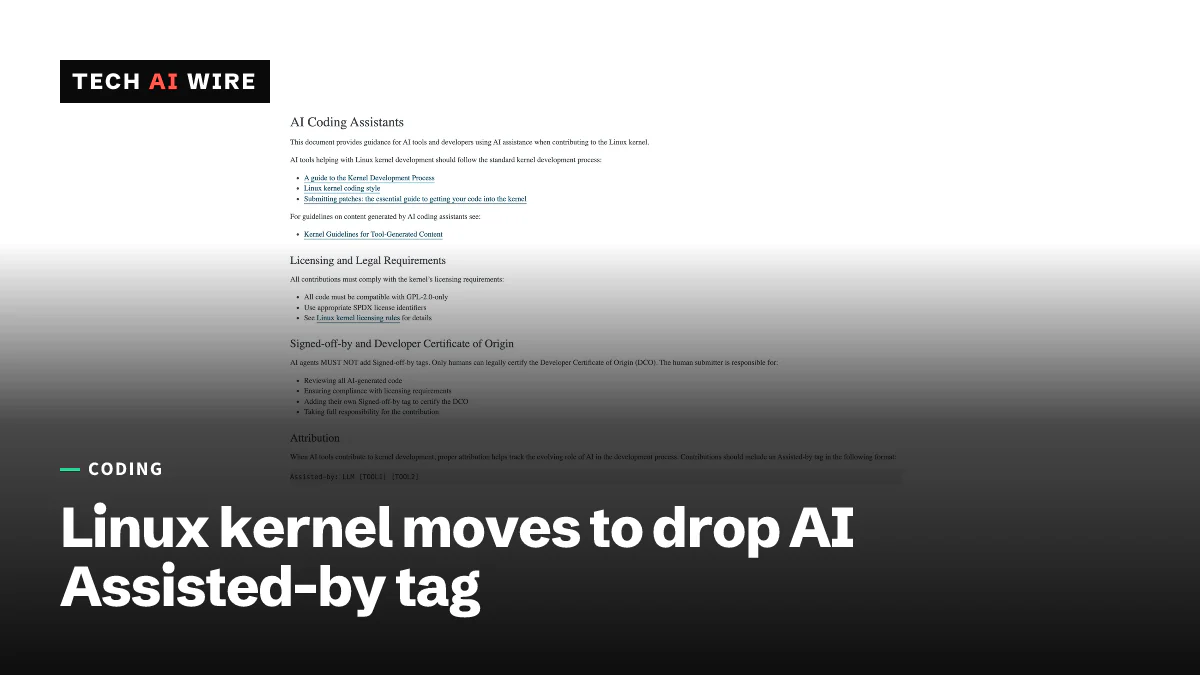
Linux kernel maintainers have agreed to stop requiring an "Assisted-by" tag on patches written with help from AI tools. The tag was meant to show which code an AI helped write. But only about 10% of commits in Linux 7.3 carried it, even though AI use is believed to be far more common. Linus Torvalds backs the change, while some maintainers want a replacement before the rule goes.
A tag, in kernel terms, is a line at the end of a commit message, such as "Signed-off-by" or "Reviewed-by." "Assisted-by" named the AI tool that helped write a patch.
What was decided
About 30 invited developers met at the Maintainers Summit in Prague on October 8, 2026. A majority agreed that AI-assisted patches no longer need the tag, heise reports.
Sasha Levin, the developer behind the original rule, then posted a patch titled "docs: remove Assisted-by references." He sent a revised version on October 13. Jonathan Corbet of LWN.net has accepted it into the kernel's docs-next branch for documentation changes, heise says. It still has to reach the main kernel tree.
The change does not hide AI use entirely. Under the patch, developers describe their AI tools in the cover letter, the email that introduces a patch series, instead of in each commit. AI agents are still not allowed to add a "Signed-off-by" line, which certifies that a person has the right to submit the code.
Why the tag is going
The numbers did the arguing. Of the 18,533 commits in Linux 7.3 up to its seventh release candidate, only about 10% carried the tag, both heise and Next report. Merge commits were not counted. Corbet wrote that the real share of AI-assisted patches is "surely much higher," as quoted in French by Next.
Levin gave several reasons, according to heise. Some developers do not know the rule. Others leave the tag out on purpose. Maintainers rarely ask. So a missing tag says nothing about how a patch was made.
How the rule started
The tag is young. Levin first raised the idea in July 2025, proposing a "Co-developed-by" tag for AI contributions that later became "Assisted-by," Next reports. Maintainers adopted it at the 2025 summit, and the "AI Coding Assistants" policy took effect with Linux 7.0. Corbet approved it in January 2026.
An earlier attempt to remove the tag failed in July, heise says. Greg Kroah-Hartman argued to keep it then.
Who disagrees
The change is not unanimous. Laurent Pinchart, one of the developers in the mailing-list debate, refused in a message on October 13 to remove the tag until a replacement exists, Next reports. His argument is that a rule sets expectations, even when some people ignore it.
Torvalds sees it differently. He opposes rules that ban particular tools and called them "stupid," heise reports. According to Next, he said contributors must understand their code, and that understanding has little to do with which tools they used. He added that low-quality patches mostly come from newcomers, and that blaming AI tools is counterproductive.
Torvalds also uses these tools himself. Earlier this month he used Claude Code to rework part of the Linux page cache, and said so in the commit message.
Where other projects stand
Open-source projects are split on AI contributions, Next notes. Debian, Fedora, LLVM and Firefox accept them if the code can be reviewed and explained. We covered Debian's vote to allow AI-assisted contributions in August. Gentoo, NetBSD, Zig and Krita refuse them or have paused them, and SourceHut banned LLM-assisted code outright. KDE has no official position.
What this means for developers
If you send patches to the Linux kernel, watch for the docs change to reach mainline. Until then, the current documentation still asks for the tag. Once it lands, mention AI tools in your cover letter instead.
The rule that matters does not change. You must understand every line you submit and sign off on it yourself. An AI tool can never add your "Signed-off-by" for you.
For maintainers of other projects, the kernel's data is a warning. A disclosure rule that only 10% of contributors follow gives a false picture of how code is written. If you want honest disclosure, make it easy, ask for it in review, and decide what you will do with the answer.
Sources
Related articles
MeshXFS: an AI-written clustered file system built on XFS
MeshXFS 0.90.130 turns XFS into a clustered file system, released for up to 16 nodes. AI agents wrote its clustering code, with no line-by-line human review.

Torvalds uses Claude Code to rework the Linux page cache
Linus Torvalds posted eight Linux kernel patches made with Claude Code. On his laptop, 8-thread small reads used about 4x fewer CPU cycles each.
GNOME drafts an RFC process for big technical decisions
A 14-day comment period, named stakeholders and a merge request: GNOME has drafted a formal way to settle the decisions it now makes in chat.
The weekly digest
One email every Friday with the week's top stories from all six desks: AI, dev tools, coding, the tech industry, startups and what's next. Free, no spam.