Ubuntu 26.10 ships with Linux 7.3 and Rust coreutils
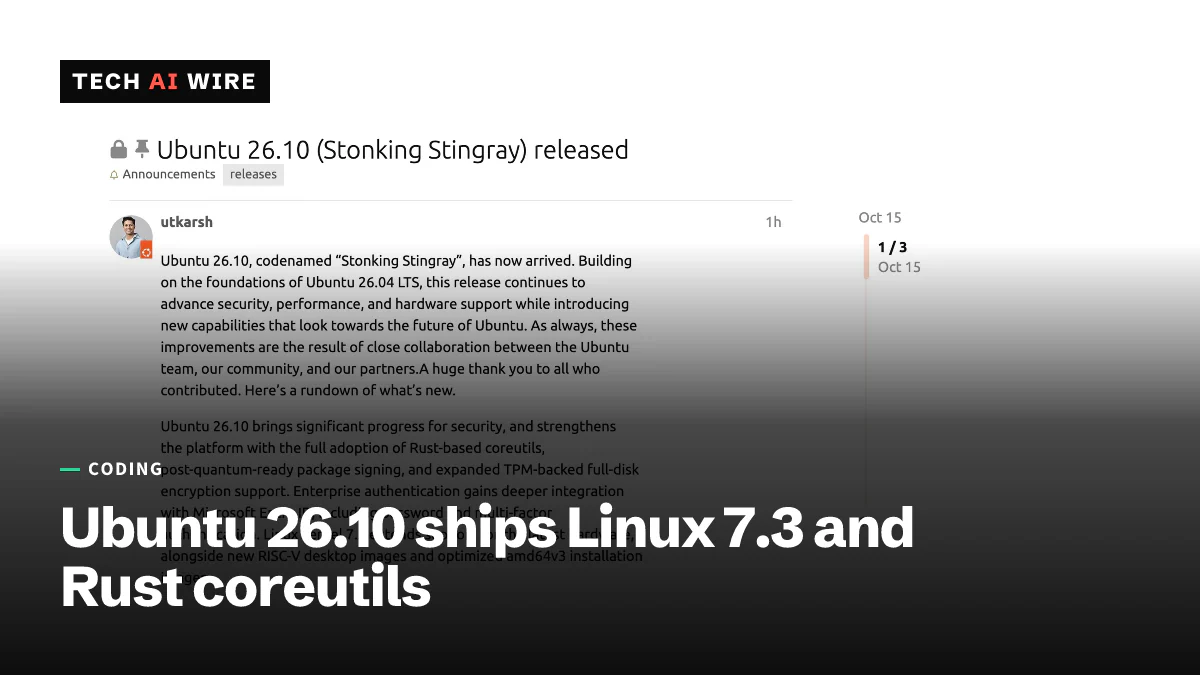
Ubuntu 26.10 shipped on October 15, 2026, with Linux 7.3, GNOME 51 and fully Rust-based coreutils. It is supported for nine months, until July 2027.
3 min read
By the numbers
- Linux kernel version, built from release candidate 7.3-rc6
- 7.3
- of support, until July 2027
- 9 months
- official flavors released alongside Ubuntu
- 10
- Rust version in the default toolchain
- 1.97.1
Canonical released Ubuntu 26.10, codenamed "Stonking Stingray", on October 15, 2026. It ships Linux 7.3, the GNOME 51 desktop and a complete switch to Rust-based core command-line tools. It is an interim release with nine months of support, so it suits developers who want newer toolchains before the next long-term support (LTS) version.
What's new in Ubuntu 26.10
The release announcement on Ubuntu Discourse lists these headline changes:
- Linux 7.3 and GNOME 51. The images use kernel 7.3.0-9.9, built from the release candidate Linux 7.3-rc6, the release notes say.
- Rust coreutils. The basic file commands, including cp, mv and rm, now all come from uutils, a Rust rewrite of GNU coreutils.
- New install images. There are RISC-V desktop images, plus amd64v3 images built for newer x86 processors.
- Stronger security. Package signing is now post-quantum-ready, meaning it is designed to resist future quantum computers. Full-disk encryption backed by a TPM, a chip that stores encryption keys, now works on more PCs.
- Enterprise sign-in. Users can log in with Microsoft Entra ID, using a password and multi-factor authentication.
- Myna. An opt-in speech-to-text preview that runs on the machine itself.
Ten official flavors launched alongside it, including Kubuntu, Xubuntu and Ubuntu Studio.
Toolchain and server versions
The release notes list these default developer tools:
| Tool | Version in Ubuntu 26.10 |
|---|---|
| GCC | 15.2.0 |
| LLVM | 22.1.8 |
| Python | 3.14.7 |
| Rust | 1.97.1 |
| Go | 1.27 |
| OpenJDK | 25.0.4 |
| .NET | 10.0.112 |
| Zig | 0.16 |
| systemd | 261.3 |
GCC 15 stays the default compiler. Server packages include OpenSSH 10.5, OpenSSL 4.0, PHP 8.5.9 and MySQL 9.7 LTS.
Rust coreutils finish their move
In September, we reported that Ubuntu 26.10 would move cp, mv and rm to Rust coreutils. They were the last GNU commands left. The final release completes the switch, and Phoronix describes the migration as fully completed.
The release also adds Sequoia PGP tools, sq and sqv, to the main archive. The older gpg and gpgv tools remain. On the desktop, dbus-broker replaces dbus-daemon, the service programs use to send each other messages.
The desktop itself is GNOME 51, which we covered when GNOME 51 was released in September. Michael Larabel of Phoronix reports "nice performance improvements over Ubuntu 26.04 LTS" in benchmark tests.
What was removed
The release notes list several removals and deprecations:
- Support for old System V init scripts, through systemd-sysv-generator, is gone.
- WEP, an old and insecure Wi-Fi encryption method, is removed from Settings.
- The xxd tool is dropped from minimal images, and pollinate from cloud images.
- Postfix's BerkeleyDB hash: and btree: maps are deprecated.
Upgrading from Ubuntu 26.04 LTS
Users of Ubuntu 26.04 LTS are offered the upgrade automatically only if they chose to hear about every release, the announcement says. Users set to receive LTS upgrades only are not offered it. The upgrade is free.
Some machines must wait. Systems that use TPM-backed full-disk encryption cannot upgrade from 26.04 LTS at release. Canonical expects to allow it later in the 26.10 cycle.
The release notes also flag these known issues:
- Upgrades may stop on a broken /lib32 link.
- Legacy GRUB changes may stop TPM-encrypted systems from booting.
- Keyboards may fail on some Snapdragon X2 Elite laptops, because of a Linux 7.3 bug.
- OpenSSH packages left in the "rc" state should not be purged until a pending fix ships.
What this means for developers
For developers deciding whether to move to Ubuntu 26.10:
- Pick the right release. Support ends in July 2027. Production servers that need years of updates should stay on 26.04 LTS.
- Test scripts against Rust coreutils. Build and deploy scripts that depend on exact GNU cp, mv or rm behavior should run in a 26.10 container or virtual machine first.
- Convert old init scripts. A service still shipped as a System V init script will no longer start through the compatibility layer. Rewrite it as a systemd unit.
- Try the newer toolchains. Python 3.14.7, Rust 1.97.1, Go 1.27 and LLVM 22 make 26.10 a quick way to test code before the next LTS.
- Read the known issues first. Laptops with TPM encryption or Snapdragon X2 Elite chips should wait for the listed fixes before upgrading.
Sources
- Ubuntu 26.10 (Stonking Stingray) released - Ubuntu Discourse
- Ubuntu 26.10 release notes - Ubuntu documentation
- Ubuntu 26.10 Released With Linux 7.3 + GNOME 51, Rust Coreutils Migration Complete - Phoronix
Related articles

GNOME OS Preview offers stable GNOME 51.1 builds
GNOME OS Preview, announced October 16, 2026, builds GNOME's own operating system from stable GNOME 51.1 instead of nightly code, for early adopters.
YSERVER 1.7 adds Vulkan 1.2 and cuts 4K VRAM use
YSERVER 1.7 cuts 4K VRAM use from 2-4GB to about 1.2GB, near X.Org's 0.9GB, and adds Vulkan 1.2 support for older Intel graphics.
Mold 3.0 ships its Rust rewrite as a drop-in linker
Mold 3.0 is the first release written in Rust. It needs Rust 1.95, drops Intel's oneTBB and links as fast as 2.42.1, the last C++ version.
The weekly digest
One email every Friday with the week's top stories from all six desks: AI, dev tools, coding, the tech industry, startups and what's next. Free, no spam.