Inkling 2 Mini open weights: which build fits your RAM
Inkling 2 Mini scores 79.2% on SWE-bench Verified under Apache 2.0. Our table matches each build, from 7.76 GB to 22.87 GB, to the RAM it needs.
5 min read
Drafted with AI from the sources linked in this article, then fact-checked and edited by Claire Whitmore before publishing. How we work
By the numbers
- total parameters, 3.4B active per token
- 26.4B
- size of the checkpoint Thinking Machines ships
- ~20 GB
- SWE-bench Verified score, per the model card
- 79.2%
- cost per task in Artificial Analysis's index run
- $0.59
- 1-bit (UD-IQ1_S)
- 7.76 GB
- 2-bit (UD-Q2_K_XL)
- 9.14 GB
- 3-bit (UD-Q3_K_XL)
- 13.63 GB
- 4-bit (UD-Q4_K_XL)
- 17.63 GB
- 8-bit (UD-Q8_K_XL)
- 22.87 GB
Thinking Machines Lab released Inkling 2 Mini on November 20, 2026, an open-weights model built to run on a laptop. The lab reports 79.2% on SWE-bench Verified, a test of fixing real code bugs, and the weights ship under the Apache 2.0 license. The catch is memory: the published advice runs from 9 GB to 32 GB, depending on which file you download.
Thinking Machines Lab is the AI company behind the Inkling models and Tinker, its hosted service for running and fine-tuning them.
What Thinking Machines released
According to the Thinking Machines announcement, Inkling 2 Mini has 26.4 billion parameters in total. It is a mixture-of-experts model. That means only a small slice of the model works on each token, the word piece a model reads or writes. The Hugging Face model card puts that slice at 3.4 billion parameters, or 5.4 billion when repeated layers are counted. The Hugging Face blog rounds it to 3 billion.
The repeated layers are the unusual part. Inkling 2 Mini is a "looped transformer." Its 24 layers sit in four blocks of six, and the middle two blocks run three times for every token. The announcement says this lets the model think longer without writing more text, which also keeps its reasoning easier to monitor.
The model reads text and images and writes text. The model card gives a context window of up to 1 million tokens. The weights are on Hugging Face, and the model runs in Ollama, LM Studio, llama.cpp, vLLM and SGLang. Thinking Machines also hosts it on Tinker.
Which build fits your machine
Four pages publish Inkling 2 Mini's builds: the model card, Unsloth's run guide, Ollama's library page and LM Studio's listing. Unsloth makes compressed copies of open models. Tech AI Wire put their figures side by side, because the pages do not agree on a minimum.
| Build | Download size | Memory advice, as published | Same top token as 8-bit | Published by |
|---|---|---|---|---|
| Original checkpoint (NVFP4 + MXFP8) | about 20 GB | 32 GB+ on Apple silicon, 32 GB+ VRAM elsewhere, or one DGX Spark | not stated | Model card |
| Ollama, all three tags | 20 GB | a Mac with 32 GB+ or a DGX Spark | not stated | Ollama |
| LM Studio GGUF | 17.50 GB | at least 18 GB of RAM | not stated | LM Studio |
| UD-Q8_K_XL (8-bit) | 22.87 GB | 24 GB | reference | Unsloth |
| UD-Q4_K_XL (4-bit, Unsloth's default) | 17.63 GB | 17-18 GB | 98.0% | Unsloth |
| UD-Q3_K_XL (3-bit) | 13.63 GB | 13-15 GB | 96.3% | Unsloth |
| UD-Q2_K_XL (2-bit) | 9.14 GB | 10-11 GB | 91.6% | Unsloth |
| UD-IQ1_S (1-bit) | 7.76 GB | 9 GB | 89.4% | Unsloth |
The "same top token" column comes from Unsloth's guide. It shows how often a smaller file picks the same next token as Unsloth's 8-bit file. The 4-bit build agrees 98.0% of the time. The 1-bit build agrees 89.4% of the time.
The advice differs by page. LM Studio says its 17.50 GB file needs at least 18 GB of RAM, but that leaves no room for the full 1-million-token context. Ollama and the model card recommend 32 GB or more for the 20 GB original. Unsloth says its builds run in 16 GB of RAM, or 24 GB for full precision. It calls its ranges a starting point. Long prompts, image input and other open apps all add to the memory bill.
Read together, the pages draw a simple line. A 16 GB laptop is limited to the 1-bit to 3-bit files. A 24 GB machine fits the 4-bit default with some room for context. A 32 GB machine runs the original checkpoint as Thinking Machines ships it.
How it compares with Qwen3.8-27B
The model card compares Inkling 2 Mini with four open models. The closest rival is Alibaba's Qwen3.8-27B, a 27-billion-parameter model that uses all of its weights for every token. These are the lab's own results.
| Test | Inkling 2 Mini | Qwen3.8-27B |
|---|---|---|
| DeepSWE v1.1 (coding agent) | 48.2% | 42.2% |
| SWE-bench Verified | 79.2% | 77.8% |
| SWE-bench Pro v2 (Hard) | 77.9% | 73.8% |
| Terminal Bench v2.1 | 71.6% | 73.0% |
| LongBench v2 (long documents) | 66.9% | 52.3% |
| AA-Omniscience, non-hallucination | 63.4% | 71.4% |
Artificial Analysis, an independent benchmarking firm, gave both models 20 on its Intelligence Index. It found Inkling 2 Mini uses about 38% more output tokens than Qwen3.8 27B. Each task still cost $0.59 and took 9.0 minutes, against $3.53 and 38.2 minutes for Qwen.
The model card lists clear weak spots. Factual recall trails the larger Inkling 2 Small, and the model makes more confident errors. It can get stuck in long reasoning loops, especially while debugging. It may delete or overwrite files without asking. Quality also drops outside English.
What this means for developers
Check your memory before you download anything, then pick a row from the table above. On a Mac with 32 GB or more, ollama run inkling-2-mini fetches the 20 GB original. On a 16 GB or 24 GB machine, start with Unsloth's 4-bit or 3-bit file. The 1-bit and 2-bit files drop below 92% agreement with the 8-bit build, so treat them as a last resort for coding.
Expect some setup friction. Unsloth says llama.cpp needs its build b12588-mix-c0c3de8, or a support folder for mainline llama.cpp, to handle the looped layers. The model card warns that local support for looped models is new and speed varies.
Treat it like any coding agent that can touch files. The model card says to run agent work in a sandbox and to require confirmation before destructive actions. It also suggests capping output tokens and agent turns to stop runaway reasoning.
For teams, Apache 2.0 allows commercial use. LM Studio's listing also points to a Thinking Machines acceptable use policy, so read that before shipping a product on it. If you would rather not run it at all, Artificial Analysis lists first-party API pricing of $0.15 per million input tokens and $0.50 per million output tokens.
Inkling 2 Mini joins Recursive Flint, a 40-billion-parameter open coding model that also targets laptops. The hardware side has moved too, from Apple's new Mac mini and Mac Studio to Nvidia's RTX Spark laptops.
Sources
- Introducing Inkling 2 Mini - Thinking Machines Lab
- Inkling-2-Mini model card - Hugging Face
- Inkling 2 Mini is now on Hugging Face - Hugging Face Blog
- Thinking Machines has released Inkling 2 Mini, an open weights looped transformer - Artificial Analysis
- Inkling 2 Mini - Run Locally Guide - Unsloth
- inkling-2-mini - Ollama
- Inkling 2 Mini - LM Studio
Related articles
Nanbeige4.3-33B open model tops Qwen on agent coding
BOSS Zhipin's Nanbeige lab released Nanbeige4.3-33B under Apache 2.0, claiming 80.9 on Terminal-Bench 2.1 against 73.0 for Qwen3.8-27B.
Recursive Flint: open 40B coding model runs on a laptop
Recursive's Flint, a 40B mixture-of-experts coding model with 2.5B active, scores 74.2% on SWE-bench Verified and runs locally under Apache 2.0.
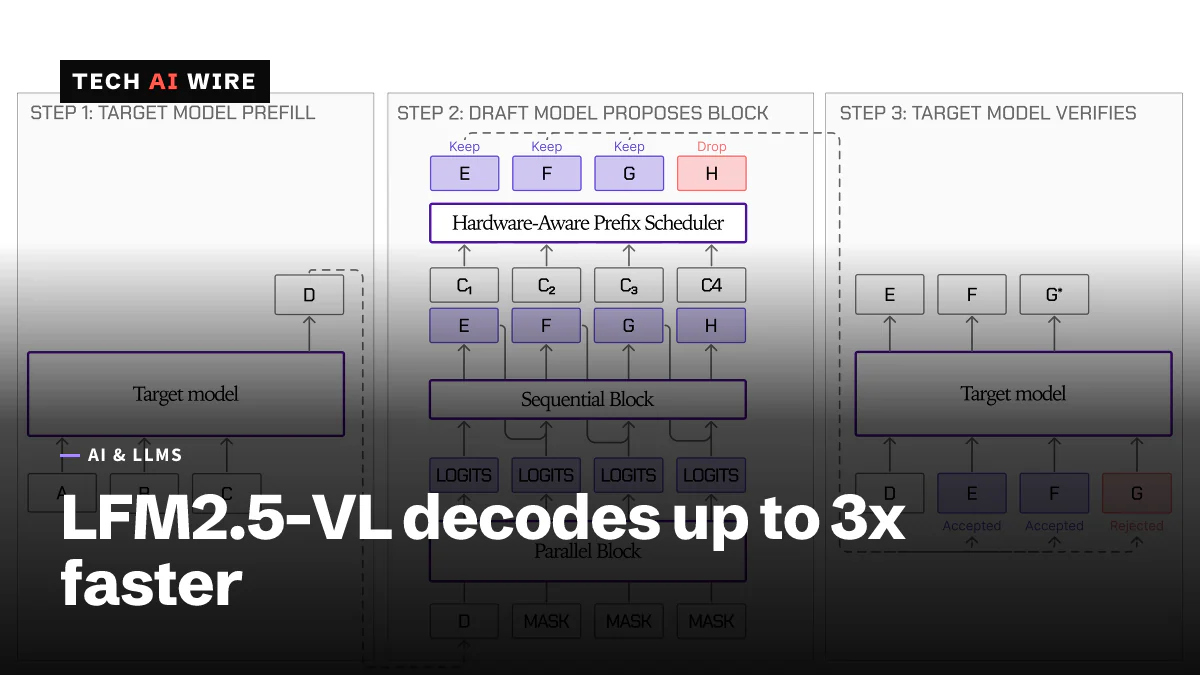
Liquid AI LFM2.5-VL-DSpark speeds up its 3B vision model
Liquid AI's 280M-parameter LFM2.5-VL-DSpark draft model decodes its 3B vision model up to 3.13x faster on an M5 Max, with identical output.
The weekly digest
One email every Friday with the week's top stories from all six desks: AI, dev tools, coding, the tech industry, startups and what's next. Free, no spam.