Google privacy policy lets Gmail, Photos data shape ads
Google's privacy policy, effective October 16, 2026, lets Gmail, Drive and Photos content shape ads once those apps are connected to its AI features.
4 min read
Drafted with AI from the sources linked in this article, then fact-checked and edited by Claire Whitmore before publishing. How we work
By the numbers
- date the updated Google privacy policy took effect
- Oct 16
- Personal Intelligence beta launch in Gemini
- Jan 2026
Google's updated privacy policy lets content from Gmail, Drive and Google Photos shape the ads a person sees, once that person connects those apps to Google's AI features. The policy took effect on October 16, 2026. It turns what was a flat promise into a promise with an exception, and it covers some of the most private data people keep online.
The Hacker News reported the change on October 24. How-To Geek and CyberInsider described the same new exception a day earlier.
What the Google privacy policy now says
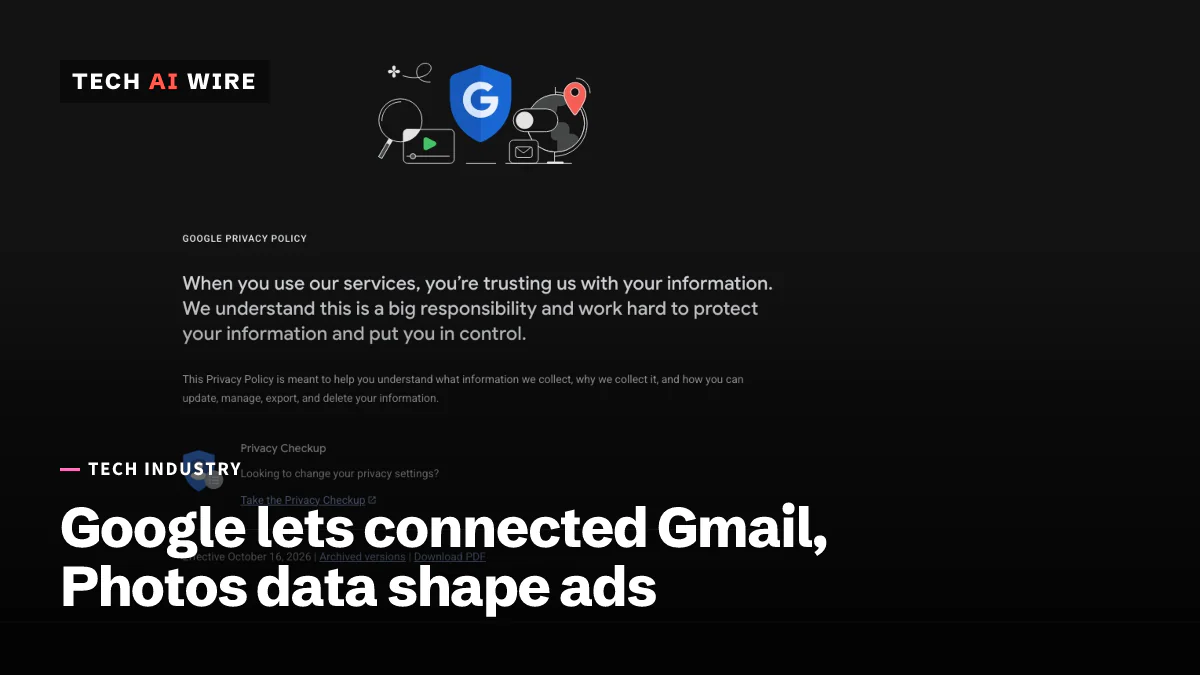
The key line sits in the ads section of the policy. It still opens with the old promise: "We don't show you personalized ads based on your content from Drive, Gmail, or Google Photos." Personalized ads are ads picked for one person, based on what Google knows about them.
Then comes the new condition. The promise holds "unless you choose to make data from these services available to other Google services that support personalized ads." According to The Hacker News, the policy also names Search directly: "Search may process some of the data that you allow Search to access to personalize content, including ads."
CyberInsider says the earlier wording had no such exception. Content from the three apps was simply kept out of ad personalization.
How Gmail and Photos data reaches ads
The route runs through Personal Intelligence. This is the feature that lets Gemini, Google's AI assistant, and Google Search read from a person's other Google apps to give more personal answers. The Hacker News says it launched in Gemini in January 2026 as a beta. It is open to eligible users over 18 worldwide, except in the European Economic Area, Switzerland, the U.K. and Nigeria.
CyberInsider gives an example of how a signal could travel. A user asks Search for things to do on a trip. Search reads a hotel booking from Gmail to answer. Under the new wording, that same detail could also become an ad signal. CyberInsider adds that this does not mean every piece of connected data is used for ads.
How-To Geek makes the practical point. Both Personal Intelligence in Gemini and Google Search can pull from connected apps. So a person may see ads shaped this way just by using those features normally, unless they accept fewer features.
The limits Google keeps
The policy keeps several limits in place. Google says it does not show personalized ads based on sensitive categories, "such as race, religion, sexual orientation, or health." According to CyberInsider, Google also says it does not share names or email addresses with advertisers unless the user asks it to.
The default also stays the same. A person who never connects Gmail, Drive or Photos to these AI features is not affected by the exception.
How to turn it off
The Hacker News and CyberInsider describe two ways to opt out:
- Disconnect Gmail, Drive and Photos from Personal Intelligence.
- Turn off Personalized Recommendations under Search Services Personalization in your Google Account.
How-To Geek walks through five steps to unlink Google Photos and Google Workspace from Search. It also names the trade-off. With Gmail disconnected, Search can no longer use booking details from your inbox for its suggestions.
There is one catch. CyberInsider says disconnecting an app does not erase what Search already holds in Search Services History. That history has to be deleted on its own. Wider ad choices live in My Ad Center.
AI assistants are becoming ad platforms
Google is not the only AI company linking assistants to ads. The Hacker News notes that OpenAI began showing ads to logged-in adult U.S. users in January 2026. It recently added 26 more countries, for 89 in total. OpenAI says "advertising does not influence the answers ChatGPT provides." Tech AI Wire reported in August that ChatGPT ads hit a $1 billion run rate in under 200 days.
What this means for developers
For IT teams, the first job is an audit. How-To Geek lists Google Workspace among the services a user can link to Search. Check whether staff have connected work mail or files to Search or Gemini, and decide whether that fits your data policy. The answers those features give are useful, but the data now has a second use.
If you write help pages or support users, give the full opt-out, not half of it. Disconnecting an app stops new data from flowing. It does not clear Search Services History, so tell people to delete that too.
If you build an AI assistant with connectors to mail, files or photos, this is the pattern to study. Data a user grants to get better answers can, under a policy like this one, also feed ads. Say plainly in your own policy whether connector data ever reaches advertising. Users now have a reason to ask.
Watch the regions that are excluded today. Personal Intelligence is not offered in the European Economic Area, Switzerland or the U.K. If Google expands it there, the same exception will meet stricter privacy rules.
Sources
- Google Says Gmail and Photos Data Shared With AI Search Could Be Used for Targeted Ads - The Hacker News
- Google gives itself permission to use data from Gmail and Google Photos for ads - How-To Geek
- Google adds Gmail, Photos, and Drive ad-targeting exception to privacy policy - CyberInsider
- Google Privacy Policy - Google
Related articles
ChatGPT visual ads start testing inside image generation
OpenAI will test image ads in ChatGPT's image generator later in October in the US, adding measurement partners such as AppsFlyer, Adjust and LiveRamp.

OpenAI's __obi cookie ties ad pixels to ChatGPT accounts
OpenAI's ad pixel sets a one-year __obi cookie linking other sites to a ChatGPT account; scraped identity beat advertiser data 685 to 255.

AdFection: Citizen Lab finds spyware delivered via ads
Citizen Lab says Israeli firm Discover-Tech used targeted ads to deliver Candiru spyware with no click. At least 45 Al Jazeera devices were targeted.
The weekly digest
One email every Friday with the week's top stories from all six desks: AI, dev tools, coding, the tech industry, startups and what's next. Free, no spam.