Cloudflare Clairic model returns typed values, not text
In Cloudflare's own claims test, a pipeline led by its new Clairic model ran in 19.3 seconds instead of 61.7 and cost 49% less than an LLM alone.
4 min read
- Clairic + Clef + GLM-5.3
- 19.3s
- GLM-5.3 for every step
- 61.7s
Cloudflare released a preview of Clairic on October 19, 2026, a model that pulls exact values out of emails, documents and photos. Unlike a chatbot, it returns typed data such as a number or a date, not written text. In Cloudflare's own test, a pipeline that used it first finished more than three times faster and cost 49% less.
What Clairic does
Cloudflare's announcement calls Clairic the first of a new kind of model it names "extraction models." You send it text, plus up to four images, and a list of the fields you want. It sends back each field as a value of the type you asked for.
The types cover text, numbers, dates and times, durations, lists, estimates and forecasts. When the answer is not in the input, the model returns null, meaning empty. Each answer also carries a confidence score.
Clairic runs on Workers AI, Cloudflare's service for running AI models on its own network. Developers call it as @cf/cloudflare/clairic from a Worker, Cloudflare's serverless code, or through a REST API.
Why no output tokens matters
Most language models write their answer one token at a time. A token is a small chunk of text, and output tokens are usually the expensive part of a bill. Clairic skips that step. "There is no reasoning and no output tokens," Cloudflare writes, and output is not charged.
That design has a trade-off. "The architecture makes every answer well formed, not necessarily correct," the post says. A value will always have the right type, but it can still be wrong.
Estimates come with a range, not just one number. Clairic gives a middle value and an 80% interval, the range the true value should fall in four times out of five.
Cloudflare's test
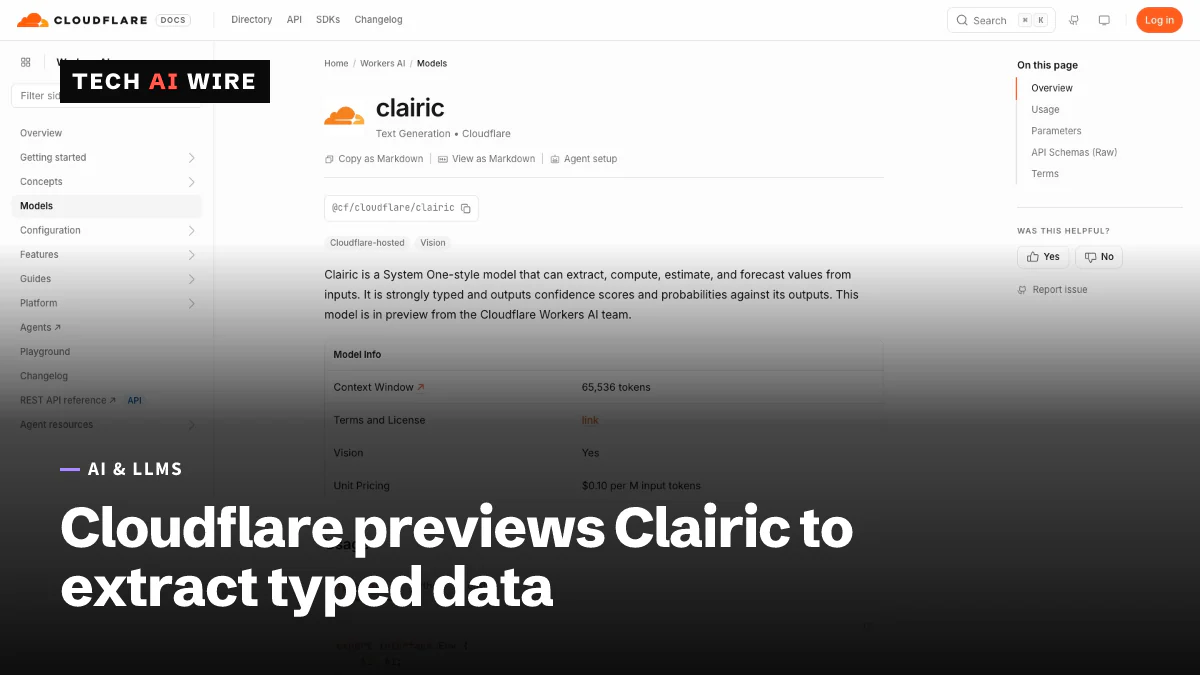
Cloudflare tested a damaged-goods insurance claim process. One pipeline used Clairic to pull out the facts, then Clef to make the decision, then the GLM-5.3 language model to write the reply. Clef is the decision model Cloudflare released earlier this month. The other pipeline used GLM-5.3 for every step.
| Measure | Clairic + Clef + GLM-5.3 | GLM-5.3 for every step |
|---|---|---|
| Time end to end | 19.3 seconds | 61.7 seconds |
| Fact extraction step | 0.46 seconds (Clairic) | 16.1 seconds |
| Decision step | 0.22 seconds (Clef) | 21.9 seconds |
| Cost per million claims | $6,032 | $11,740 |
Both pipelines got the facts and the decision right in every run, Cloudflare says. In a separate test, Clairic forecast daily US airport security passenger counts for 21 days. Its forecasts were off by 3.3% on average, and 17 of the 21 real counts fell inside its 80% range.
PPC Land checked the math and found one gap. The step times for the all-LLM run add up to 60.4 seconds, not 61.7. It also calculates that output tokens make up about 97% of the cascade's cost.
Limits and open questions
Cloudflare is direct about the weak spots. "Reading is strong, but multi-step arithmetic isn't yet," the post says. The model's ranges can be too narrow on unfamiliar data. Its forecasting is basic and does not replace dedicated time-series tools. Cloudflare calls the current version "an early checkpoint."
Cloudflare says it will release the model's weights "soon," but gives no date or license. The price is clearer. Cloudflare's Workers AI model page lists $0.10 per million input tokens, the figure RuntimeWire also reports. The same page gives a context window of 65,536 tokens, the most text one request can hold. PPC Land, working from the blog post alone, had said no per-token price was published.
What this means for developers
Clairic makes the case for splitting AI work by job: a cheap, fast model reads, and a large model only writes. If your app pays mainly for output tokens, that split is worth testing.
- Put it in front, not instead. Use Clairic to pull fields out of emails or receipts, then send only the hard cases to a full language model.
- Use the null and confidence values. Set a threshold below which a person or a larger model checks the result. A well-formed answer is not a correct one.
- Keep math out of it. Ask for the raw values and do sums in your own code, since multi-step arithmetic is a known weakness.
- Test on your own documents. All the figures above come from Cloudflare's tests. Run a few hundred of your real inputs before trusting the speed or accuracy.
- Budget on input size. At $0.10 per million input tokens and no output charge, the bill tracks how much you send. Trim long email threads before you send them.
Sources
- Introducing Clairic, a new System One class of extraction models - Cloudflare Blog
- Cloudflare's Clairic model cuts AI pipeline cost 49% in its own test - PPC Land
- Cloudflare gives structured data tasks their own AI model with Clairic - RuntimeWire
- clairic - Workers AI models - Cloudflare Docs
Related articles

Inception Mercury 3 diffusion LLM claims 1,068 tokens/sec
Inception's Mercury 3 diffusion LLM claims 1,068 tokens a second, a 1M-token context and $0.20/$0.70 per million tokens, half off at launch.

TypeSafe's Jev returns typed decisions, not text
Jev answers in 70 to 500 milliseconds and charges $0.042 per million input tokens, with output free. It cannot generate text at all.

DeepSeek warns developers a significant API price rise is coming
DeepSeek warned developers on August 6 that API prices will rise 'significantly' soon, with no figures or dates - while V4-Flash is the cheapest well-known model to run.
The weekly digest
One email every Friday with the week's top stories from all six desks: AI, dev tools, coding, the tech industry, startups and what's next. Free, no spam.