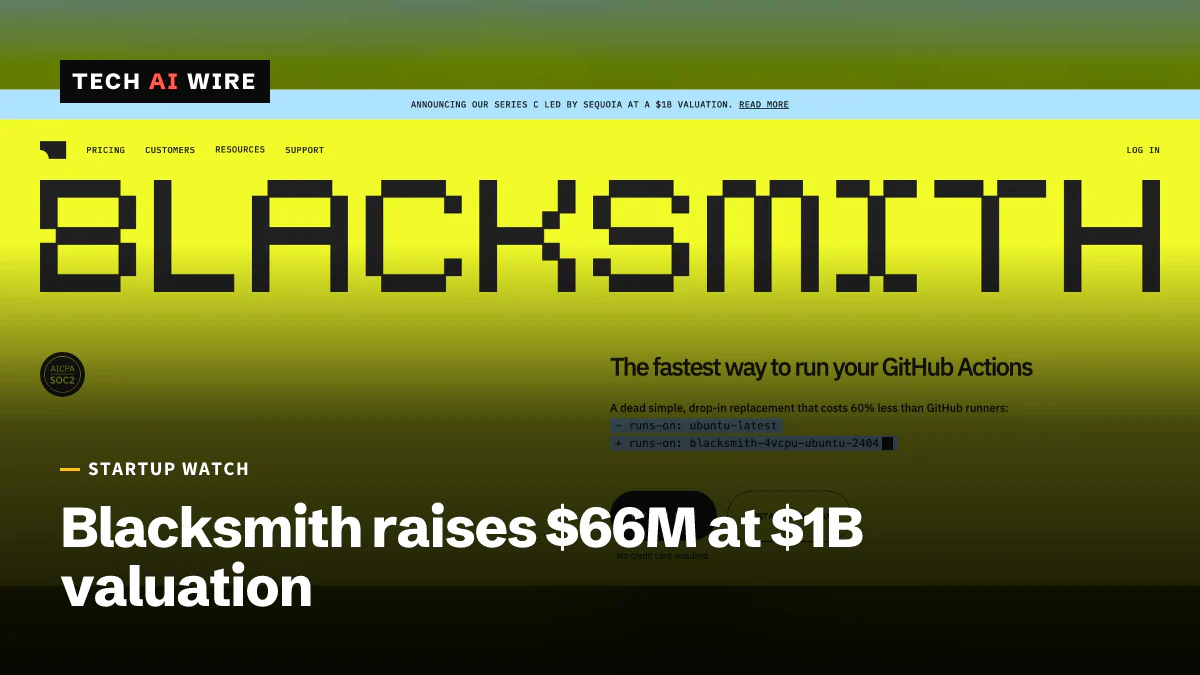
Blacksmith raises $66M at $1B to test AI-written code
Blacksmith raised $66 million led by Sequoia at a $1 billion valuation, two months after a $45 million round valued the CI startup at $550 million.
3 min read
Drafted with AI from the sources linked in this article, then fact-checked and edited by Claire Whitmore before publishing. How we work
By the numbers
- weekly code checks, up from 5 million at the start of 2026
- 90M
- companies using Blacksmith, up from about 5,000 in August
- 10,000+
- growth in annual recurring revenue since January
- 17x
- Series A
- 60M
- Series B, August 2026
- 550M
- Series C, October 2026
- 1000M
Blacksmith, a startup that runs automated code tests for software teams, has raised $66 million at a $1 billion valuation, Fortune reported on October 21, 2026. Sequoia Capital led the Series C. The round came about two months after a $45 million Series B, led by Peak XV Partners, valued Blacksmith at $550 million. Its pitch is simple: AI writes code faster than teams can check it.
What Blacksmith sells
Blacksmith works on continuous integration, or CI. CI is the step where every code change is automatically built and tested before it is merged and shipped. Developers wait on it many times a day.
Blacksmith sells fast cloud runners, the machines that execute those test jobs, plus caching tools that skip repeated work. Crypto Briefing says it is positioned as faster and cheaper than GitHub Actions. The company claims jobs run twice as fast at 60% lower cost on average, according to AI Weekly. It also offers Codesmith, a coding agent that diagnoses failed checks and tries to fix them.
Unlike rivals that rent servers from the big clouds, Blacksmith owns "tens of thousands" of machines in data centers worldwide, Fortune reports. It runs its own software on them.
The numbers behind the round
Blacksmith was founded in 2024 by Aditya Jayaprakash, Aayush Shah and Aditya Maru, and went through Y Combinator. Fortune's figures show how fast it has grown since January.
| Metric | Figure | Source |
|---|---|---|
| Weekly code checks | 90 million, up from 5 million at the start of the year | Fortune |
| Companies using it | More than 10,000, up from about 5,000 in August | Fortune |
| Annual recurring revenue | Up 17 times since January; revenue in the "tens of millions" | Fortune |
| Largest customers | More than $1 million a year each | Fortune |
| Employees | About 40, aiming for around 75 by year-end | Fortune |
| Total raised | About $124.5 million | Fortune, Crypto Briefing |
The outlets do not fully agree. Crypto Briefing puts the customer count at 5,000 to 6,000 or more and headcount at about 30. Named customers include Ashby, Granola, Handshake and LangChain, per AI Weekly. Premji Invest joined the round alongside existing investors Peak XV, GV and Y Combinator.
Why AI coding drives demand
Jayaprakash argues that AI tools have made writing code the easy half of the job. "Now the bottleneck has shifted to the second piece, which is: how do I actually validate all this code?" he told Fortune.
Each stronger AI model sends more code into CI. Fortune reports that Blacksmith's CI volume rose 40% after Anthropic's Claude Fable 5 launched in July. Asked whether model makers' own coding products cut into its business, Jayaprakash said: "Usage on us actually goes up."
Owning hardware has a cost. Fortune notes it leaves Blacksmith exposed to the industry-wide shortage of compute and memory.
What this means for developers
Blacksmith's growth is a measurable sign of a shift many teams already feel: CI time is becoming the slow, expensive part of shipping.
- Measure your own CI wait. Track how long pull requests sit waiting on builds and tests. If AI coding tools raised your pull request volume, that number has likely grown too.
- Price the alternatives. Third-party runners like Blacksmith plug into existing CI workflows. Run the same jobs on both and compare minutes and cost, rather than trusting the 60% claim.
- Check where your code runs. A runner service executes your code and secrets on its machines. Review its security reports and access controls before moving private repositories.
- Plan for volume, not just speed. If more code is generated each month, test budgets grow with it. Caching and running only affected tests matter more than raw speed.
Sources
Related articles
FuriosaAI raises $620M at $2.9B for its RNGD AI chip
Korean AI chip startup FuriosaAI raised $620 million at a $2.9 billion valuation, with $280 million from Korea's state-backed National Growth Fund.
Upwind raises $400M at $3.8B after Datadog talks
Cloud security startup Upwind raised a $400 million Series C at a $3.8 billion valuation, choosing new money over a sale to Datadog at about that price.

General Compute raises $100M Series A at $800M valuation
General Compute raised a $100 million Series A at an $800 million post-money valuation to run AI inference on chips from Nvidia's rivals.
The weekly digest
One email every Friday with the week's top stories from all six desks: AI, dev tools, coding, the tech industry, startups and what's next. Free, no spam.