General Compute raises $100M Series A at $800M valuation
General Compute raised a $100 million Series A at an $800 million post-money valuation to run AI inference on chips from Nvidia's rivals.
3 min read
Drafted with AI from the sources linked in this article, then fact-checked and edited by Claire Whitmore before publishing. How we work
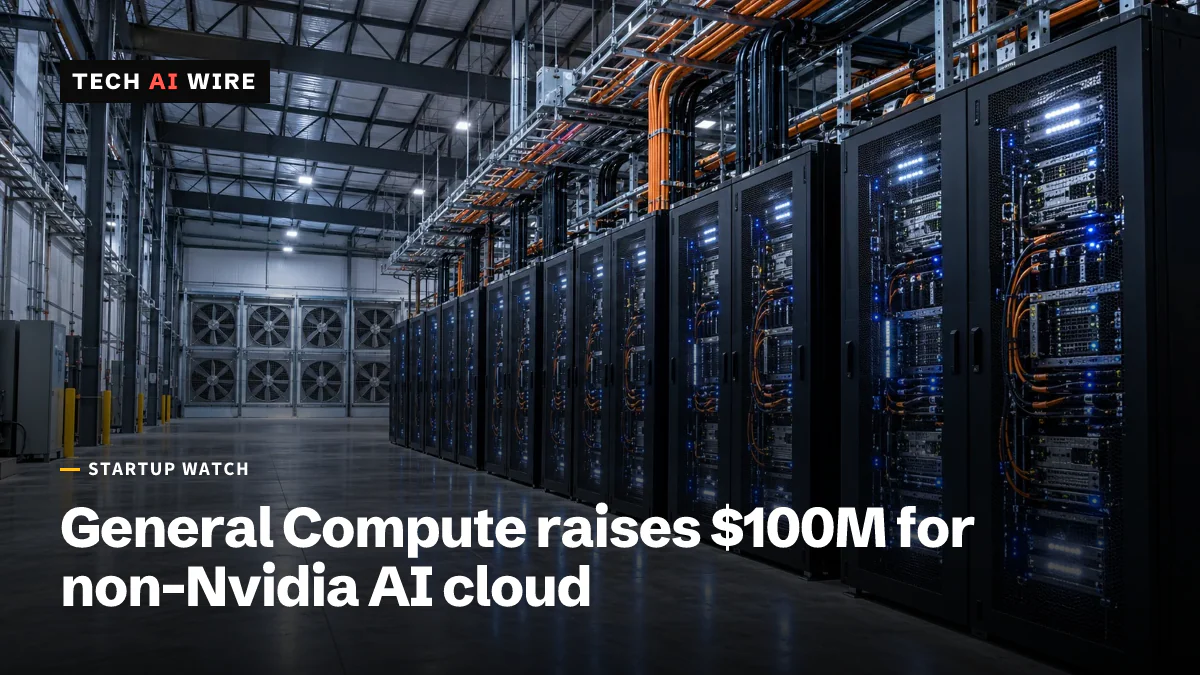
By the numbers
- Series A, led by Blackbird and Abstract Ventures
- $100M
- post-money valuation, up from $60M
- $800M
- yearly recurring revenue from one large customer deal
- $100M
- of capacity the company plans to deploy in 2027
- 75 MW
General Compute, a startup that rents out AI computing power built on chips from Nvidia's rivals, has raised a $100 million Series A. Blackbird Ventures and Abstract Ventures led the round, which values the company at $800 million after the money, TechCrunch reported on October 27, 2026. The round lands as investors question whether small AI cloud providers can survive at all.
The valuation jumped fast. TechCrunch says the company was valued at $60 million after a seed round in May.
What General Compute runs
General Compute calls itself a neocloud. That is the industry name for newer cloud companies that rent out AI hardware, as opposed to giants like Amazon, Microsoft and Google.
Its focus is inference, the work of running an AI model to answer requests, rather than training new models. The company's website describes it as "the inference cloud for alternative chips." It buys the hardware, places it in rented data center space and handles power, cooling, networking and software. Customers can rent the bare machines or sign a contract that guarantees a level of throughput.
The chips come from several Nvidia rivals:
| Chip maker | Role, per General Compute and TechCrunch |
|---|---|
| Cerebras | CS-3 systems for generating output tokens |
| SambaNova | Inference chips, bought through a $400 million deal |
| Positron | Inference chips |
| d-Matrix | Listed on the company site for generating output |
| Nvidia | GPUs handle "prefill," the step that reads the prompt |
The split matters. The company site says Nvidia GPUs process the incoming prompt, while the other chips generate the answer one token at a time. That second step, called decode, is where speed per user shows up.
TechCrunch describes the $400 million SambaNova deal as the first debt financing of inference chips. The company site also says General Compute raised a $15 million seed round, which TechCrunch does not mention.
Customers and capacity
According to TechCrunch, one large customer, which was not named, signed a deal worth $100 million in annual recurring revenue. Other customers are cloud companies that sell fast inference to developers.
The company plans to deploy 75 megawatts of capacity in 2027 and expects access to 200 megawatts of power, TechCrunch reports. It leases space in colocation sites, shared data centers where many firms rent room, and converts former bitcoin-mining sites. The company website says it has "over 30 MW of capacity and counting" and that deployments go live from the first quarter of 2027.
General Compute also makes speed claims on its site. It shows 2,000 tokens per second per user against 110 for a typical GPU cloud. Those are the company's own figures, not independent tests.
Betting against the neocloud gloom
The round arrives during a rough patch for the sector. Elon Musk warned this week that "200+ neoclouds are going to see guppy-level death and consolidation," as TechCrunch quotes him.
Co-founder and CEO Finn Puklowski told TechCrunch that fears of a chip-led collapse are "massively overstated." Demand is strong, he said: "I have people calling me up every single week asking me to do TPUs, GPUs, any chip."
James Palmer, a principal at Blackbird, explained the investor case. "Cerebras, Positron, SambaNova, all need distribution partners who can take them to scale," he told TechCrunch.
SambaNova's CEO, Rodrigo Liang, put the open question plainly. "Everyone in this market is selling speed," he said. "The real question is whether you can make money doing it."
What this means for developers
Teams that run AI models in production have a growing set of options outside Nvidia hardware. This round shows investors will fund them.
- Test speed on your own prompts. Claims of 2,000 tokens per second per user are vendor numbers. Run your real workload, which may have long prompts that change the picture.
- Check model support first. Alternative chips do not run every model. Confirm your exact model and context length are supported before you sign.
- Read the contract terms. Throughput guarantees are only useful if the penalties for missing them are clear. Ask what happens when capacity is late.
- Weigh supplier risk. Small clouds can fold or merge, as Musk predicts. Keep a fallback provider and avoid lock-in across your serving code.
- Watch the 2027 build-out. Much of the planned capacity is not live yet. Delivery on the 75-megawatt plan will show if the model works.
General Compute now has the money to prove that point. Whether specialty chips can beat GPUs on cost, and not only on speed, is the test ahead.
Sources
Related articles
Mueon raises $65M to stack data center chips in 3D
Mueon, founded by former Intel engineers, raised a $65 million Series A led by Maverick Silicon to build Cubelets, stacked 3D compute and memory modules.
Modal raises $750M at $15.75B as its revenue run rate tops $1B
AI compute startup Modal raised a $750 million Series D led by Accel at a $15.75 billion valuation, after its annualized revenue run rate passed $1 billion.

Crusoe reportedly raises $3B at a $30B valuation
Crusoe has reportedly raised $3 billion at a $30 billion valuation, three times its October 2025 mark, after signing a $13 billion cloud deal with Jane Street.
The weekly digest
One email every Friday with the week's top stories from all six desks: AI, dev tools, coding, the tech industry, startups and what's next. Free, no spam.