Warp Sciences raises $215M to automate drug chemistry
Warp Sciences, led by ex-OpenAI product chief Kevin Weil, raised a $215M Series A at an $865M valuation to build AI and robot chemistry labs in the US.
4 min read
By the numbers
- Series A, led by Lightspeed
- $215M
- reported post-money valuation
- $865M
- employees at launch
- ~20
Warp Sciences, a new company run by former OpenAI product chief Kevin Weil, has raised a $215 million Series A to automate the chemistry behind new medicines. Lightspeed Venture Partners led the round, announced on October 22, 2026. It values the roughly 20-person startup at $865 million after the investment, according to H2S Media, which credits Bloomberg for that figure.
The bet is that AI needs real lab data to help science the way it helped coding. "AI has dramatically accelerated software engineering and mathematics," Weil said, according to Startup Editor, but "it has yet to make the same impact in the physical sciences."
What Warp does
Warp is a contract research organization, or CRO. A CRO is an outside lab that drug companies hire to do research work for them. Warp's website calls it "the U.S. chemistry CRO helping scientists discover new medicines faster." It is based in South San Francisco.
Warp will not invent or own drugs of its own; its clients keep control of their programs. Its first service is lead optimization. That is the stage after a promising molecule is found, when chemists make and test many small variations to improve it.
According to Lightspeed's post, each design-make-test round should take two to three weeks. Lightspeed puts a typical full program at two to four years.
How the robots learn
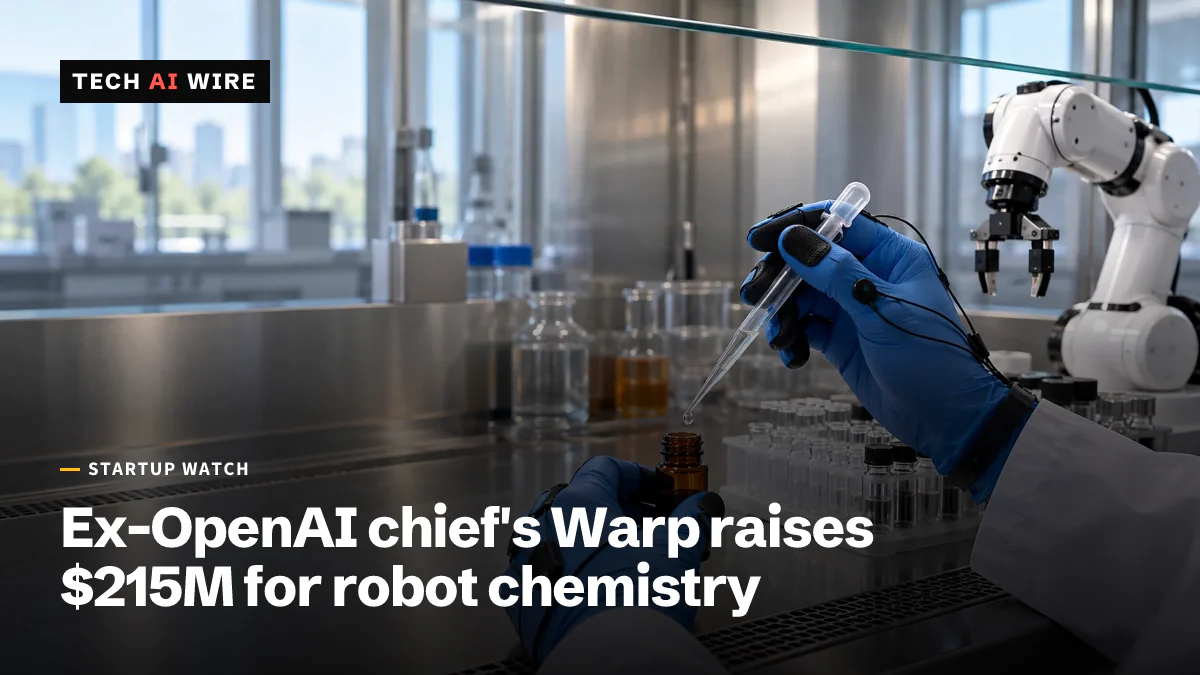
At first, experienced chemists do most of the work by hand. They wear cameras and pressure-sensing gloves that record what they do, according to The AI Landscape and H2S Media. That recording becomes training data. Over time, robots take over the repetitive, high-volume steps.
Warp also logs every step of every run, including failures, Lightspeed writes. Published lab data skews toward experiments that worked, so failed runs are rare and useful training material. The company has already bought robotic arms and AI chips, The AI Landscape reports.
Lightspeed says Warp plans to sell predictions later, not only finished compounds. For now, the company is "working with a small number of design partners," its website says. It names none.
The team and the backers
The four founders come from AI labs, government and drug discovery:
| Founder | Role at Warp | Background |
|---|---|---|
| Kevin Weil | CEO | Former OpenAI chief product officer, later ran its science work |
| Sol Reisberg | Chief science officer | About 20 years in medicinal chemistry, including Gilead and Schrödinger |
| DJ Patil | Chief operating officer | First US chief data scientist |
| Manohar Paluri | Chief technology officer | 14 years at Meta, helped found its FAIR AI lab |
IVP, Premji Invest, Lux Capital, Mayfield and Menlo Ventures joined the round, The AI Landscape and Startup Editor report. Angel investors listed on Warp's site include Sarah Friar, Brian Armstrong, Dylan Field and Reid Hoffman.
Lightspeed says it decided "in the very first meeting." Weil left OpenAI in April, H2S Media reports. OpenAI itself is moving into the same field: it bought drug-program startup Orchestra Bio this week.
The China angle
Warp's pitch is also about where this work happens today. Drugmakers have long sent lead optimization to cheaper Chinese firms such as WuXi AppTec, H2S Media and The AI Landscape note. Lightspeed puts the two largest companies doing this work at close to $100 billion in combined market value.
US policy is pushing the other way. The BIOSECURE Act, signed in December 2025, limits federal buying from designated firms. Sources differ on timing: H2S Media says its bans are not expected before 2027, while Startup Editor says rulemaking could run to 2028. The Defense Department listed WuXi AppTec in June as linked to China's military, but a judge blocked that listing in August.
Reisberg described the trade-off from the customer side. Overseas partners "delivered speed and value," he said, according to Startup Editor, but "I still worried about protecting the intellectual property behind our programs."
What this means for developers
For engineers, Warp is another sign that AI money is moving from software into labs and robots. Its whole model depends on data pipelines: video and glove-sensor capture, run logs that keep failures, and models trained on both. Those are software and ML jobs, and Lightspeed says Warp is hiring roboticists and AI researchers.
For biotech teams that outsource chemistry, Warp is one new US option to evaluate. Ask for turnaround times against the two-to-three-week target, and how your data is kept apart from its training sets.
Watch the scale problem. With about 20 people, Warp must match the price and speed of established Chinese CROs, H2S Media notes. Lightspeed itself says replacing offshore partners could take up to eight years. The next sign of progress will be named customers and published cycle times.
Sources
- Why We're Backing Warp - Lightspeed Venture Partners
- Warp Sciences - Warp Sciences
- Ex-OpenAI science chief launches Warp Sciences with $215M to automate drug labs - The AI Landscape
- Kevin Weil launches Warp Sciences with $215M to build AI drug labs - H2S Media
- Former OpenAI science lead founds Warp Sciences, raises $215 million to use robots and AI to reshape U.S. drug discovery - Startup Editor
Related articles
Eka Robotics raises $150M at $1.45B for force-aware robots
Eka Robotics raised $150M at a $1.45B valuation, led by a16z and F-Prime, for robots that grip by feel and pick about 1,500 items an hour.

Mecka AI raises $60M from Sequoia for robot training data
Mecka AI raised a $60M Series B led by Sequoia, with Nvidia and M12. The startup pays people to record everyday tasks with body sensors to train robots.
Parallel Systems raises $100M for driverless freight rail
Parallel Systems, founded by ex-SpaceX engineers, raised a $100M Series C led by AVP to build battery-powered rail vehicles that run without drivers.
The weekly digest
One email every Friday with the week's top stories from all six desks: AI, dev tools, coding, the tech industry, startups and what's next. Free, no spam.