Universal Quantum raises $100M to link quantum chips
UK startup Universal Quantum raised a Series A of more than $100 million, co-led by DCVC and Firgun Ventures, to scale its modular trapped-ion chips.
3 min read
By the numbers
- Series A, co-led by DCVC and Firgun Ventures
- $100M+
- investors in the round, per Startup.eu
- 15
- contract with the German Aerospace Center
- $77M
- technical staff across three continents
- 100+
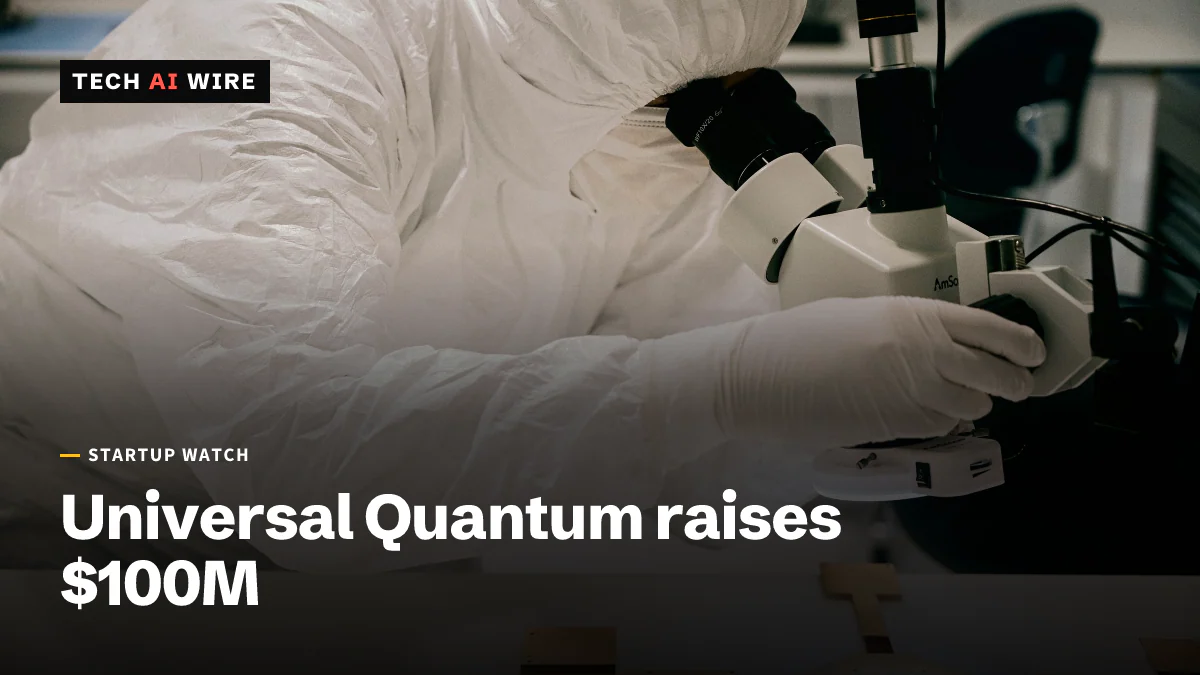
Universal Quantum, a UK quantum computing startup, has raised a Series A of more than $100 million, co-led by DCVC and Firgun Ventures. The company announced the round on October 8, 2026. It will use the money to build modular quantum computers from linked chips and to expand into Singapore, the United States and Japan.
The round
DCVC is a US investor in deep technology, and Firgun Ventures focuses on quantum companies. Startup.eu counts 15 investors in the round. StartupRise reports that it is the largest Series A ever raised by a UK quantum computing company.
| Detail | Figure |
|---|---|
| Round | Series A |
| Amount | More than $100 million (Startup.eu's deal snapshot lists €89.5 million) |
| Co-leads | DCVC, Firgun Ventures |
| Other investors | EDBI, Artal, Integral GlobalTech, Main Sequence, Hostplus, NGS Super, IAG Capital, EdenBase, Eigenstate Holdings, SiteGround Capital |
| Strategic investors | Nauta Capital, The Venture Collective |
| Angel | Dave Baszucki, Roblox CEO |
| Valuation | Not disclosed |
EDBI is a Singapore sovereign investor, and Integral GlobalTech is based in Japan, Ventureburn notes. CEO Sebastian Weidt declined to give a valuation, Bloomberg reports. He said the investor base was "meant to be as global and sovereign as possible, aligning where we'd like to be more active."
How the technology works
A quantum computer stores information in qubits, which can hold more than one state at once. Universal Quantum builds trapped-ion qubits. These are charged atoms held in place and controlled with lasers, according to Bloomberg.
The company's bet is modularity. Instead of one huge processor, it builds chips that link together into larger machines, Startup.eu reports. Ventureburn says its chip tiles connect directly, without the photonic links, which carry data as light, that some designs need. The long-term goal is a fault-tolerant machine, one that corrects its own errors well enough to run long calculations.
The company names drug discovery, battery design and climate modeling as target uses, according to Ventureburn and StartupRise.
Who Universal Quantum is
Physicists Sebastian Weidt and Winfried Hensinger founded the company in 2018 as a University of Sussex spinout. Ventureburn says its blueprint dates to 2017. It has more than 100 technical staff across three continents, according to Startup.eu and Ventureburn.
Government work already pays some of the bills. Startup.eu reports a $77 million contract with the German Aerospace Center (DLR) to build a quantum computer. Bloomberg says the company also sells consultant-style services for future machines, but it does not disclose revenue.
The new money funds a research center in Singapore, the company's first outside Europe. It also pays for growth in the United States, Japan and Hamburg, Germany.
A decade-long timeline
Weidt is candid about the timing. He expects a useful machine in about a decade, Bloomberg reports. "It's hard to build these machines," he said. "No one can map this out."
Investors are betting on that long arc anyway. Firgun's Zeynep Korutürk called the company "one that is well positioned to help define the future of industrial-scale quantum computing," StartupRise reports. Bloomberg notes that no UK public money went into this round.
What this means for developers
Quantum computing will not change most software teams' work this year, and Universal Quantum's own CEO says the same. The round still matters for people who plan technology over the long term.
- Read the timeline literally. A useful machine "in about a decade" is the founder's own estimate. Treat sales pitches that promise quantum advantage sooner with care.
- Watch the German contract. The $77 million DLR deal is the clearest test of whether the modular design works. A delivered machine would say more than any funding round.
- Follow the chip-linking claim. If tiles really connect without photonic links, building bigger machines gets simpler. Look for published results, not only company statements.
- Plan for security early. Large quantum computers could one day break some of today's encryption. Security teams usually plan such migrations years ahead, so the long timeline is a reason to start, not to wait.
- Note the geography. Singapore, Japan and Hamburg are now on the company's map. Research teams in those places may find partnership or hiring chances first.
Sources
- UK quantum computing startup Universal Quantum secures over $100 million Series A in one of the sector's largest early-stage financings - Startup.eu
- Universal Quantum Raises $100 Million to Build a Working Quantum Computer - Ventureburn
- Roblox CEO, Singapore Fund Join $100 Million Round in Universal Quantum - Bloomberg
- Universal Quantum Raises €89 Mn Series A to Scale Large-Scale Quantum Computing - StartupRise
Related articles
Atomic Machines emerges with $250M to build micro-machines
Atomic Machines left stealth on October 7 with $250 million raised and PrimeSwitch, a relay for 800-volt AI data centers that opens in 50 microseconds.
Vinci raises $250M to speed up chip physics simulation
Vinci raised a $250M Series B at a $1.5B valuation for AI physics simulation it says runs up to 1,000 times faster than conventional chip design tools.
RobCo hits $1B valuation as employees sell $40M in shares
RobCo passed a $1 billion valuation, double its level nine months ago, as employees sold $40 million in shares. Its two-armed Alfie robot ships in 2027.
The weekly digest
One email every Friday with the week's top stories from all six desks: AI, dev tools, coding, the tech industry, startups and what's next. Free, no spam.