Tenstorrent raises $1.5B at $6.2B to scale Galaxy servers
Jim Keller's AI chip firm raised $1.5 billion at a $6.2 billion valuation, more than double 2024, to build Galaxy servers and license chip designs.
3 min read
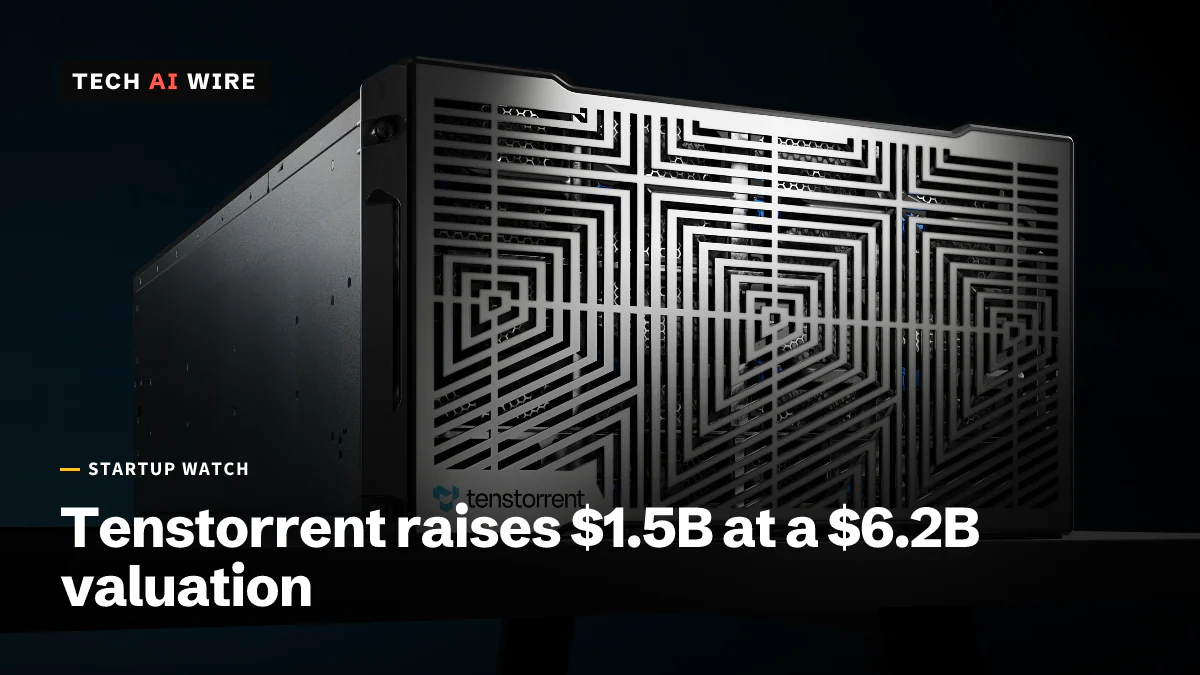
By the numbers
- raised in the Series E round
- $1.5B
- valuation after the round
- $6.2B
- valuation after its 2024 round, per Bloomberg
- $2.6B
Tenstorrent, the AI chip company run by Jim Keller, raised $1.5 billion at a $6.2 billion valuation on October 19, 2026. The round more than doubles its value since 2024. It also gives one of the few independent challengers to Nvidia the money to build servers in volume.
The round
Tenstorrent's announcement calls it a Series E, a late-stage funding round. The $6.2 billion figure is a post-money valuation, meaning it includes the new cash. Two investment firms led the round: Trace Capital, founded by Ben Mahdavi in Los Angeles, and New York's Innovation X.
Many others joined. The company lists ARK Invest, Fidelity, Morgan Stanley, T. Rowe Price, Sandisk, Tether Investments, XTX Markets and Virtu Financial among them. Earlier backers include Samsung, LG Electronics, Hyundai Motor Group and Bezos Expeditions, Jeff Bezos's investment firm.
The step up is large. Tenstorrent was valued at $2.6 billion after its 2024 round, The Next Web reports, citing Bloomberg. Capital Brief gives the same figure. The Globe and Mail puts the earlier deal at $2 billion, when the company raised $693 million.
| Detail | Figure |
|---|---|
| New money | $1.5 billion |
| Valuation after the round | $6.2 billion |
| Valuation after the 2024 round | $2.6 billion (Bloomberg, via The Next Web) |
| Staff | About 1,150 (Bloomberg) or 1,000 (The Globe and Mail) |
| Founded | Toronto, about 10 years ago (The Globe and Mail) |
What Tenstorrent sells
Tenstorrent sells AI computing "at every size," from one card or workstation up to racks and large clusters. Its main product is Galaxy, a server that runs open-weight AI models. Those are models whose files anyone can download, such as chatbots, coding assistants and video generators.
The company also licenses its chip designs to other firms. Its announcement names two: the TT-Ascalon CPU core and the Tensix AI core. Samsung and LG are among the chip designers using them.
The CPU design is based on RISC-V, an open set of processor instructions that anyone can build on without paying a license fee. Tenstorrent's software stack is open source too, so developers can see and change the code that drives the chips.
"We built one architecture and sell it at every size," Keller said in the announcement. He was an architect of Apple's A4 and A5 chips, AMD's Zen design and Tesla's self-driving chip.
Why it chose money over a sale
Intel and Qualcomm each held takeover talks with Tenstorrent earlier this year, Bloomberg reported in May. The Globe and Mail says each reportedly offered upward of $5 billion, which it could not confirm.
Keller told The Next Web the company chose to raise money instead. He named one turning point: a May demonstration in which Galaxy servers ran DeepSeek's models.
Investors are betting on that mix of chips and code. "Few companies design the chip and the software that runs on it. Tenstorrent does both," said George Bousis of Protagonist, one of the investors.
The company says the money will go to two things. One is deploying Galaxy servers at scale. The other is improving the chip designs it licenses. The Globe and Mail adds that Tenstorrent claims faster AI inference, the work of running a trained model, than Nvidia's graphics chips. No independent test of that claim appears in the reports.
What this means for developers
A well-funded rival gives teams that run open-weight models a second supplier to price against Nvidia. That only helps if your models run well on it.
- Test your model on the open stack. The software is open source, so you can check support for your model before buying hardware. Do that before any sales call.
- Ask for independent numbers. The speed claim against Nvidia comes from Tenstorrent itself. Request results on your own workload, measured as cost per token served.
- Watch the licensing side. Tenstorrent cores already go into chips from Samsung and LG. Your next device or server may carry its designs without its name on the box.
- Plan for on-premises use. Galaxy targets companies that run models in their own data centers. If your data cannot leave your building, it belongs on your shortlist.
- Track delivery, not funding. The money is for building servers in volume. Ask about lead times, because supply is what decides whether a second vendor is real.
Sources
- Tenstorrent Announces Series E - Tenstorrent
- Tenstorrent raises $1.5B at a $6.2B valuation to scale its Galaxy servers - The Next Web
- Nvidia challenger Tenstorrent raises $1.5-billion, valuing Toronto-founded company at $6.2-billion - The Globe and Mail
- AI chip startup Tenstorrent raises USD1.5b, doubles its valuation - Capital Brief
Related articles
Mueon raises $65M to stack data center chips in 3D
Mueon, founded by former Intel engineers, raised a $65 million Series A led by Maverick Silicon to build Cubelets, stacked 3D compute and memory modules.
Vinci raises $250M to speed up chip physics simulation
Vinci raised a $250M Series B at a $1.5B valuation for AI physics simulation it says runs up to 1,000 times faster than conventional chip design tools.
Modal raises $750M at $15.75B as its revenue run rate tops $1B
AI compute startup Modal raised a $750 million Series D led by Accel at a $15.75 billion valuation, after its annualized revenue run rate passed $1 billion.
The weekly digest
One email every Friday with the week's top stories from all six desks: AI, dev tools, coding, the tech industry, startups and what's next. Free, no spam.