GNOME 51 ships reworked frame scheduling in Mutter
GNOME 51 arrived September 16 with smoother frame scheduling, FIDO2 passkey login, and one removal developers should note: legacy NVIDIA EGLStreams.
3 min read
By the numbers
- when Ubuntu 26.10 ships GNOME 51
- Oct 15
- what Ubuntu 26.04 LTS stays on
- GNOME 50
- when the next GNOME release is planned
- March 2027
GNOME 51 was released on September 16, 2026, and the headline change is in the compositor rather than the apps. The release announcement, posted by Matthias Clasen, promises "a smoother and responsive interface with improved frame scheduling." The release is codenamed A Coruña.
Frame scheduling is how the desktop decides when to draw. Getting it wrong shows up as animations that stutter under load, so this is the kind of change users feel without being able to name.
What changed in Mutter
Mutter is GNOME's window manager and compositor, the component that puts pixels on screen. Phoronix reports improvements there aimed at desktop responsiveness, alongside enhanced frame scheduling. OMG! Ubuntu describes the work as frame clock optimizations that improve how smooth the interface feels.
Two more compositor items are the ones to write down. Phoronix reports a new Wayland protocol, ext-background-effect-v1, and the removal of legacy NVIDIA EGLStreams support. Mutter also now supports custom pointer acceleration profiles, the feature this site covered when it landed in development earlier this month.
What shipped in the apps
The app changes are broad and mostly about speed and small gaps.
| Area | What is new |
|---|---|
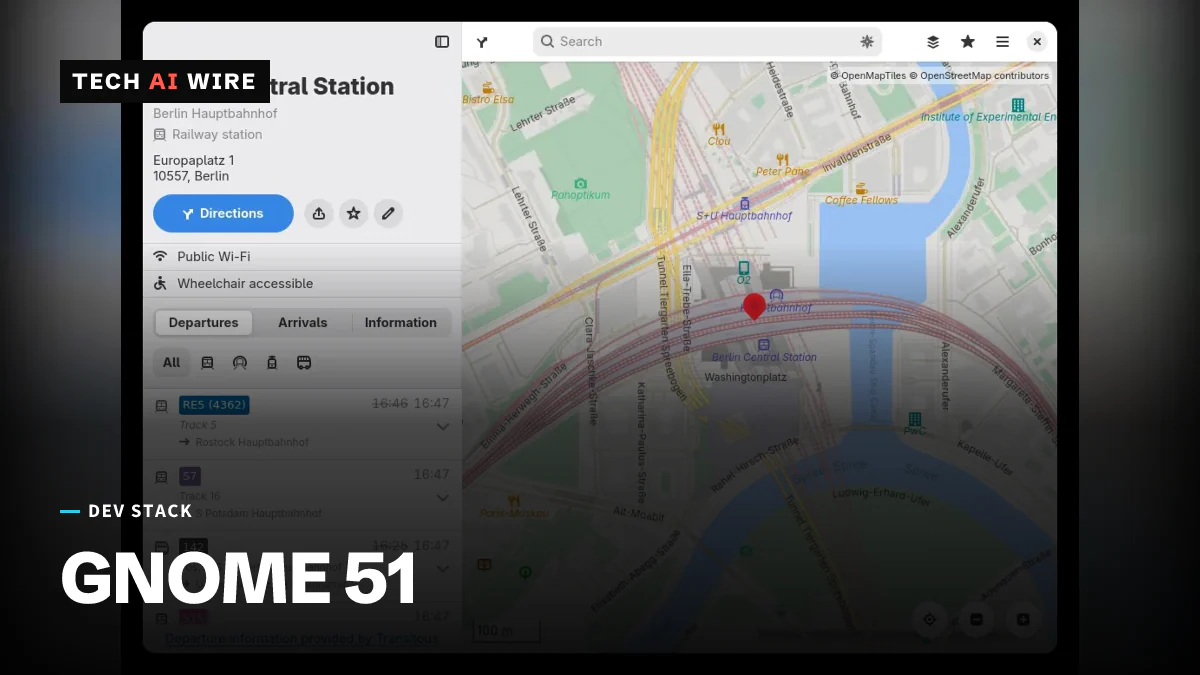
| Maps | Offline area downloads, plus live transit departure times |
| Login | FIDO2 passkey support through GDM's unified authentication |
| Accessibility | A "Reduced Motion" option that dials animations down |
| Display | Monitor brightness and HDR settings now persist across reboots |
| Files | Nautilus is faster in large folders and shows file-count badges while dragging |
| Previews | The File Previewer got a UI revamp; Sushi is ported to GTK4 |
| Settings | Disable the touchpad when a mouse connects, and auto-rotate on accelerometer devices |
OMG! Ubuntu calls it "a more modest release" than recent cycles, and notes two things that missed the cut: a GTK4 port of Disks and a touchpad scroll-speed setting. GNOME Software starts faster, Calendar is optimized, Papers can draw and import signatures, and the Image Viewer now shows camera and color information.
What this means for developers
The EGLStreams removal is the item that can break something. If you maintain software or an image that still depends on legacy NVIDIA EGLStreams paths with Mutter, GNOME 51 is where that stops being supported. Test on the release rather than assuming the proprietary driver's current path covers you.
Treat the new Wayland protocol as a capability to read, not adopt. An ext-background-effect-v1 protocol suggests compositor-side background effects become something a client can ask for, which matters if you ship a shell component or a compositor of your own. Read the protocol text before designing against it, because a new ext- protocol is a contract that can still change.
Plan your test matrix around the LTS gap. GNOME 51 ships in Fedora 45 and in Ubuntu 26.10, and OMG! Ubuntu reports Ubuntu 26.10 arrives on October 15, 2026. Ubuntu 26.04 LTS stays on GNOME 50. So the users most likely to file your bug reports will be split across two GNOME versions for the next year. The LTS is the one your enterprise users run.
Frame scheduling changes are worth measuring rather than trusting. If your application animates, or if you have ever chased a dropped-frame complaint, this release changes the timing assumptions underneath you. The next release is planned for March 2027, so anything you find now has a full cycle to get fixed.
Sources
- GNOME 51 released - GNOME Discourse
- GNOME 51 Released With Improved Frame Scheduling, Many App Improvements - Phoronix
- GNOME 51 released with passkey login and smoother UX - OMG! Ubuntu
Related articles
GNOME 51 adds custom pointer acceleration profiles
GNOME 51, shipping September 16, 2026, lets users define a custom pointer acceleration curve instead of picking one fixed speed profile.
Linux 7.4 kbuild patches cut kernel build times
A kbuild series aimed at Linux 7.4 cuts no-op builds by roughly 80% and trims 37.6 seconds off a full allmodconfig rebuild.

Fedora 45 beta swaps the kernel console for kmscon
Fedora 45 moves the text console out of the kernel. Three tools stop working, and the beta landed September 15 with an automatic fallback to fbcon.
The daily brief
Three to five stories a day, and what each one means for the people who build software. Free, no spam.