TorchNeuron beta brings native PyTorch to AWS Trainium
89% of the top 100 text-generation models now run on AWS Trainium out of the box, up from 46%, as the TorchNeuron PyTorch backend enters public beta.
3 min read
By the numbers
- of the top 100 text-generation models run out of the box
- 89%
- with the older Optimum Neuron v0.4.5 path
- 46%
- best-case speedup from a vision kernel
- 2.4x
TorchNeuron, a new way to run PyTorch code on Amazon's Trainium chips, entered public beta on October 20, 2026. It matters because most popular open models now run on Trainium without changes. Hugging Face says 89% of the 100 most-used text-generation model designs work out of the box, up from 46% with the older tooling.
What TorchNeuron is
Trainium is the AI chip Amazon designs and rents out through AWS, its cloud business. PyTorch is the most widely used library for building and training AI models. Until now, PyTorch code reached Trainium through a translation layer, and many models needed extra work to run.
TorchNeuron is a PyTorch plugin that adds Trainium as a native device. AWS's documentation says it "registers Trainium as a standard PyTorch device." In practice, a developer moves a model to the device named neuron, the same way they would move it to a GPU with cuda.
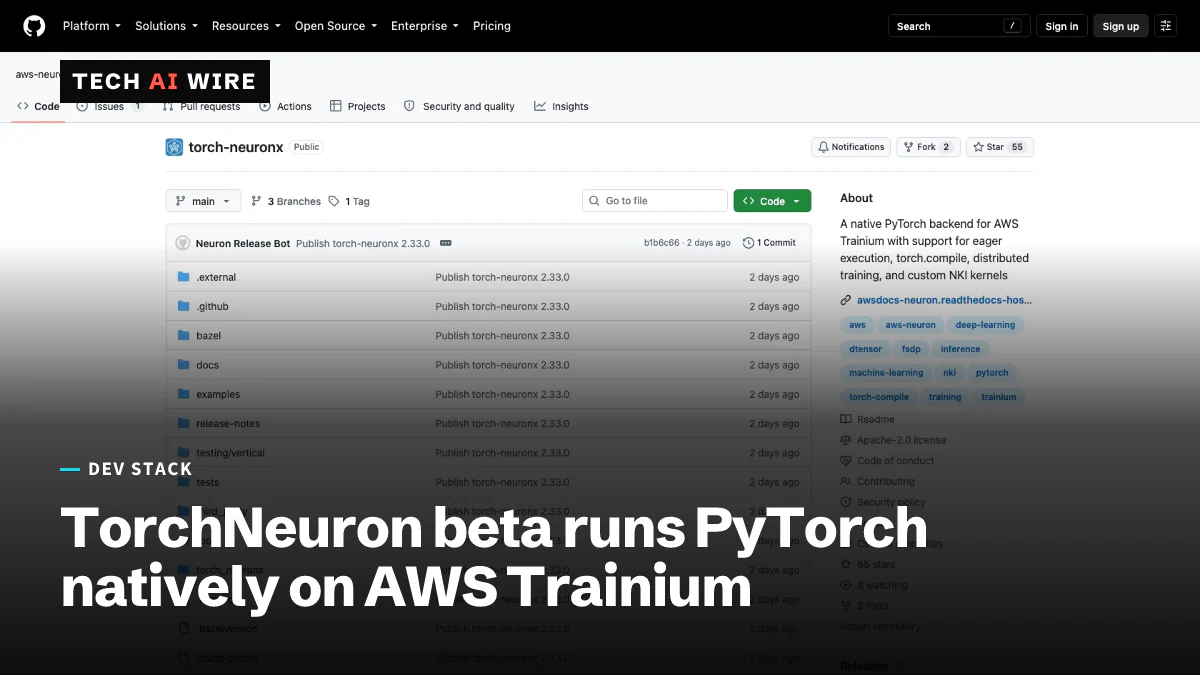
The project is open source under the Apache-2.0 license, according to its GitHub page. AWS lists it as a public beta in the Neuron 2.33 release, its software kit for the chips.
What changed from the old path
The older route went through Optimum Neuron, a Hugging Face library, which relied on PyTorch XLA. XLA is a compiler layer that turns a model into a fixed graph before it runs. That approach made many models hard to support, because each one needed its own adaptation.
TorchNeuron drops that layer. Hugging Face's own libraries now run on Trainium directly: Transformers for language models, Diffusers for image models, plus Accelerate, PEFT and TRL for training and fine-tuning. The table below sums up the features, from the AWS documentation and the Hugging Face post.
| Feature | What it means |
|---|---|
| Eager mode | Code runs line by line, as normal PyTorch does |
torch.compile | Optional compiling for speed, using the neuron backend |
| Distributed training | FSDP, DDP, DTensor, tensor and pipeline parallelism |
| Custom kernels | Hand-written chip code through AWS's NKI language |
| Chips | Trainium 2 and Trainium 3; FP8 and MXFP8 need Trainium 3 |
FSDP and DDP are standard PyTorch ways to split training across many chips. FP8 is a smaller number format that saves memory and time.
Models and speed
Hugging Face's post shows a fine-tuning run of Qwen3-8B with TRL, split across chips with tensor parallelism and FSDP. It also runs image pipelines such as FLUX.1-dev, FLUX.2 and Qwen-Image with tensor parallelism.
AWS's documentation lists mixture-of-experts models, which route each input to a few specialist sub-networks. DeepSeek, GPT-OSS and Qwen3 are supported. Training those models goes through a separate tool, TorchTitan Neuron.
The only speed figure is narrow. A vision transformer kernel from AWS's Neuron team gives "up to a x2.4 speedup on Trainium," the Hugging Face post says. It does not say what that is measured against.
How to install it
The GitHub page gives a pinned install, run after the Neuron driver and runtime packages are in place:
pip install torch==2.14.0 --index-url https://download.pytorch.org/whl/cpu
pip install "torch-neuronx==2.14.*" "neuronx-cc==2.*" "nki>=0.6" --extra-index-url https://pip.repos.neuron.amazonaws.com
The pins matter. TorchNeuron ships under the same package name, torch-neuronx, as the older XLA-based product. Earlier versions install the old one, the repository warns. Running python -m torch_neuronx.collect_env confirms the device is usable from PyTorch. AWS's ready-made machine images and containers have it preinstalled.
What this means for developers
TorchNeuron turns Trainium from a special target into one more PyTorch device. That is the step that makes price comparisons with GPUs practical for ordinary teams.
- Test your own model first. 89% coverage still leaves about one in ten popular designs that need work. Run a short training or inference job before planning a move.
- Pin versions in every environment. An unpinned
torch-neuronxin a requirements file can pull the old XLA product. Checkcollect_envoutput in CI. - Check the chip generation. Only Trainium 2 and 3 instances are supported. If your plan depends on FP8 training, you need Trainium 3.
- Treat it as beta. None of the three sources calls it ready for production. Keep a GPU fallback for anything with a deadline.
- Benchmark cost per job, not per hour. The 2.4x figure covers one kernel with no stated baseline. Measure your own tokens per dollar before you commit budget.
Sources
- TorchNeuron: running HF models on AWS Trainium is easier than ever - Hugging Face
- TorchNeuron: native PyTorch backend overview - AWS Neuron documentation
- aws-neuron/torch-neuronx - GitHub
Related articles
TorchTPU: Google open-sources native PyTorch for TPUs
TorchTPU runs PyTorch natively on Google TPUs, passing 98% of 4,917 Hugging Face models tested. PyTorch/XLA is deprecated and archived on November 15.
NVIDIA Run:ai goes open source, GPU sharing included
NVIDIA released the full Run:ai GPU orchestration platform as open source on October 13, split into four modules teams can adopt one at a time.

Tenstorrent raises $1.5B at $6.2B to scale Galaxy servers
Jim Keller's AI chip firm raised $1.5 billion at a $6.2 billion valuation, more than double 2024, to build Galaxy servers and license chip designs.
The weekly digest
One email every Friday with the week's top stories from all six desks: AI, dev tools, coding, the tech industry, startups and what's next. Free, no spam.