Rust is now a tier-1 language at Microsoft
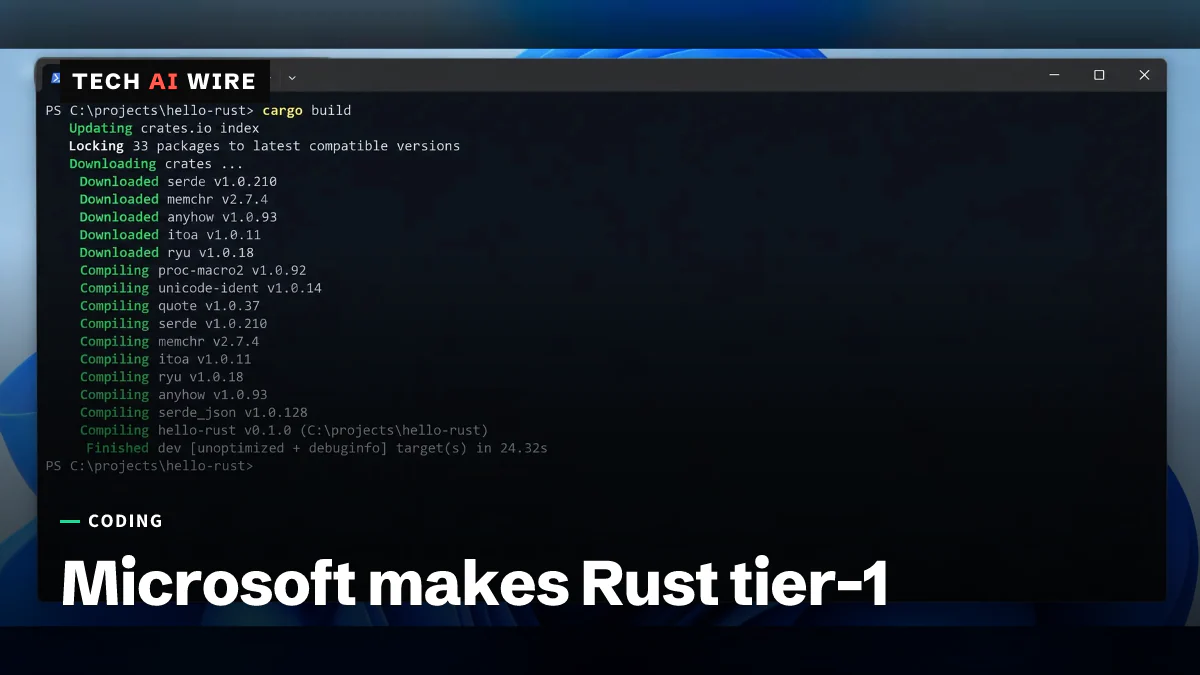
Microsoft made Rust a tier-1 language beside C++, C# and TypeScript. More than 100 of its repositories now build Rust code.
3 min read
By the numbers
- Microsoft repositories building Rust code
- 100+
- of Windows CVEs that are memory issues, per Mark Russinovich
- ~70%
- tier-1 languages at Microsoft: Rust, C++, C# and TypeScript
- 4
Microsoft has given Rust tier-1 language status internally, putting it on the same footing as C++, C# and TypeScript. Victor Ciura, a Principal Engineer on the Rust tooling team in Microsoft's DevDiv/CoreAI group, announced it in a guest post on the Rust Foundation's site published September 10, 2026. For developers outside Microsoft, the interesting part is not the label. It is the compiler work the label paid for.
"Rust sits among C++, C#, and TypeScript as one of the best-supported languages for internal development at Microsoft," Ciura wrote.
What tier-1 buys a language inside Microsoft
Tier-1 is an internal engineering commitment, not a marketing tier. Ciura listed what it obliges Microsoft to provide its own teams:
- Secure, reproducible builds of the toolchain itself
- Developer tooling that meets the bar set for C++ and C#
- Quality and release workflows
- Deep platform integration on Windows
- Compliance with Microsoft's Security Development Lifecycle
The security argument behind it is blunt. Mark Russinovich, Microsoft's Azure CTO, has said that "~70 percent of Windows CVEs are memory issues," The Register reported on September 11, 2026. His conclusion was equally blunt: "no matter how much we really want to make C and C++ better, we can't make it as good as what Rust starts with."
rustc_codegen_utc wires Rust into MSVC
The technical centerpiece is a compiler backend called rustc_codegen_utc. It connects rustc, the Rust compiler, directly to UTC, the optimizer inside Microsoft's own C++ toolchain. It sits in the same family as rustc_codegen_llvm, the backend nearly every Rust developer uses today.
The point is unified code generation on Windows. A project mixing Rust and C++ currently runs two separate optimizers with two sets of assumptions. Routing both through UTC means one optimizer sees the whole program. "Those investments land on a common foundation for both C++ and Rust," Ciura wrote, meaning work done for the C++ compiler now benefits Rust too.
More than 100 Microsoft repositories already build hybrid Rust and C++ projects this way, according to the Rust Foundation post.
Where Rust already runs at Microsoft
| Area | What is written in Rust |
|---|---|
| Windows | Platform integration, firmware, drivers, kernel, hypervisors |
| Microsoft 365 | Outlook, Word, Excel, OneDrive and SharePoint services |
| Text rendering | DirectWrite Core |
| Services | Built on Oxidizer, Microsoft's own set of Rust crates for scalable services |
Oxidizer is the internal crate collection Microsoft uses to build services in Rust, and The Register reports the Microsoft 365 work above was built on it. DirectWrite Core, Windows' text rendering implementation, was described as a Rust component by Ciura on the corrode.dev Rust in Production podcast in April 2025.
What this means for developers
Nothing here ships to you today. rustc_codegen_utc is Microsoft's internal backend, and neither the Rust Foundation post nor The Register says it will be released publicly or upstreamed into rustc.
Watch it anyway, for a specific reason. Rust has effectively had one production code generator, LLVM, for its whole life. Alternative backends like rustc_codegen_gcc and rustc_codegen_cranelift exist but carry nothing like Windows' workload. A second backend under real production pressure tends to expose places where the language has quietly assumed LLVM's behavior. Those fixes usually land upstream whether or not the backend itself does.
If you ship a Windows library, the mixed-language case is the one to think about. Today a Rust and C++ codebase pays for two toolchains and two optimizers, and cross-language inlining does not happen. Microsoft is solving that internally. There is no public timeline for anyone else getting it.
For everyone else, the signal is about hiring and longevity rather than syntax. Tier-1 status means Microsoft has committed maintenance budget, not just enthusiasm, to Rust toolchain work, and that commitment is what keeps a language viable over a decade. The same bet is showing up elsewhere in systems software this month. The mold linker's author is rewriting it from C++ into Rust, aiming to become Linux's default linker.
Sources
- Guest Post: Rust Is Tier-1 Language at Microsoft - Rust Foundation
- Microsoft annoints Rust as a 'Tier 1' internal language - The Register
- Rust in Production S04E01: Microsoft with Victor Ciura - corrode.dev
Related articles
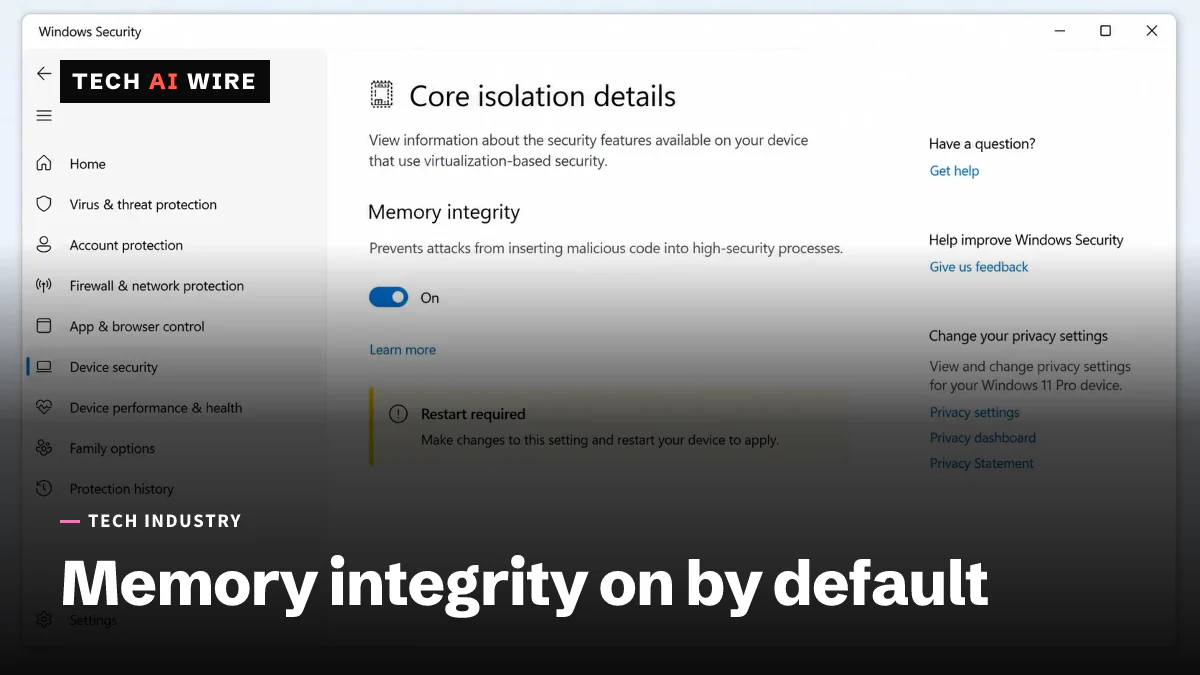
Windows 11 turns on memory integrity by default from October 13
Microsoft will switch on Windows 11's kernel protection automatically on eligible PCs from the October 13 Patch Tuesday. Old drivers are the thing most likely to break.
Rustls 0.23.45 fixes a TLS 1.3 flaw open since 2024
Versions 0.23.13 through 0.23.44 accepted TLS 1.3 handshake messages at the wrong encryption level, a bug introduced in September 2024.

Rust supply chain attack slips build-time malware into arrayref
Malicious versions of arrayref, internment, and append-only-vec ran a remote payload during cargo build for under two hours before crates.io removed them.
The daily brief
Three to five stories a day, and what each one means for the people who build software. Free, no spam.