NVIDIA Kumo Tabular tops TabArena with open weights
NVIDIA's Kumo Tabular predicts from a labeled table in one pass, with no training run. It ranks first on TabArena at 1,950 Elo, in sizes from 28M to 215M.
3 min read

By the numbers
- Elo score, first place on TabArena
- 1,950
- faster than LimiX-2, according to NVIDIA
- 17x
- parameters across the three model sizes
- 28M-215M
- classes in one classification pass
- 10
NVIDIA released Kumo Tabular on September 29, 2026, a model that makes predictions from a spreadsheet-style table without being trained on it first. NVIDIA's announcement says it takes first place on TabArena, a public benchmark for this kind of task, with an Elo score of 1,950. The weights are free to download under a license that allows commercial use.
Tabular data is the rows and columns of a database or a CSV file: customers, transactions, sensor readings. Most prediction work on it still means training a fresh model for every dataset, often a gradient-boosted tree library. Kumo Tabular skips that step, which changes how quickly a team can get a first usable answer.
How in-context prediction works
Kumo Tabular uses in-context learning, the same idea that lets a chat model follow examples placed in its prompt. You hand it rows where the answer is already known. It reads them as context, then predicts the answer for new rows in a single pass. Nothing about the model changes: there is no training run and no weight update.
The model card's quick-start example shows the shape of it. You install the structured-data-models package with pip, load a table, and pass the labeled rows and the new rows together. The example runs on a CUDA GPU, NVIDIA's graphics card platform.
Sizes, limits and licenses
NVIDIA publishes the weights in three sizes, from 28 million to 215 million parameters. That is tiny next to a chat model, which is part of the point: it is built to be fast and cheap to run.
| Item | Detail |
|---|---|
| Model sizes | Three, from 28M to 215M parameters |
| Column types | Numbers and categories |
| Columns | Up to 100 |
| Classification | Up to 10 classes in one pass |
| Rows tested | Datasets of up to 60,000 rows |
| Weights license | OpenMDW-1.1, which NVIDIA says permits commercial use |
| Code license | Apache 2.0 for NVIDIA-written code |
Text, images and timestamps need preprocessing before the model can use them, Superpower Daily reports. The NVIDIA/structured-data-models repository holds the code. It requires Python 3.11 or newer and PyTorch 2.7 or newer, and it exposes familiar fit() and predict() methods. The same repository also carries TabICLv2, TabFM and KumoRelational, NVIDIA's other models for structured data.
How it scores
NVIDIA's post makes three claims:
- First place on TabArena, with an Elo score of 1,950.
- The top overall ranking on TALENT, a second benchmark suite for tabular models.
- Predictions 17 times faster than LimiX-2, a competing tabular model.
Superpower Daily reports that NVIDIA ran its evaluation on an RTX 6000 Pro GPU. The post credits David Holzmüller and Vignesh Kothapalli for research contributions.
TabArena's own maintainers have already wired the model into their benchmark code. A pull request merged on September 28, 2026 changes how TabArena wraps Kumo Tabular. Bagged copies of the model, several copies whose predictions are combined, can now predict on the GPU instead of the CPU. Rebuilding the estimator for each prediction adds about 16 milliseconds, according to the pull request.
What this means for developers
Treat Kumo Tabular as a new baseline, not an automatic replacement. If you already have a tuned gradient-boosted model, run both on the same held-out rows and compare accuracy and latency. In-context models are strongest when you need a decent answer fast, on a dataset you have not modeled before.
Check the limits before the leaderboard. Up to 100 columns, 10 classes per pass and datasets tested to 60,000 rows cover many business tables, but not all of them. A wide feature table or a large multi-class problem falls outside what NVIDIA has shown.
Plan for a GPU. The quick-start and the repository are built around CUDA, and NVIDIA's reported numbers come from a high-end workstation card. Measure the latency you actually get on the hardware you run in production.
Read the weights license separately from the code license. The code is Apache 2.0, but the weights use OpenMDW-1.1, a license many legal teams will not have reviewed yet. NVIDIA says it permits commercial use. Get that confirmed in writing before the model reaches a customer-facing system.
Finally, the TabArena merge is the part worth watching. Once an independent benchmark runs the model in its own harness, the Elo figure stops being only a vendor claim. Check the public leaderboard again in a few weeks.
Sources
- NVIDIA Kumo Tabular Sets a New Accuracy-Efficiency Frontier for Tabular Prediction - Hugging Face
- nvidia/Kumo-Tabular - Hugging Face
- NVIDIA/structured-data-models - GitHub
- Kumo Tabular: keep the network outside the estimator so bagged models predict on the GPU - TabArena on GitHub
- NVIDIA Releases Kumo Tabular to Predict From Tables Without Task-Specific Training - Superpower Daily
Related articles

Holo4 open-weight agent models score 61.7% on OSWorld 2.0
H Company's Holo4-27B scores 61.7% on OSWorld 2.0 at $1.22 a task, but only its Apache 2.0 sibling, 35B-A3B, can be self-hosted commercially.
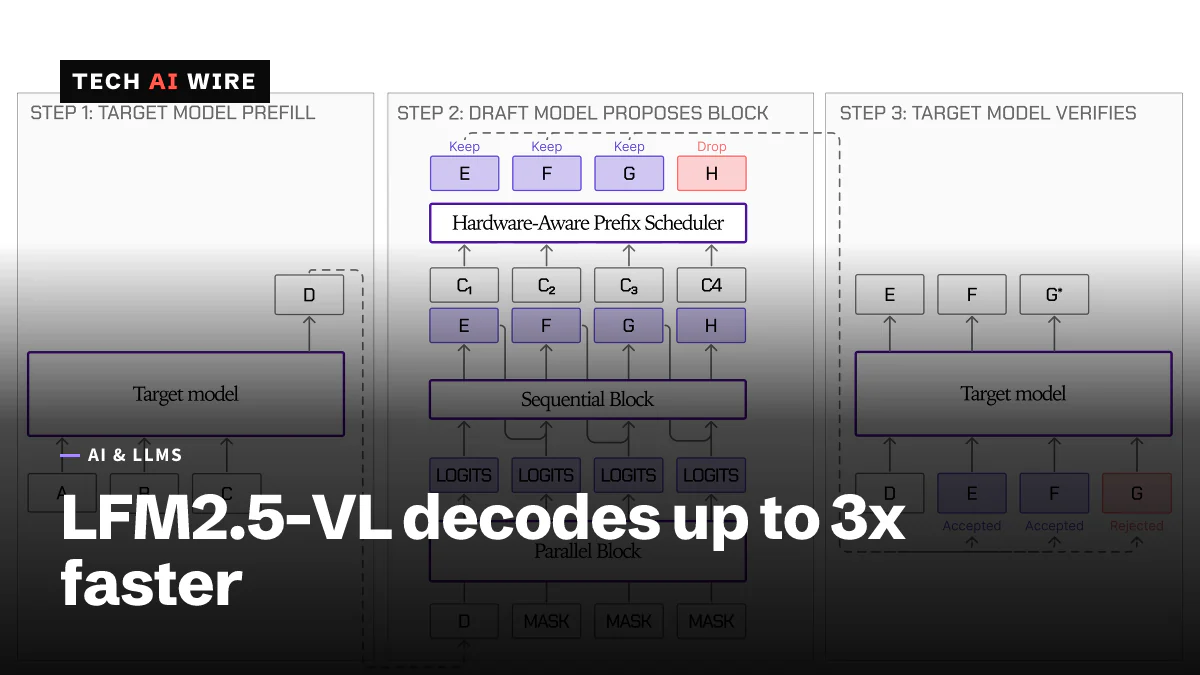
Liquid AI LFM2.5-VL-DSpark speeds up its 3B vision model
Liquid AI's 280M-parameter LFM2.5-VL-DSpark draft model decodes its 3B vision model up to 3.13x faster on an M5 Max, with identical output.
Laya's typed decisions, explained
A typed-decision model fills in fixed questions with typed answers and a confidence score. Laya's 421M open weights let you verify that yourself.
The daily brief
Three to five stories a day, and what each one means for the people who build software. Free, no spam.