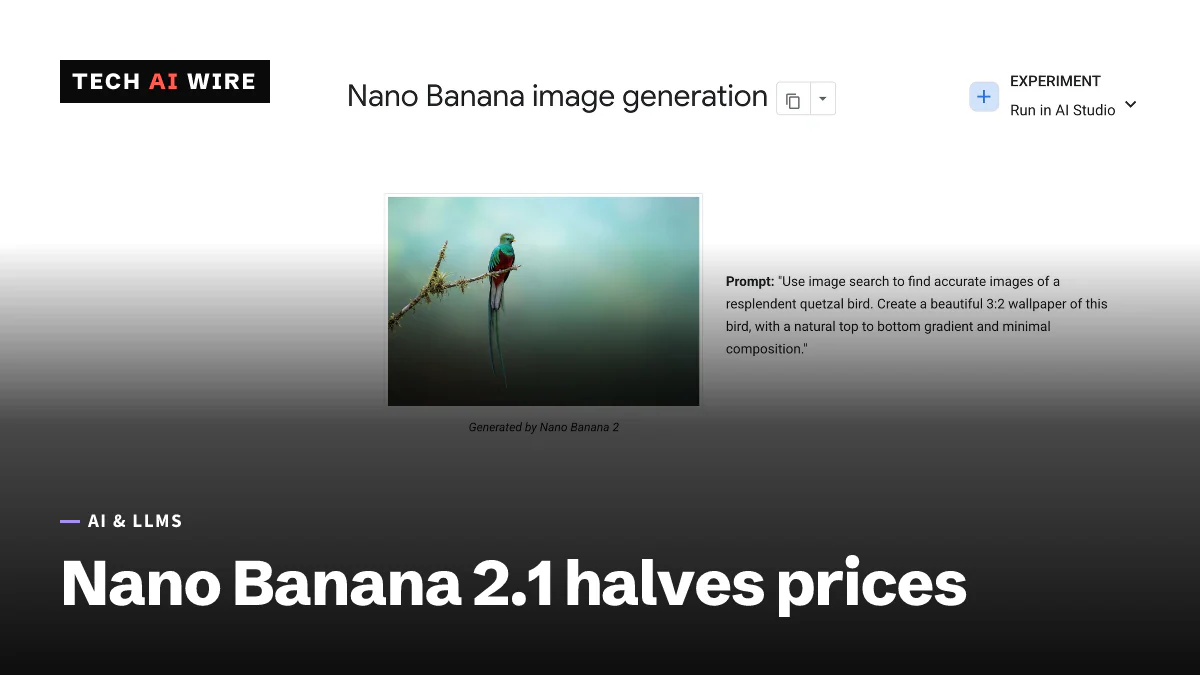
Nano Banana 2.1 halves the price of Gemini images
Google's Nano Banana 2.1 image model costs $0.0336 per 1K image in the Gemini API, half the price of Nano Banana 2, which Google has now deprecated.
3 min read
By the numbers
- per 1K image for Nano Banana 2.1
- $0.0336
- per 1K image for Nano Banana 2
- $0.067
- reference images per request, at most
- 14
- widest new aspect ratio
- 8:1
Google released Nano Banana 2.1 on October 6, 2026, a new Gemini image model that costs half as much per picture as the one it replaces. A standard 1K image now costs $0.0336 in the Gemini API, against $0.067 for Nano Banana 2, according to Google's pricing page. Google has deprecated Nano Banana 2 at the same time. Any app built on it now has a reason, and a cheaper option, to switch.
What Nano Banana 2.1 is
Nano Banana is Google's name for its Gemini image models. They create pictures from a text prompt and edit existing pictures through conversation. You can ask for a change, look at the result, then ask for another.
Google's API release notes call version 2.1 "the latest high-efficiency image generation and conversational editing model." The model name in code is gemini-nano-banana-2.1.
The release notes list five improvements:
- better visual quality
- closer adherence to the prompt
- more consistent characters across several turns of editing
- better text rendering inside images
- support for extreme aspect ratios: 1:4, 4:1, 1:8 and 8:1
An aspect ratio is the shape of the image, width against height. An 8:1 image is a long, thin banner. Google's documentation says the model accepts up to 14 reference images in one request. Reference images are pictures you supply so the model can match a person, product or style.
How the prices compare
Google prices images by output resolution. Batch requests, which run later instead of right away, cost half.
| Resolution | Nano Banana 2.1 | Nano Banana 2 |
|---|---|---|
| 0.5K | not listed | $0.045 |
| 1K | $0.0336 | $0.067 |
| 2K | $0.0504 | $0.101 |
| 4K | $0.113 | $0.151 |
| 1K, batch | $0.0168 | $0.034 |
Measured in tokens, the new model costs $30 per million tokens, down from $60. Decrypt reported a lower 4K price of $0.0756. Google's own pricing page lists $0.113, so budget with Google's figure.
What Google and Decrypt claim on quality
Decrypt says the model "outperforms our previous models across the board," quoting Google. It reports an Elo rating of 1,050 for Nano Banana 2.1, against 990 for Nano Banana 2 and 935 for the Pro model. An Elo rating comes from people comparing two images side by side and picking the better one.
The biggest jump is in infographics. Decrypt reports a factuality score of 0.521 for 2.1, up from 0.179. That score measures whether the facts drawn into a chart or diagram are correct. These are Google's figures, not independent tests.
Decrypt says the model is rolling out in the Gemini app, AI Mode in Google Search, Google Ads, Google AI Studio, Flow and Stitch.
What happens to Nano Banana 2
The deprecation is the part that needs action. Google's release notes say gemini-3.1-flash-image, the model known as Nano Banana 2, "is deprecated (no shutdown date announced)." Google points users to gemini-nano-banana-2.1 instead.
Deprecated means the model still works but is on its way out. Some reports gave a fixed shutdown date in late October. Google's deprecations page lists none for the stable model.
One older model does have a date. The same page says gemini-2.5-flash-image shuts down on March 15, 2027. Its recommended replacement is gemini-3.1-flash-lite-image.
What this means for developers
- Switch for the price, test for the look. The change is often one model string. But a new model draws differently, so run your saved prompts through both and compare the results before you switch production traffic.
- Recheck character and product consistency. If your app keeps a mascot or a product looking the same across images, test that path first. It is the area Google says improved, and the one users notice most when it breaks.
- Use batch for anything that can wait. Thumbnails, catalog images and overnight jobs cost half again through batch requests.
- Do not wait for a shutdown date. Google has not set one for Nano Banana 2. When it does, the notice period may be short. Migrating now, while both models run, is the cheapest time to do it.
- Check text in images by hand. Better text rendering helps posters and diagrams, but a 0.521 factuality score still means many generated infographics contain errors.
Track the deprecations page. Google will post Nano Banana 2's shutdown date there first.
Sources
- Release notes - Google AI for Developers
- Gemini Developer API pricing - Google AI for Developers
- Gemini deprecations - Google AI for Developers
- Google Launches Nano Banana 2.1: Better Than Its Predecessor at Half the Price - Decrypt
Related articles
Gemini 4 Argon opens to cyber defenders before developers
Gemini 4 Argon scores 77.9% on DeepSWE v1.1 and can write 1M tokens per answer, but only cyber defenders in Google's Fairwind Program can use it so far.
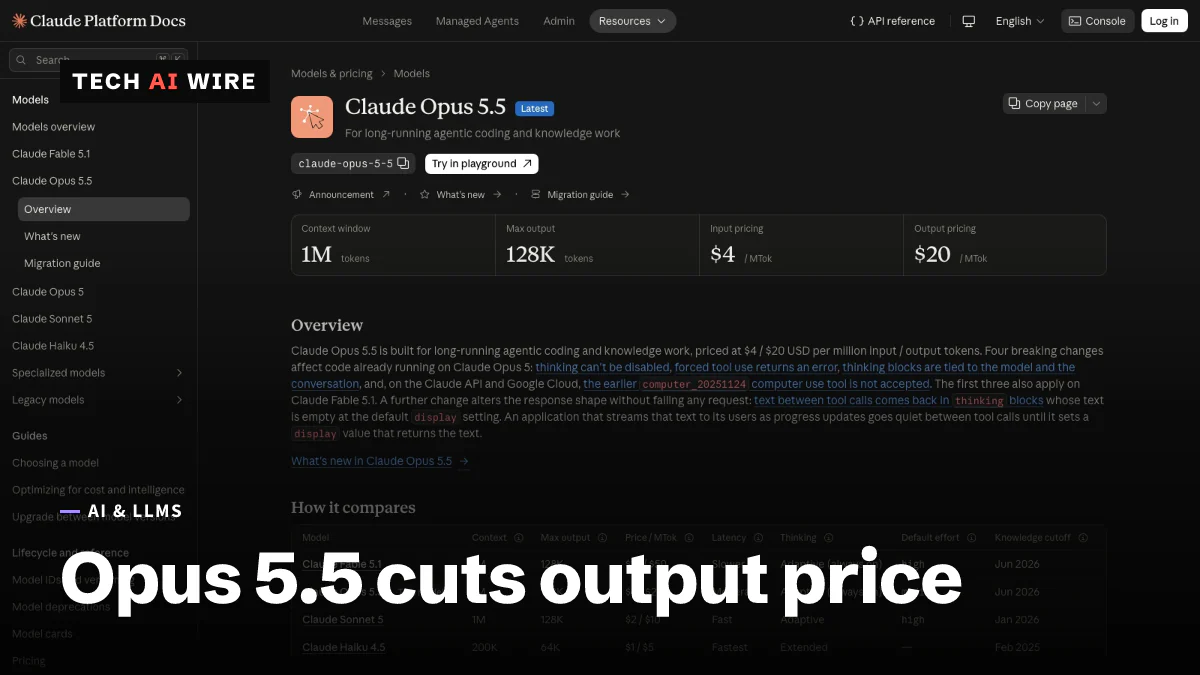
Claude Opus 5.5 cuts output price to $20 per million
Anthropic released Claude Opus 5.5 on September 22, 2026, at $4 input and $20 output per million tokens, with thinking always switched on.
TypeSafe's Jev returns typed decisions, not text
Jev answers in 70 to 500 milliseconds and charges $0.042 per million input tokens, with output free. It cannot generate text at all.
The weekly digest
One email every Friday with the week's top stories from all six desks: AI, dev tools, coding, the tech industry, startups and what's next. Free, no spam.