Google Willow cuts magic state errors 40x in Science paper
Google ran magic state cultivation on its Willow chip for the first time, cutting errors about 40x and reaching 99.99% fidelity. Scale is still unproven.
4 min read
Drafted with AI from the sources linked in this article, then fact-checked and edited by Claire Whitmore before publishing. How we work
By the numbers
- fewer errors than states made without cultivation
- ~40x
- logical fidelity of the T-states
- 99.99%
- Willow qubits used in the main experiment
- 54 of 105
- of attempts that passed every check
- 8%
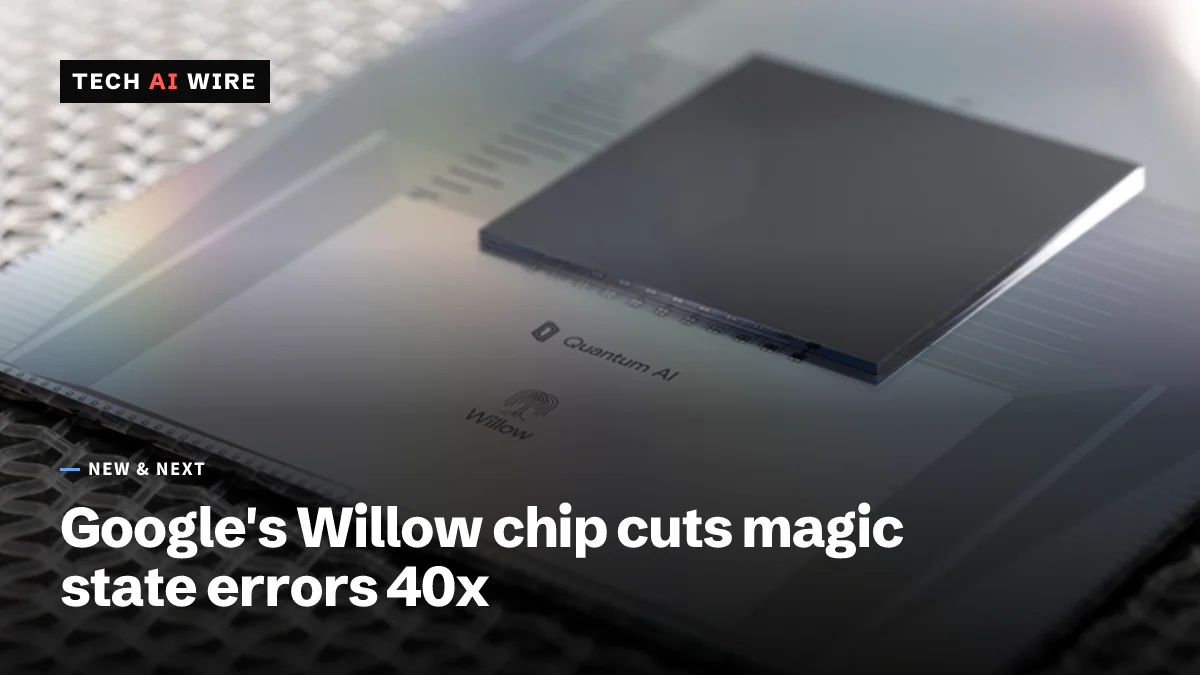
Google's quantum team has shown, for the first time on real hardware, a cheaper way to make the special "magic states" that a useful quantum computer needs. The result, published in Science on October 15, 2026, cut errors in those states about 40 times on Google's Willow chip. Magic states may eat up to 95% of a future machine's capacity, so making them cheaper attacks one of the field's biggest costs.
Google's announcement, written by research scientist Emma Rosenfeld and quantum software engineer Craig Gidney, puts it simply: "We've shown that magic state cultivation works on Google Quantum AI hardware."
What a magic state is
A quantum computer works on qubits, which can hold blends of 0 and 1 at once. Qubits are fragile, so practical machines will use error correction. That means spreading one reliable "logical" qubit across many physical ones.
Error-corrected machines can do some operations cheaply. Others they cannot do on their own. For those, the machine prepares a magic state in advance and then uses it up to perform the operation, Google explains. Each one works only once. T-states are one type of magic state.
Making magic states is costly. Google's post says that "up to 95% of a quantum computer's entire capacity might need to be dedicated to making them." Quantum Computing Report says older methods, called distillation, were projected to use 90% to 95% of a machine's physical qubits. Google says the problem was first foreseen in 2004.
How cultivation works
Gidney, Noah Shutty and Cody Jones of Google Quantum AI proposed magic state cultivation in 2024, building on an earlier idea. The new paper is the first time it has run on a real chip.
The Quantum Insider describes it as a filter. The chip spreads a rough magic state across a small group of qubits. It then runs a series of checks, throws away any attempt that fails, and grows the ones that pass.
Here, the team grew a state from a small error-correcting code into a larger one. The two codes are known as a distance-3 color code and a distance-5 surface code. Quantum Computing Report calls it "the first physical hardware implementation of magic state cultivation."
The results
| Measure | Result | Source |
|---|---|---|
| Error reduction | About 40x versus uncultivated states | |
| T-state logical fidelity | 99.99%, a record per Google | |
| Attempts kept | 8% | Quantum Computing Report |
| Qubits used | 54 of Willow's 105 | The Quantum Insider |
| Storage test | Errors about 7x higher than simulated | The Quantum Insider |
A 99.99% fidelity means roughly one error in 10,000 states. The low 8% keep rate is the price of the filter: most attempts are thrown away.
What is still unproven
The authors are clear about the limits. "Of course, we still need to demonstrate magic state cultivation at a larger scale," Google's post says. It gives no timeline for a useful quantum computer.
The Quantum Insider reports that stored states decayed faster than simulations predicted, with an error rate about seven times higher. It traces most of that to leakage, where a qubit slips out of the two states it should hold. The simulations had left that effect out. The outlet calls the work "an important, incremental advance toward practical quantum computing."
Getting the hardware to cooperate took work too. Interesting Engineering reports that early results were off because of drift in electrical equipment and changes in lab temperature. Google fixed them with better controls and a new way of benchmarking.
What this means for developers
Nothing changes in your stack this year. Google gives no date for a useful machine, and the method still has to work at a much larger scale. Treat this as a cost cut on paper, not a product.
Watch three numbers in follow-up papers: the 8% keep rate, the error rate during storage, and the qubit count. A useful machine needs magic states made fast and in bulk. A filter that discards 92% of attempts must run quickly to keep up.
If you buy cloud quantum time or track the field for your company, ask vendors how they plan to supply magic states. That one line item may decide how large and how costly a useful machine has to be.
For security teams, the advice stays the same. Move toward post-quantum cryptography, encryption designed to resist quantum attacks, on your own schedule rather than in response to headlines. Tools are already shipping: OpenSSH 10.6 added a post-quantum signature type on October 6.
The full paper, "Magic state cultivation on a superconducting quantum processor," is in Science under DOI 10.1126/science.aee7961.
Sources
- Bringing the magic: Google breaks open a bottleneck in quantum computing - Google
- Google Demonstrates Method to Cut Errors in Quantum Computing's 'Magic States' - The Quantum Insider
- Google Quantum AI Demonstrates Magic State Cultivation on Willow Processor in Science Milestone - Quantum Computing Report
- Google's quantum chip cuts magic-state errors 40-fold, reaches 99.99% fidelity - Interesting Engineering
Related articles

Fitbit Edge: Google's $179.99 tracker adds an OLED screen
Google's Fitbit Edge costs $179.99 and reaches stores October 27. It adds an OLED screen to a slim band, with built-in GPS, an ECG app and a week of battery.
Google launches Pixel 11 line with Tensor G6, starting at $899
Google announced the Pixel 11, 11 Pro, Pro XL, and Pro Fold on August 12 with the Tensor G6 chip, 256GB base storage, and prices from $899. All ship August 20.
ChromeOS updates end in mid-2034, short of 10 years
Google ends ChromeOS updates in mid-2034, so Chromebooks sold since mid-2024 get 8 to 10 years. Googlebook admin tools come in the second half of 2027.
The weekly digest
One email every Friday with the week's top stories from all six desks: AI, dev tools, coding, the tech industry, startups and what's next. Free, no spam.