Tech firms pledge $2.4B in compute to Genesis Mission
Eleven companies pledged $2.4 billion in compute credits to the Genesis Mission on October 8. Nvidia gave $1 billion; Musk, Huang and Su got science medals.
3 min read
By the numbers
- in compute credits pledged by 11 companies
- $2.4B
- from Nvidia, the largest single pledge
- $1B
- federal agencies the credits will support
- 15+
- tech leaders given national medals
- 6
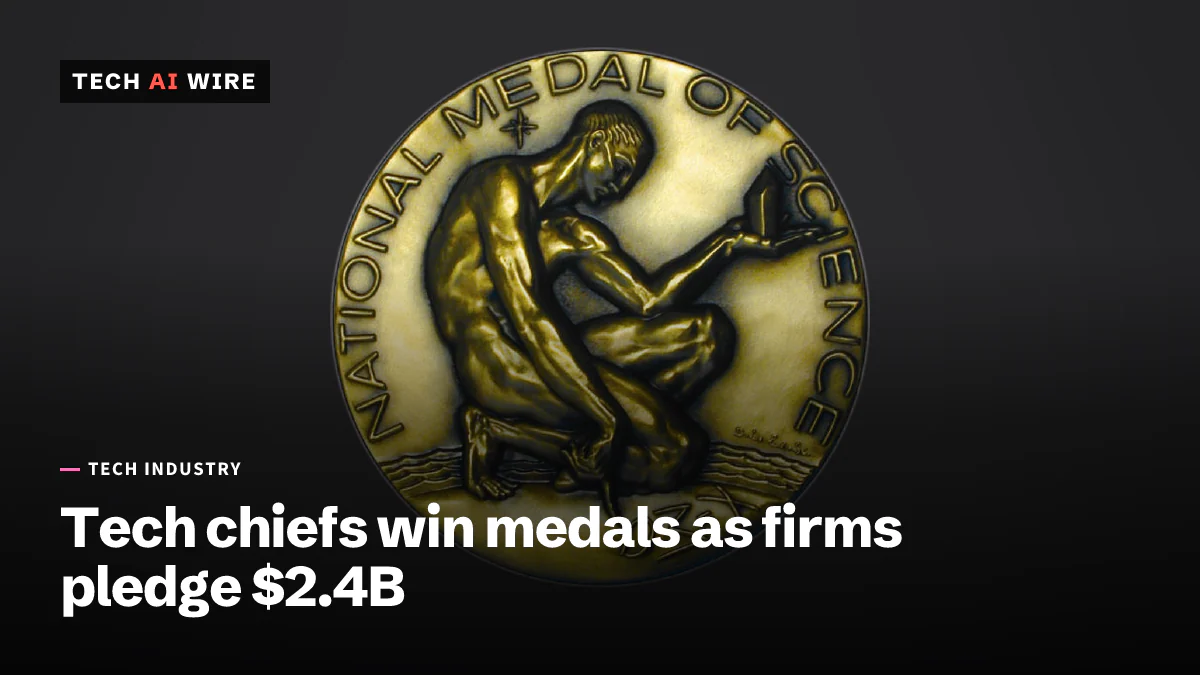
Eleven technology companies pledged $2.4 billion in computing credits to the Genesis Mission on October 8, 2026, at a White House science summit in Washington. Nvidia gave the most, $1 billion. At the same event, President Trump gave the country's top science and technology medals to six tech leaders, including Elon Musk, Jensen Huang and Lisa Su. Together, the pledges and medals tie the biggest AI and chip companies more closely to federal science policy.
Who pledged what
The credits pay for computing time, the processing power that AI models and science simulations run on. Nextgov/FCW and PYMNTS both list the same 11 pledges:
| Company | Pledge |
|---|---|
| Nvidia | $1 billion |
| AMD | $500 million |
| OpenAI | $200 million |
| Anthropic | $150 million |
| $150 million | |
| AMP | $100 million |
| Emerald AI | $100 million |
| Amazon Web Services | $50 million |
| Armada | $50 million |
| Crusoe | $50 million |
| Micron | $50 million |
Crusoe's share comes as credits on its own cloud, its CEO Chase Lochmiller said, according to PYMNTS. Anthropic is also offering Claude and technical support to more than 15 federal agencies. The White House billed the whole summit as a $6 billion push, Nextgov reports.
What the Genesis Mission is
The Genesis Mission is a federal program that directs the Energy Department to build one AI platform for science, PYMNTS explains. It combines federal research data, national laboratory supercomputers and private cloud capacity. The pledged credits go to the Genesis Mission Consortium, a group of more than 15 federal agencies working on national science and technology challenges.
Government money was announced too. The Energy Department added $159 million in new Genesis Mission project awards and $96 million for early-career researchers, Nextgov reports. The Pentagon set aside up to $350 million for quantum computing work.
"Today marks the most transformative day for the American scientific enterprise," said Michael Kratsios, who leads the White House science office. That line comes from the White House fact sheet, as quoted by PYMNTS. "Super intelligence is going to be the biggest unlock for scientists," he said at the event, NBC News reports.
The medal winners
The event, called "Science: A New Golden Age," took place at the U.S. Institute of Peace, according to NBC News. The White House named the six winners:
| Medal | Winners |
|---|---|
| National Medal of Science | Elon Musk, Sergey Brin, Jensen Huang, Lisa Su |
| National Medal of Technology and Innovation | Michael Dell, Satya Nadella |
"It's an incredible honor and something that could only happen here in America," Huang said, according to NBC News.
TechCrunch pointed to the money behind the honors. Citing The New Republic, it reported that the six winners together have given nearly $6 billion to efforts tied to Trump and his administration. Nadella's medal also came soon after the administration suspended Microsoft from a green card step for foreign workers. NBC News reports that Vice President JD Vance announced that suspension.
The summit follows other White House moves on AI this month. Six AI labs signed an accord accepting outside audits on October 1. Days later, the new Super Intelligence Force got 120 days to report back.
What this means for developers
- Federal researchers get cheaper compute. Teams at national labs and partner agencies should ask which clouds and chips the credits cover. Nvidia and AMD hold $1.5 billion of the $2.4 billion, so much of the work will run on their hardware.
- Vendors are buying a seat in government science. Free credits put a company's chips and cloud inside agency projects. Startups selling to federal agencies will often compete with these 11 firms' platforms.
- The details are still missing. The reports do not say who can apply for the credits or on what terms. Treat the totals as headline figures until agencies publish their rules.
- Policy can turn quickly. In the same week, Microsoft won a medal and lost access to a green card step for workers. Companies that rely on federal programs should plan for both.
Watch for the Energy Department's project calls. They will show who can actually apply for the credits.
Sources
- White House unveils billions in investments for Genesis Mission - Nextgov/FCW
- Tech Giants Contribute $2.4 Billion in AI Resources to White House Science Mission - PYMNTS
- Trump awards Musk and other tech titans National Medals of Science - NBC News
- President Trump awards Big Tech donors with nation's highest science prizes - TechCrunch
- President Trump Presents National Medals of Science and National Medals of Technology and Innovation - The White House
Related articles
Firmus pulls $5 billion IPO, turns to private investors
Nvidia-backed Firmus pulled its US$5 billion IPO on October 9, citing volatility. It had sought a US$30.6 billion value, triple its August round.
Federal judge rules a Flock plate search unconstitutional
A federal judge ruled a warrantless Flock license plate search broke the Fourth Amendment and threw out 91 pounds of seized meth. It is not binding precedent.

OpenAI fires three safety researchers over outside sharing
OpenAI fired three safety researchers for sharing sensitive data with an outside AI safety group. One was its contact for METR and Redwood Research.
The weekly digest
One email every Friday with the week's top stories from all six desks: AI, dev tools, coding, the tech industry, startups and what's next. Free, no spam.