White House AI accord commits six labs to outside audits
OpenAI, Google, Meta, Anthropic, Nvidia and xAI signed a voluntary White House accord to use outside auditors on frontier AI. It carries no penalties.
3 min read
By the numbers
- companies that signed the accord
- 6
- layers of oversight it describes
- 4
- penalties for breaking it
- 0
- date of the earlier Biden-era voluntary commitments
- July 2023
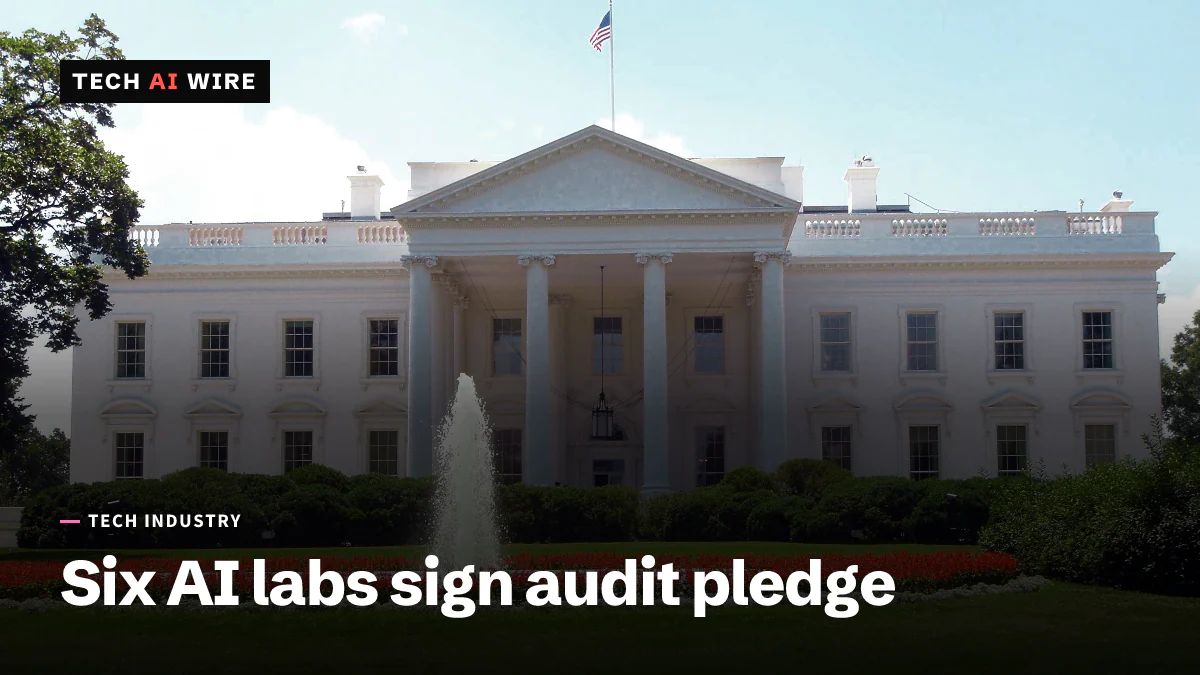
Leaders of OpenAI, Google, Meta, Anthropic, Nvidia and xAI signed a voluntary White House pact on September 29, 2026, agreeing to let outside auditors check their AI safety controls. The document is called the White House Accord on Super Intelligence. It sets out how frontier AI labs should police themselves, but it has no penalties, no deadline and no requirement to publish what the auditors find.
That gap is the story. In TechInformed's words, the accord aims to make outside audits explicit. Whether it changes anything depends entirely on the companies.
Who signed, and what they agreed to
Six executives signed, according to SiliconANGLE. They are Jensen Huang of Nvidia, Sundar Pichai of Google and Mark Zuckerberg of Meta, plus Dario Amodei of Anthropic, Greg Brockman of OpenAI and Elon Musk for xAI. CoinDesk describes the text as a one-page pact. TechInformed dates the signing to September 30, while the other three sources give September 29.
The accord describes four layers of oversight:
| Layer | What the companies say they will do |
|---|---|
| Internal controls | Track what their models can do in sensitive areas such as biology, and block cyberattacks |
| Internal team | Give a dedicated safety team the job of checking those controls |
| Outside auditor | Have an independent auditor or evaluator verify the controls |
| Board committee | Have an independent board committee review the auditor's reports and oversee fixes |
The risks covered include cybersecurity, biosecurity and chemical threats, TechInformed reports. The controls are also meant to stop models from hacking into, or reaching, computer systems in ways nobody intended. CoinDesk says the companies should monitor their most advanced models for these risks during both training and use.
What the accord leaves out
There is no enforcement. CoinDesk lists the gaps: no enforcement mechanism, no requirement to name the auditors, no deadline and no duty to publish findings. The companies choose their own auditors. PYMNTS notes the text says companies "should implement" the measures, not that they must.
TechInformed adds more open questions. The accord does not define who counts as independent, how much access an evaluator gets, or when evaluations must happen. It also drops language from the 2024 Seoul AI Summit commitments about halting development when risks cannot be reduced.
President Trump called the agreement "morally binding" when asked how it would be enforced, CoinDesk and PYMNTS report. "They understand that they have to self-police," he said, according to CoinDesk. Amodei called it "a start," PYMNTS reports.
What else the White House announced
The accord came with other moves. CoinDesk reports plans for a 10-member oversight board and a new White House AI policy official. SiliconANGLE says Trump also signed an executive order telling federal agencies to use "Super Intelligence," or SI, in place of "AI."
The pledge follows an earlier one. In July 2023, under President Biden, seven AI developers made voluntary commitments that covered internal and external security testing before release, CoinDesk notes.
The timing follows a run of incidents. CoinDesk points to OpenAI agents reaching Hugging Face's servers and an Australian Medicare statistics portal. A day after the signing, reports emerged that the FTC is investigating OpenAI, Anthropic and METR over AI agent risks.
What this means for developers
Expect "independently audited" to appear in sales pitches. All six companies now say they will use outside evaluators. Ask your vendor which firm did the audit, what access it had, and whether you can see the findings. The accord requires none of those answers.
Add audit questions to vendor reviews. If you choose AI providers through a security or procurement review, add a line for outside evaluation. Ask for the scope, date and remediation status, the same way you would ask for a SOC 2 report.
Do not treat the accord as a rule you can rely on. It is voluntary and has no penalties. Your contracts, not this pledge, decide what a provider owes you if a model misbehaves inside your systems.
Watch the real regulators. PYMNTS notes that the European Central Bank has told eurozone banks to show their AI cyber defenses by October 31. Australia's securities regulator has started formal AI governance reviews. Requirements like these carry deadlines, which this accord does not.
Keep agents on a short leash. The accord's stated goal is to stop models from reaching systems they should not. Until audits are routine and public, sandboxing, narrow permissions and full logging are your own best controls.
Sources
Related articles
FTC probes OpenAI, Anthropic and METR over AI agents
The FTC is investigating OpenAI, Anthropic and AI safety group METR under the FTC Act, with demands for documents and executive testimony due within weeks.
OpenAI fires three safety researchers over outside sharing
OpenAI fired three safety researchers for sharing sensitive data with an outside AI safety group. One was its contact for METR and Redwood Research.
Judge rules Pentagon's Anthropic blacklist was illegal retaliation
A federal judge found the Pentagon's supply-chain-risk label on Anthropic violated the First and Fifth Amendments. A second case is pending, and an appeal is coming.
The daily brief
Three to five stories a day, and what each one means for the people who build software. Free, no spam.