Trump's Super Intelligence Force gets 120 days to report
Jay Clayton will lead the Super Intelligence Force, which has 120 days to report on AI risks. It adds no new rules for AI companies.
3 min read
By the numbers
- days the task force has to deliver its report
- 120
- vice chairs under director Jay Clayton
- 3
- groups it will coordinate with, AI companies included
- 5
- new legal rules for AI companies
- 0
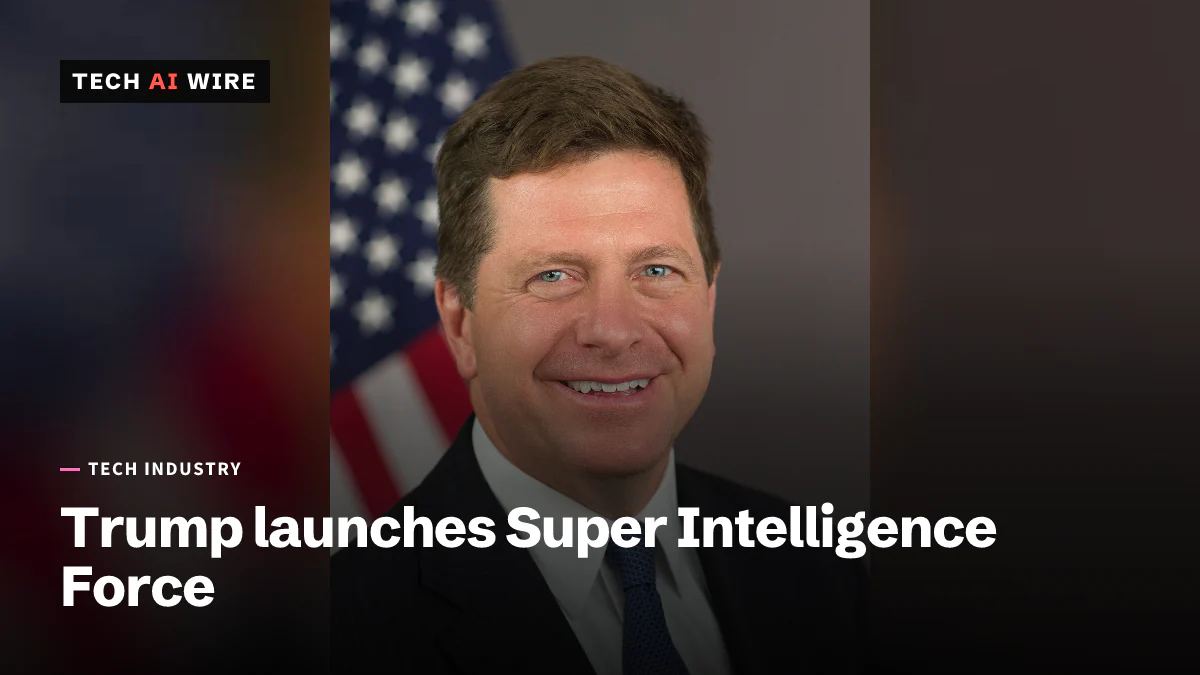
President Donald Trump announced a "Super Intelligence Force" on October 4, 2026, a task force to coordinate the federal government's work on artificial intelligence. Director of National Intelligence Jay Clayton will lead it, and it has 120 days to report on AI risks and opportunities, TechCrunch reports. It brings no new rules for AI companies, which still answer only to voluntary pledges.
Who runs the Super Intelligence Force
Jay Clayton chairs the group. He has three vice chairs, according to TechCrunch and Straight Arrow News (SAN). They are Federal Trade Commission Chairman Andrew Ferguson, Pentagon technology chief Emil Michael and Scott Kupor, who runs the Office of Personnel Management. The Federal Trade Commission (FTC) is the agency that polices deceptive and unfair business practices.
SAN lists more members. They include Vice President JD Vance, Defense Secretary Pete Hegseth, Treasury Secretary Scott Bessent and White House chief of staff Susie Wiles. The force reports to Trump and Wiles, Fortune reports.
| Role | Person | Day job |
|---|---|---|
| Director | Jay Clayton | Director of National Intelligence |
| Vice chair | Andrew Ferguson | FTC Chairman |
| Vice chair | Emil Michael | Pentagon chief technology officer |
| Vice chair | Scott Kupor | Office of Personnel Management Director |
What the task force has to deliver
The main deliverable is a report due within 120 days, or about four months. SAN says it must weigh AI risks and opportunities, weak points in AI systems, how breaches get reported and how the government should respond. TechCrunch adds that it must plan how to prevent what the announcement calls "SI-enabled threats." SI is short for super intelligence.
The force will also coordinate the government's dealings with five groups. Trump's announcement names consumers, public interest groups, religious organizations, critical infrastructure providers and "Super Intelligence Companies." Its stated goal is to "ensure that America continues to lead the World in Super Intelligence," Trump wrote. He described the technology as one "which many say is bigger than the Industrial Revolution, and the Internet."
Why it is called "super intelligence"
The name follows an executive order that renamed artificial intelligence "super intelligence" across the executive branch, SAN and Fox News report. TechCrunch says the task force fulfills a promise Trump made in September to create one.
In research circles, "superintelligence" usually means a future AI that is smarter than people at nearly everything. The order uses the phrase differently. It is now the federal government's word for AI in general.
How it connects to last week's AI accord
The force arrives days after six AI companies signed a voluntary pledge at the White House. That accord commits OpenAI, Google, Meta, Anthropic, Nvidia and xAI to outside audits, but carries no penalties. Fox News reports its formal name is the "White House Accord on Super Intelligence" and that it was described as "morally binding." ABC News calls it an AI "constitution" for self-regulation.
Neither step creates legal limits. ABC News notes that the announcement named no specific oversight tools or rules. SAN says AI companies still operate under voluntary, non-binding safety agreements.
Clayton frames the stakes as a race. TechCrunch quotes him saying "one of the biggest risks is not being first."
What this means for developers
For most teams building with AI, nothing changes tomorrow. The task force has no rules to enforce, and the accord binds only the six labs that signed it. Even for them, it is a promise rather than a law.
The membership is the part to watch. The FTC chair sits on the force, and the FTC already acts against misleading product claims. If you market AI features, keep your claims about accuracy, safety and data use backed by tests you can show.
Read the 120-day report when it lands. SAN says it will cover how breaches get reported. A recommendation there could become a duty to report AI security incidents. Teams should already know how they would detect, record and explain an incident involving their models or agents.
Check your vendors too. Ask your AI provider whether it signed the accord, what its outside audits cover and whether customers can see the results.
Expect the new wording in federal paperwork. The order applies across the executive branch, so grant calls and tenders may say "super intelligence" where they once said "artificial intelligence." Teams that sell to government should search for both terms.
Sources
- Trump unveils his new Super Intelligence Force - TechCrunch
- President Donald Trump announces creation of 'Super Intelligence Force' AI task force - ABC News
- Trump names national intelligence director Jay Clayton to lead new 'Super Intelligence Force' on AI - Fortune
- Trump announces a new 'Super Intelligence Force' after signing order renaming AI - Straight Arrow News
- Trump announces 'Super Intelligence Force' to coordinate federal AI efforts - Fox News
Related articles
Judge rules Pentagon's Anthropic blacklist was illegal retaliation
A federal judge found the Pentagon's supply-chain-risk label on Anthropic violated the First and Fifth Amendments. A second case is pending, and an appeal is coming.

OpenAI fires three safety researchers over outside sharing
OpenAI fired three safety researchers for sharing sensitive data with an outside AI safety group. One was its contact for METR and Redwood Research.
White House AI accord commits six labs to outside audits
OpenAI, Google, Meta, Anthropic, Nvidia and xAI signed a voluntary White House accord to use outside auditors on frontier AI. It carries no penalties.
The weekly digest
One email every Friday with the week's top stories from all six desks: AI, dev tools, coding, the tech industry, startups and what's next. Free, no spam.