Mueon raises $65M to stack data center chips in 3D
Mueon, founded by former Intel engineers, raised a $65 million Series A led by Maverick Silicon to build Cubelets, stacked 3D compute and memory modules.
3 min read
By the numbers
- Series A, led by Maverick Silicon
- $65M
- total raised to date
- $80M+
- claimed power and cost efficiency gain, not yet shown
- 10x
Mueon, a data center hardware startup founded by former Intel engineers, has raised $65 million in a Series A round led by Maverick Silicon. The company announced the round on October 15, 2026. Mueon builds "Cubelets," modules that stack processors and memory in three dimensions instead of spreading them across a server board. If the design works, it could pack far more AI computing into the same rack space and power budget.
Mueon raised a $15.5 million seed round in 2025, when it came out of stealth, and has now raised more than $80 million in total, its announcement says.
Who invested
Maverick Silicon, a fund that invests in chip companies, led the round. The company's announcement lists the full group:
| Role | Investors |
|---|---|
| Lead | Maverick Silicon |
| Participants | Intel Capital, Geodesic Alliances Fund, Oregon Venture Fund, M-Ventures, Wellington Capital, IQT, Defined |
| New board members | Manish Muthal of Maverick Silicon and Srini Ananth of Intel Capital |
"This financing gives us the scale to bring the next generation of compute and memory system-scale integration to market," said Wilfred Gomes, Mueon's co-founder and CEO.
What a Cubelet is
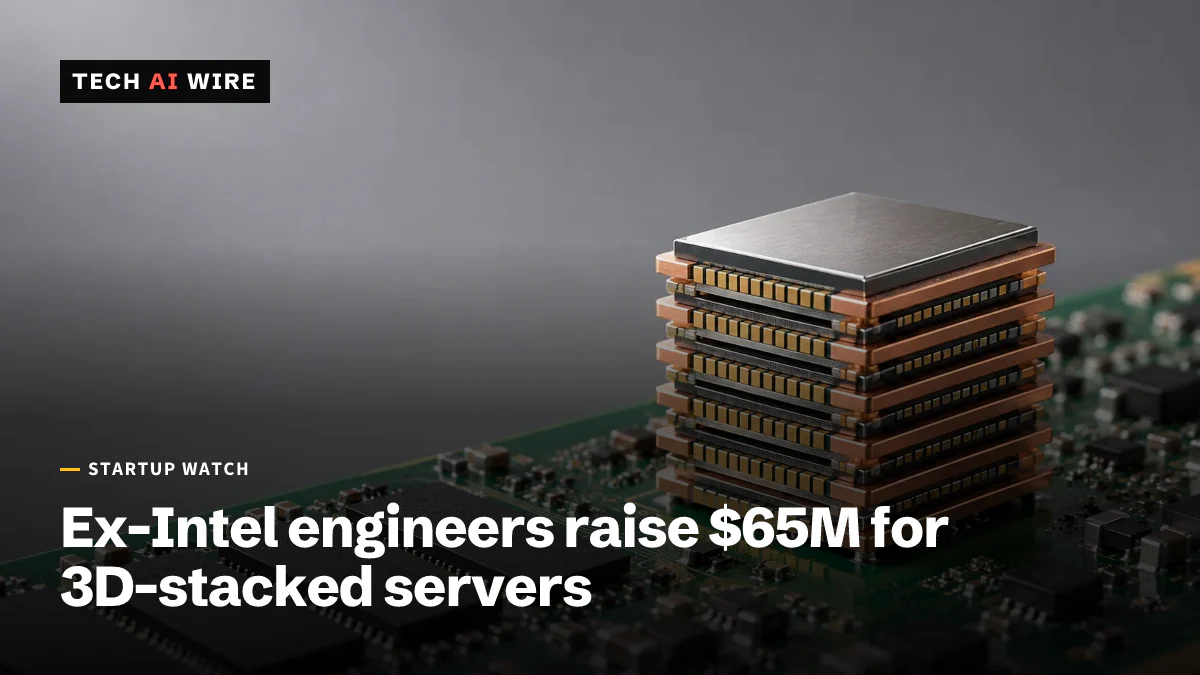
A normal server spreads its parts out. Processors, memory, power circuits and cooling sit side by side on a flat board, and data travels between them over wires. Mueon instead stacks those parts into a small cube. Each Cubelet combines compute, memory, the links between them, power delivery and cooling. Cubelets then stack together to build larger systems.
Oregon Venture Fund, one of the investors, says the cubes can use GPU, x86 or Arm processors. "Think of them as Legos for the data center," it wrote in a post explaining its investment.
The work runs on four tracks, according to Mueon:
- chip and system architecture
- advanced integration, meaning packaging, power and cooling
- software that lets Cubelets run familiar AI frameworks
- validation with partners in the wider ecosystem
Who is behind it
Gomes founded the company with Jack Hwang, its chief technology officer, SiliconANGLE reports. Both are former Intel engineers. Oregon Venture Fund describes the team as "former Intel fellows and industry experts." It says the team includes the co-inventor of Foveros, Intel's 3D chip-stacking technology, without naming that person.
"Mueon's architecture is built to move past today's rack-level constraints," Gomes said, as quoted by SiliconANGLE.
The claims, and what is unproven
Mueon says Cubelets could deliver "up to 10X gains in power and cost efficiency within the same rack footprint." It says the design can scale toward megawatt-class density, a megawatt being a million watts of power. Oregon Venture Fund adds that a Cubelet system could halve the latency and cost of a comparable server.
These are targets, not results. The announcement says the money will move Cubelets from platform development toward system validation and production readiness. In other words, the hardware is not yet ready to ship. The funds will also pay for more engineers and staff, and deeper work with customers.
The pitch rests on power. Oregon Venture Fund notes that data centers are expected to use twice as much electricity by 2030 as they do today. That is roughly the power Japan consumes, it says.
What this means for developers
- Do not plan around it yet. Mueon is moving toward validation, not shipping. Teams buying AI hardware for the next year should treat Cubelets as something to watch, not to order.
- Watch the software layer. A new hardware design succeeds only if common AI frameworks run on it without rewrites. Mueon lists that as one of its four tracks. Ask about framework support first if you evaluate it.
- Ask for measured numbers. The 10x figure is a design goal. When Mueon publishes tests, compare power per useful result, such as tokens per watt, against the GPUs you run now.
- Track the power problem it targets. Rack power and cooling already limit many AI deployments. Any design that fits more compute in the same footprint is aimed at that limit, whoever builds it.
- Note the backers. Intel Capital now has a board seat, and the team includes a Foveros co-inventor. Watch whether Mueon announces a manufacturing partner, since the announcement names none.
Sources
- Mueon nabs $65M in funding to develop 3D computing modules - SiliconANGLE
- Mueon Raises $65M in Series A Funding to Scale its Cubelets Exponential Computing Platform - Mueon via PR Newswire
- Why we invested in Mueon - Oregon Venture Fund
Related articles
Tenstorrent raises $1.5B at $6.2B to scale Galaxy servers
Jim Keller's AI chip firm raised $1.5 billion at a $6.2 billion valuation, more than double 2024, to build Galaxy servers and license chip designs.
Salience Labs raises $125M for all-optical AI data center switches
Salience Labs raised a $125 million Series B led by Bullhound Capital, with Intel Capital and AMD Ventures, to scale optical switches that link GPUs.

Atomic Machines emerges with $250M to build micro-machines
Atomic Machines left stealth on October 7 with $250 million raised and PrimeSwitch, a relay for 800-volt AI data centers that opens in 50 microseconds.
The weekly digest
One email every Friday with the week's top stories from all six desks: AI, dev tools, coding, the tech industry, startups and what's next. Free, no spam.