ChatGPT copies real New Yorker cartoonists' signatures
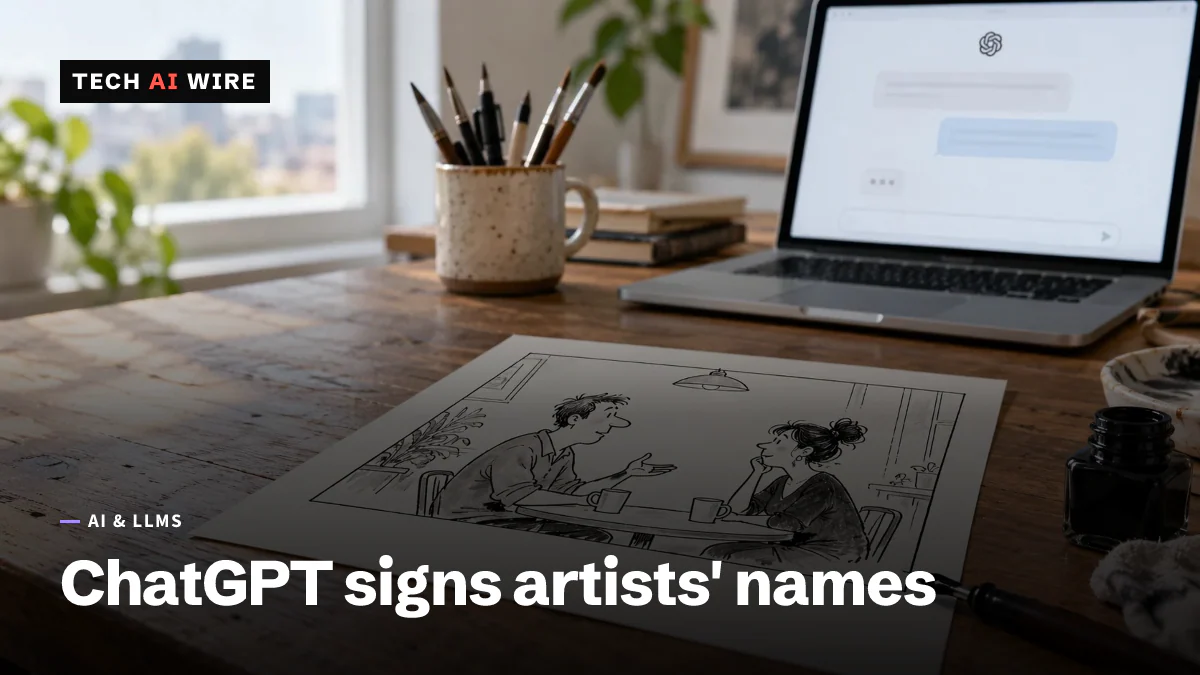
ChatGPT has signed AI-made New Yorker-style cartoons with the names of more than 15 real cartoonists, though OpenAI's Condé Nast deal excluded cartoons.
3 min read
By the numbers
- New Yorker cartoonists whose signatures appeared
- 15+
- year of OpenAI's Condé Nast deal, which excluded cartoons
- 2024
- fake cartoons Brendan Loper knows carry his name
- 2
ChatGPT has been signing AI-generated cartoons in the style of The New Yorker with the real signatures of the magazine's cartoonists. Signatures of more than 15 cartoonists have turned up on these images, The Daily Cartoonist reported on October 5, 2026, following tests by Nieman Lab reporter Andrew Deck. The images are not just imitations of a style. They carry a working artist's name, which tells readers a real person drew them.
Whose names appeared
The Daily Cartoonist names the artists whose signatures were reproduced. The list covers Brendan Loper, Harry Bliss, Emily Flake, Joe Dator, Pat Byrnes and Peter Vey. It also includes Jason Adam Katzenstein, George Booth, Liza Donnelly, Ellis Rosen and Saul Steinberg.
Loper explained the problem on his own newsletter. His signature reads "BLOPER," and ChatGPT reproduced it on at least two cartoons he knows of. One was a viral cartoon featuring Tim Curry and Dolly Parton. "My name has been taken by some faceless trillion dollar entity," he wrote.
For a cartoonist, the signature does a specific job. "The signature for me is the certificate of authenticity," Loper told The Daily Cartoonist. "If I put my name on it, it's official, it's mine."
What the licensing deal said
OpenAI has a licensing agreement with Condé Nast, the publisher of The New Yorker. The A.V. Club reports that the 2024 deal explicitly excluded training on cartoons. A licensing deal of this kind lets an AI company use a publisher's material in exchange for payment.
That exclusion makes the signatures hard to explain. An image model learns patterns from the pictures it is trained on. A model that reproduces a specific artist's signature has likely seen that signature many times. None of the reports says where ChatGPT saw these cartoons.
How OpenAI responded
OpenAI's main response so far is a warning message. The A.V. Club reports that ChatGPT showed this text: "This prompt may violate our guardrails concerning similarity to third-party content." A guardrail is a rule that blocks or flags certain requests. According to The A.V. Club, OpenAI showed the message but took no further action.
The cartoonists are also unimpressed by the work itself. Katzenstein called the output "an uncanny simulacrum of an impression of a joke," as quoted by The A.V. Club. He added that "it's not the point for it to actually be funny or good."
The case lands in a busy week for AI labeling. OpenAI made its textGrain watermark for ChatGPT text opt-in for API users on October 5. A watermark marks content as machine-made. A forged signature does the opposite: it marks machine-made content as human.
What this means for developers
If your product generates images through an API, a fake signature is your problem too. A user can post the picture with a real artist's name on it, and your service made it. Add a check to the output path. Text recognition on generated images can flag a signature-like mark in a corner before the file reaches the user.
Filter prompts as well as outputs. Requests that name a publication or a living artist's style are the ones most likely to pull in a real signature. Decide your policy for them now, and log the prompts that trigger it so you can review patterns.
Teams that rely on content deals should read the exclusions, not just the headline. The Condé Nast deal reportedly excluded cartoons, yet cartoon signatures still came out of the model. Ask any model vendor how it enforces exclusions in training data, and get the answer in writing.
Finally, label what your product makes. A clear machine-made label on generated images costs little. It protects the artists whose names a model might copy, and it protects you when one does.
Sources
- AI Now Scraping Signatures As Well As Cartoonists' Styles - The Daily Cartoonist
- AI has come for comics on stage and in The New Yorker - The A.V. Club
- What's In A Name Anyway? ChatGPT and Me. - Brendan Loper
Related articles
Amazon Bedrock Managed Agents for OpenAI enters preview
AWS opened a public preview of Bedrock Managed Agents on September 29, 2026: OpenAI-model agents that run inside your AWS account, in three US regions.
OpenAI Decisions API opens to all developers in beta
OpenAI's Decisions API is now in public beta. It returns a probability, a pick or a score instead of text, runs on GPT-6 Luna and costs $0.10 per 1M input tokens.

ChatGPT brings GPT-6 and Intelligent UI to free users
OpenAI rolled GPT-6 out to ChatGPT, with paid plans on October 7 and Free and Go on October 8. Free users get GPT-6 Luna and interactive answers called Intelligent UI.
The weekly digest
One email every Friday with the week's top stories from all six desks: AI, dev tools, coding, the tech industry, startups and what's next. Free, no spam.