Open-source firmware boots on a consumer AMD desktop board
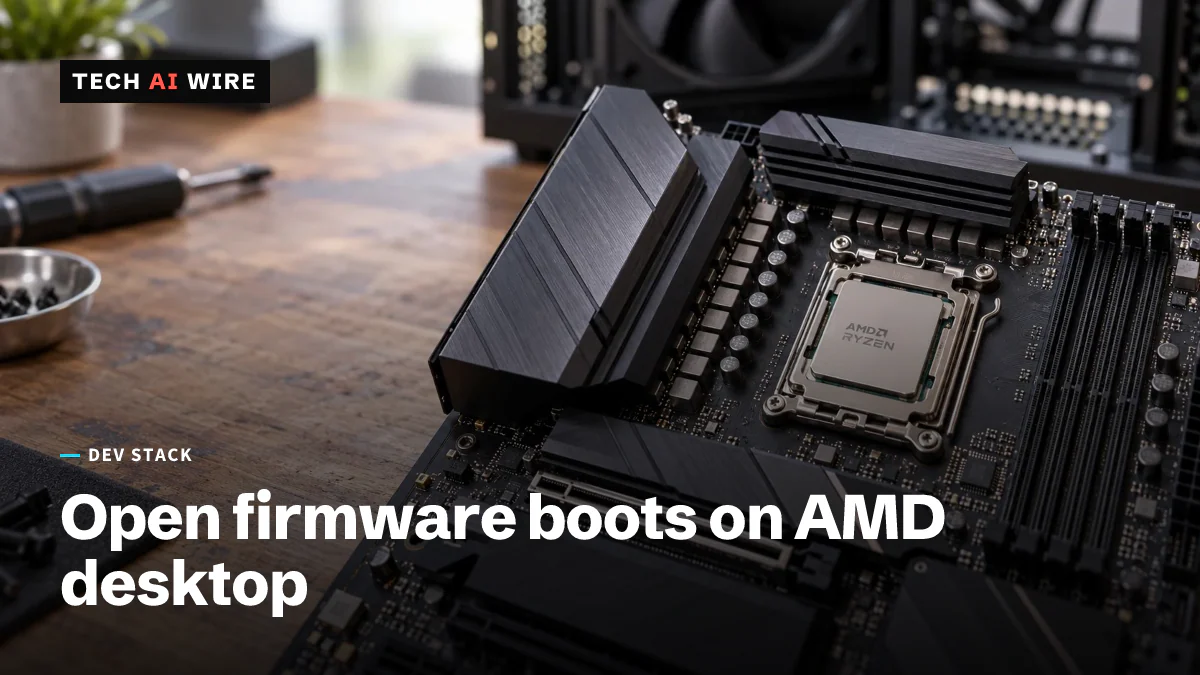
Coreboot and AMD's openSIL now run on the MSI B850P, a real desktop AM5 board. It cuts closed-source firmware code by 79.1%, but it ships as a paid product, not a free download.
3 min read
By the numbers
- less closed-source firmware code
- 79.1%
- cold-boot memory training time
- 30-60s
A firmware consulting firm has gotten an open-source boot stack running on an ordinary desktop motherboard you can actually buy. 3mdeb shipped version 0.9.0 of its Coreboot and AMD openSIL port for the MSI PRO B850P on July 30, 2026, and Phoronix has now published hands-on testing of it. The board is the first consumer AM5 desktop system running this stack; 3mdeb had already done the same for an EPYC server board earlier in the year.
Every PC motherboard runs firmware before the operating system takes over. On this AMD board, that job normally belongs to AGESA, AMD's closed-source initialization code, wrapped in UEFI firmware written by the board maker. Neither is code you or anyone outside AMD and MSI can inspect.
What replaces the closed code
openSIL is AMD's own open-source library for silicon initialization, the low-level work of getting a chip's memory and I/O ready to run. Coreboot is the open-source firmware project that replaces the rest of UEFI's job. Together they replace AGESA and MSI's stock UEFI firmware.
3mdeb states the result: a 79.1% reduction in closed-source firmware code compared to the vendor's stock firmware. That does not mean the board runs zero proprietary code. AMD's fTPM 2.0 security module still runs on the chip itself, and 3mdeb notes that tuning options still depend on APCB and the Platform Security Processor, both still partly closed.
What works today
The port supports only Ryzen 8000-series "Phoenix" chips for now. Phoronix tested it with a Ryzen 7 8700G, 8 cores and 16 threads, and confirmed the system boots both Ubuntu 26.04 LTS and Windows 11 25H2. Cold-boot memory training, the process of calibrating DDR5 timings at startup, takes 30 to 60 seconds.
The board supports UEFI Secure Boot, ROM Armor 3 write protection, and TCG OPAL disk encryption. Getting graphics working took real engineering. An earlier 3mdeb post from June 3, 2026 describes roughly 6,400 new lines of openSIL code and 2,000 lines of Coreboot code just to bring up the I/O expansion chipset. Graphics initialization needed another 2,000 lines on top of that.
Known rough edges
Phoronix's testing turned up four issues that anyone trying this should expect.
| Issue | Effect |
|---|---|
| UEFI capsule updates | Don't survive a reset |
| S5 power state | Restoration doesn't work |
| Serial console | Occasionally hangs |
| WiFi card | Intermittently disappears from the PCI device list |
Ryzen 9000-series chips are not supported yet. Linux's own amdgpu graphics driver still hits a hard fault on this setup. 3mdeb's own account of the graphics work says a nomodeset workaround is needed to boot with a display.
The part that's easy to misread
This is not a free download. 3mdeb sells the finished firmware as the "Dasharo Pro Package" through its own store. The underlying openSIL and Coreboot code is open source, but assembling, testing and supporting it for this specific board is 3mdeb's commercial product.
What this means for developers
If you want an auditable, open firmware stack on real desktop hardware, this is the closest a mainstream AM5 board has come. It is also a paid product you can buy today, not a project you have to build yourself. Check the known-issues list against your own use case first. A WiFi card that intermittently vanishes is disqualifying for some setups and irrelevant for others.
Firmware transparency and CPU-level security have both been active fronts on AMD hardware this year. This site covered Zen 6 removing the need for one of Linux's speculative-execution mitigations just two days ago. An open firmware stack does not replace that kind of chip-level protection, but it does let you verify what runs before the operating system loads at all.
If you are building or auditing firmware yourself, the numbers here are a useful gauge. 6,400 lines of new code for one chipset's I/O bring-up alone shows what porting Coreboot to a new consumer board actually costs in effort. Open-firmware work sometimes gets portrayed as a toy-project scale. This is not that.
Sources
Related articles

Nouveau boots on Nvidia's DGX Spark GB10, unofficially
A Red Hat engineer got the open-source Nouveau driver and NVK running on Nvidia's DGX Spark GB10. It took about 100 patches, and upstreaming isn't settled yet.
Asahi Linux now officially supports M3 series Macs
Asahi Linux has merged M3, M3 Pro and M3 Max support into its installer. Wi-Fi, USB 3 and AV1 decoding work. Sleep, HDMI and fast 3D do not.
Kubernetes 1.37 promotes rootless mode to beta
Kubernetes 1.37 moves KubeletInUserNamespace to beta. The kubelet, container runtimes, CNI plugins and kube-proxy can now all run as a non-root user.
The daily brief
Three to five stories a day, and what each one means for the people who build software. Free, no spam.