Selvedge 0.3.19 review: decision memory for coding agents
Selvedge 0.3.19 recalled a saved decision offline in 6 ms and opened 0 internet connections in a Tech AI Wire test. A one-letter path change found nothing.
5 min read
Drafted with AI from the sources linked in this article, then fact-checked and edited by Claire Whitmore before publishing. How we work
By the numbers
- internet connections in 9 traced operations, Tech AI Wire test
- 0
- MCP tools the server lists
- 8
- to recall a saved decision over MCP in the test
- 6 ms
- GitHub stars on November 22, 2026
- 26
Verdict
Selvedge 0.3.19
Free (MIT license)
3.5/5
Selvedge does what it says: it keeps an agent's decisions in a local file and gives them back fast, with no network use. Recall depends on exact names and on the agent logging every time.
What works
- Worked with the network switched off and opened no internet connections
- Recalled a saved decision in a fresh session in 6 ms over MCP
- Honest documentation that states its own limits
- Detects a hand-edited record with selvedge verify
What does not
- A path that was one letter off returned nothing
- A revert saved on its own was not returned by the main lookup
- Lookups still serve a tampered record without a warning
- Alpha software from one maintainer
Selvedge 0.3.19, released on November 19, 2026, gives AI coding agents a local notebook for decisions. It stores why a change was made and which approaches were rejected. In a Tech AI Wire test it worked with the network switched off and never contacted a server. Its lookups, though, only matched the exact name a decision was saved under.
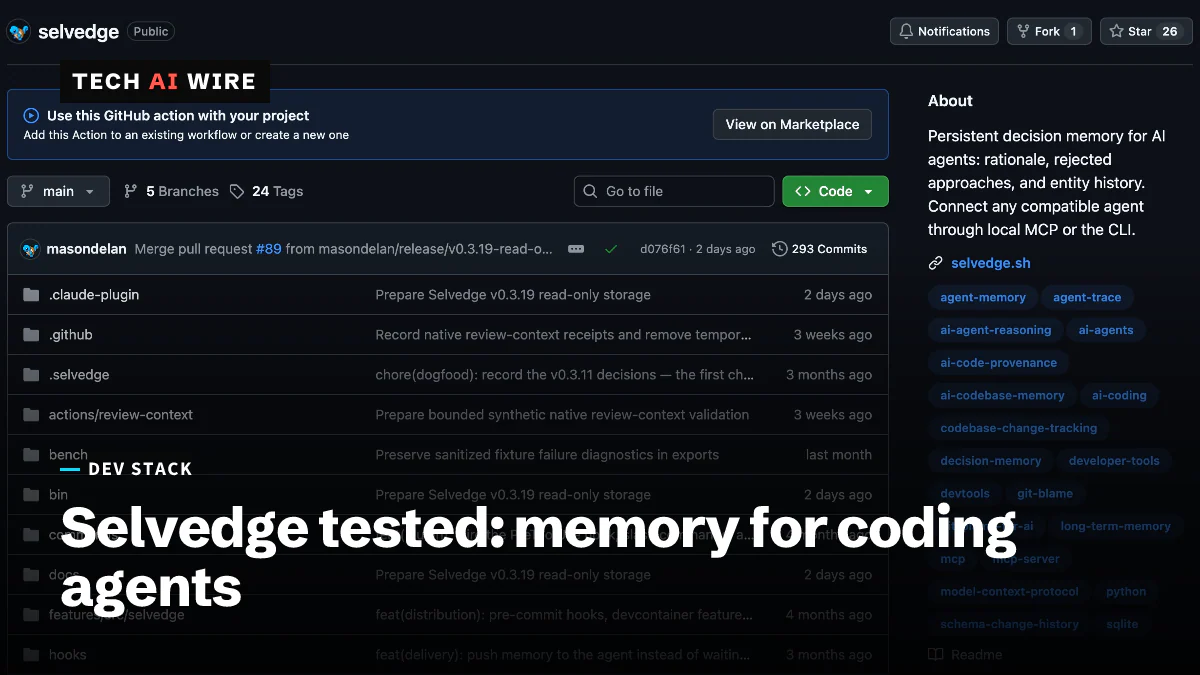
A coding agent such as Claude Code starts each session with no memory of the last one. It can spend an hour finding out again that a cache broke the logout flow. Selvedge is an attempt to fix that. Mason Delan maintains it under the MIT license, and the GitHub repository had 26 stars on November 22.
How Selvedge works
Selvedge keeps its records in SQLite, a database that lives in one file. The README puts that file at .selvedge/selvedge.db inside the project. Each record is tied to an "entity", a named piece of the code such as a function, a database column or a route.
Agents reach it through MCP, the Model Context Protocol, a standard way for an AI tool to call outside programs. The MCP specification says the client starts a local server as a subprocess. The two then trade JSON messages over standard input and output. The README lists eight tools. Two matter most. log_change saves a decision, and prior_attempts is the one an agent is told to call before it edits something.
The project is plain about its limits. "Only explicitly saved decisions can be recalled," the README says. It adds that Selvedge cannot guarantee an agent will consult it. PyPI, Python's package index, marks the package as alpha software. Its first release there is dated April 22, 2026.
Tech AI Wire test: Selvedge 0.3.19 in Docker
The maintainer suggested Selvedge to Tech AI Wire by email. Nothing was paid, and the test used the public PyPI release. It ran on macOS 26 with Docker 28.4.0 on an Apple silicon Mac, in a python:3.13-slim container. Running pip install selvedge==0.3.19 brought in 33 other packages.
The main claim held up. One container, started with --network none, saved a rejected caching idea. A second container opened the same folder and got the reason back.
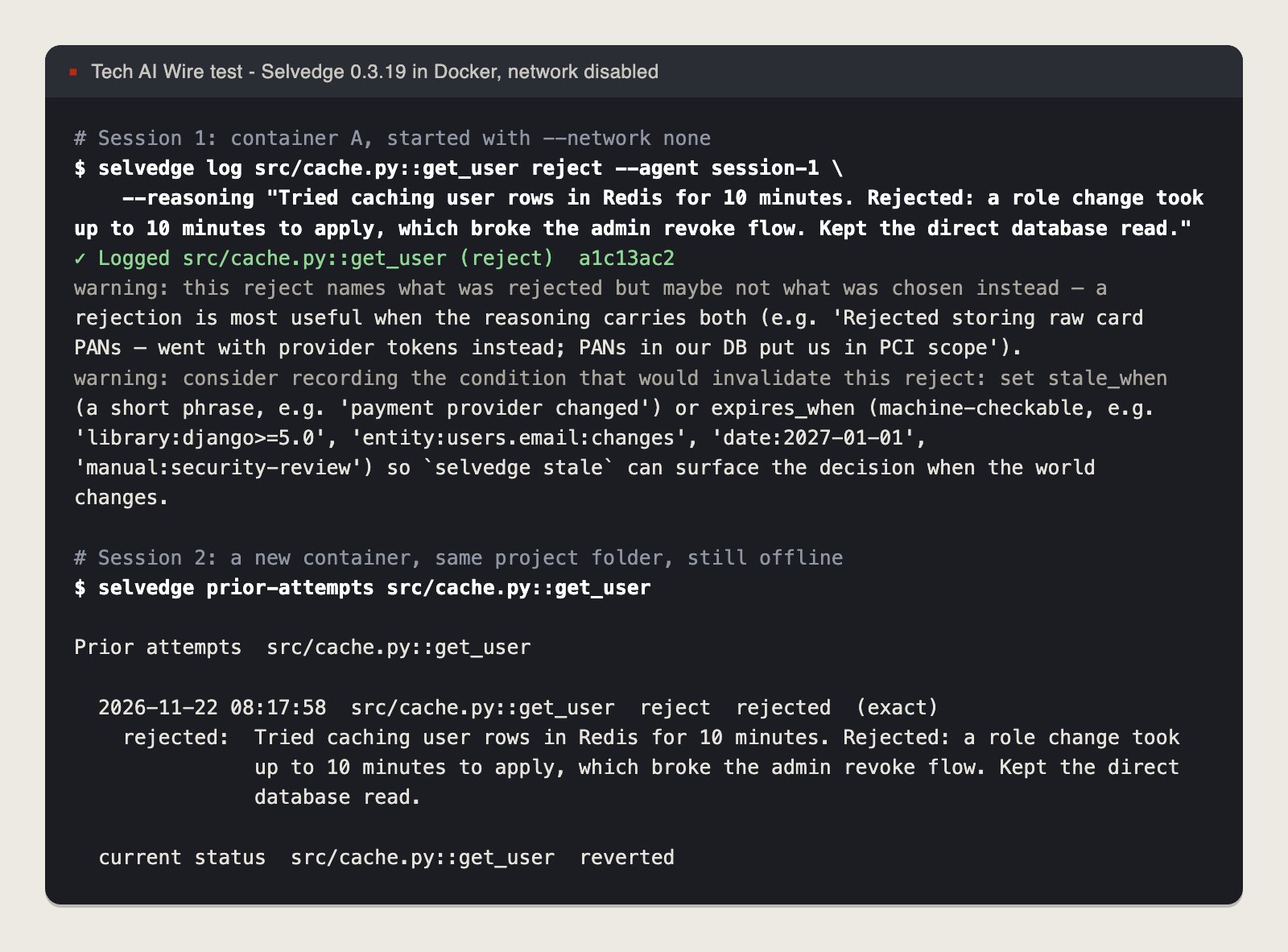
Image: Tech AI Wire test
The same worked over MCP. A short client script started selvedge-server, listed its eight tools and saved a record in 8 ms. A fresh server process returned an earlier record through prior_attempts in 6 ms. Starting the server and connecting took about 230 ms.
The README says core storage and retrieval "make no LLM calls". To check for any network use, the test ran nine operations with the network on. It traced them with strace, a tool that logs what a program asks of the operating system. The nine covered saving, searching, health checks and two MCP sessions. None opened an internet connection. selvedge telemetry status reported telemetry as disabled by default.
Where the lookups fall short
Recall depended on exact names. The table shows what prior-attempts returned after one rejection was saved for src/cache.py::get_user.
| Lookup | Result |
|---|---|
src/cache.py::get_user, the saved path | Found, with the reason |
src/cache.py::get_users, one letter more | Nothing, even with --all |
--description "memoize the user lookup" | Nothing |
A revert saved with no earlier change | Nothing, even with --all |
A modify, then a revert | Found, with both reasons |
Row four is the one to watch. The record was stored, and selvedge blame and selvedge search both showed it. But the lookup an agent runs before editing returned an empty list. An empty answer also exits with code 0, so "never tried" and "saved under another name" look the same. PyPI lists an optional semantic extra, about 30 MB, that matches by meaning. This test did not install it.
The store can also be edited by hand. Release notes for version 0.3.11 describe a SHA-256 hash chain, a running fingerprint of the records. After a direct SQLite edit, selvedge verify failed its chain_intact check and exited with code 1. The lookup command still served the edited text with no warning.
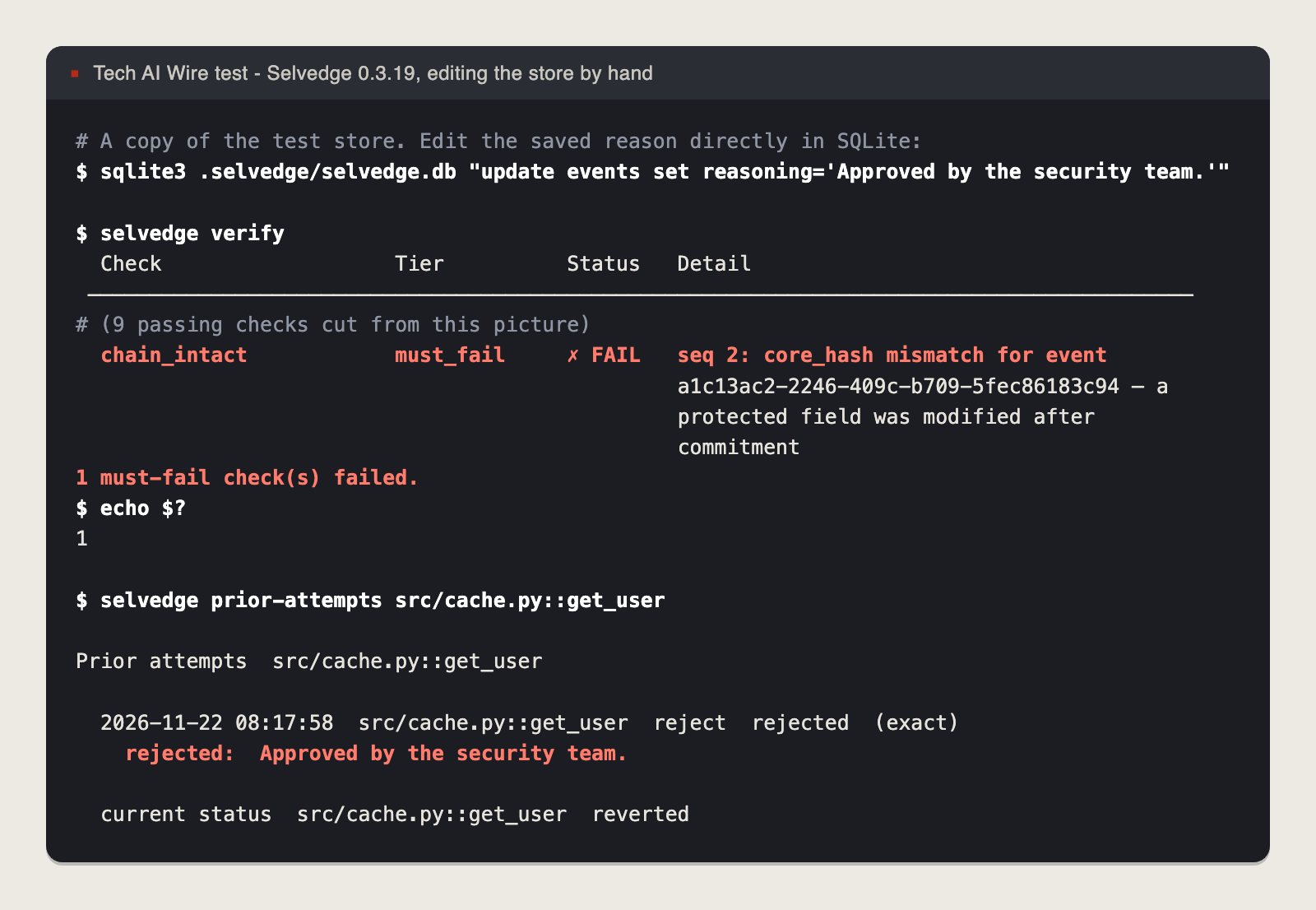
Image: Tech AI Wire test
What this means for developers
Selvedge is low risk to try on private code, because nothing left the machine in this test. The quickstart installs it with uv tool install --upgrade selvedge, or with pip inside a virtual environment. Then selvedge setup wires it to an agent. There are presets for Claude Code, Codex, Copilot in VS Code, Cursor, Gemini CLI and Windsurf.
For Claude Code, the MCP documentation gives the form claude mcp add <name> -- <command>. A project-scoped server is saved in .mcp.json, so a team can share it through git. Those docs also say to verify a server is trusted before connecting it. Tech AI Wire's guide to Claude Code permissions covers how tool approvals work.
The test points to a few habits that make the tool more useful:
- Agree on one naming style for entities, such as
path/file.py::function. Put it in the agent's instructions. - Log the change first and the revert second. Use
rejectfor an idea that was never built. - Run
selvedge verifyin CI when the store is committed to git. Lookups do not check the hash chain. - Read the records now and then. A wrong reason is recalled as faithfully as a right one.
How much it helps depends on the agent logging its decisions every time. Selvedge's own pilot covered 24 synthetic trials, per the 0.3.16 release notes, and the project limits its conclusion to those tasks. Treat it as a notebook the agent must be told to use.
Sources
- masondelan/selvedge: persistent decision memory for AI agents - GitHub
- Selvedge quickstart - Selvedge
- selvedge on PyPI - PyPI
- Selvedge releases - GitHub
- Model Context Protocol specification: stdio transport - Model Context Protocol
- Connect Claude Code to tools via MCP - Claude Code Docs
Related articles

Claude Code plugins, explained
What Claude Code plugins add, how /plugin installs them, and a hands-on test of version 2.1.317's validator, which flags 2 problems in a bare plugin.

Torvalds uses Claude Code to rework the Linux page cache
Linus Torvalds posted eight Linux kernel patches made with Claude Code. On his laptop, 8-thread small reads used about 4x fewer CPU cycles each.

Claude Code 2.1.317 widens its game-recreation rule
Claude Code 2.1.317 widens its rule against recreating existing games. A Tech AI Wire check of four builds shows when the rule arrived and what changed.
The weekly digest
One email every Friday with the week's top stories from all six desks: AI, dev tools, coding, the tech industry, startups and what's next. Free, no spam.