Salesforce Koa builds on open weights but ships closed
Salesforce says Koa makes 3x fewer errors on its own CRM Bench, but the weights are proprietary and the model runs only on Salesforce infrastructure.
3 min read
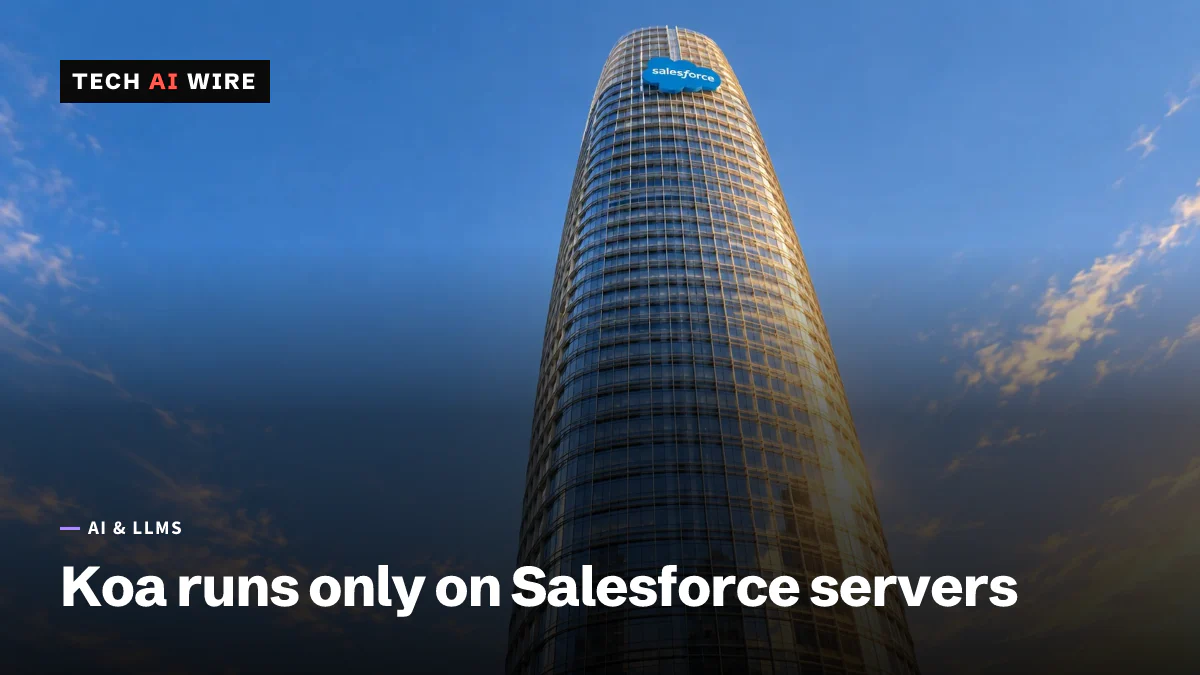
Salesforce announced Koa on September 15, 2026, its first reasoning model built in house, and it is built on Nvidia's open-weight Nemotron. Salesforce's own page then adds the detail that decides whether any of this is usable to you: the weights are proprietary, and the model runs only inside Salesforce infrastructure.
So an open-weight base produced a closed product. That is the pattern worth watching, more than the model itself.
What Salesforce says it does
Koa is aimed at enterprise work in sales, marketing and customer support, with token efficiency as a stated goal. TechCrunch reports it was post-trained on synthetic data simulating customer service and sales scenarios, rather than on real customer data.
One benchmark figure is published. Salesforce says Koa makes 3 times fewer errors on CRM Bench than leading models on real-world CRM tasks.
Read that carefully. CRM Bench is Salesforce's own benchmark, and the comparison models are not named on the page. A vendor scoring its own model on its own benchmark against unnamed rivals is a claim, not a measurement you can reproduce.
Salesforce also frames the shift in its own words. Reasoning "has always been something that we've relied on the frontier model providers for. Until now," the company says.
How you would actually get it
The delivery model is the part most coverage skipped.
| Question | What Salesforce says |
|---|---|
| Weights | Proprietary, no download |
| Where it runs | Salesforce infrastructure only |
| How it is deployed | Through Data Cloud as a managed LLM, selected in Agentforce Setup |
| Available now | Select pilot customers |
| General availability | Targeted for Winter 2026, U.S. regions |
| Open beta | Planned after general availability |
An Nvidia vice president described the design goals as "sovereign AI, time to first token, efficient reasoning, for the tokenomics of it all." The engineering interest is in that last part. Nemotron was built for efficient inference, which is what makes a smaller task-specific model cheaper to run than a frontier model.
Salesforce announced a second thing the same day: ClaudeForce, a partnership putting Anthropic's Claude inside Salesforce's infrastructure. Building its own model and reselling someone else's on the same morning is not a contradiction. It is a hedge.
What this means for developers
Check the deployment terms before the benchmark. A model you cannot download, running only on one vendor's infrastructure, is a managed service with a model inside it. Evaluate it the way you evaluate a service: latency, regional availability, price per unit of work, and what happens when you want to leave.
Do not plan around Koa this quarter unless you are already a pilot customer. General availability is targeted for Winter 2026 and limited to U.S. regions at that point, with an open beta only after. If your product needs this in Europe, there is no date.
Treat the 3x error claim as a hypothesis to test on your own data. Vendor benchmarks are useful for knowing what a model was tuned for, which here is clearly CRM work. They are not useful for predicting your results, and the site has made this point before about open-weight releases whose licenses turn out narrower than the word suggests.
The strategic read is the one to carry away. Nvidia gives away a capable base model, and a company with a distribution channel post-trains it for one domain and sells access. Expect more of this: the open weights are the input, not the product. If your plan depends on running a model yourself, check that the thing you are excited about is actually the part being opened.
Sources
- Salesforce and Nvidia's new reasoning model is everything the AI labs should fear - TechCrunch
- Salesforce Koa - Salesforce
Related articles
Mistral raises €3B at €21B, led by Samsung
Mistral raised €3 billion at a €21 billion valuation, nearly double its last round. It plans 1 GW of European compute by 2030 and will host rivals' open weights.
Qwen3.5-9B spends 32KB per token on KV cache
Qwen3.5-9B runs full attention on only 8 of its 32 layers, so its KV cache costs 32KB per token. That ratio decides whether it fits in 8GB.
Microsoft's AI code of conduct is a draft, not a rule yet
Microsoft published absolute constraints for its MAI models on September 14, 2026, then said its current models are not yet trained on the document.
The daily brief
Three to five stories a day, and what each one means for the people who build software. Free, no spam.