OpenSSL 4.1 ships DTLS 1.3 after a two-week delay
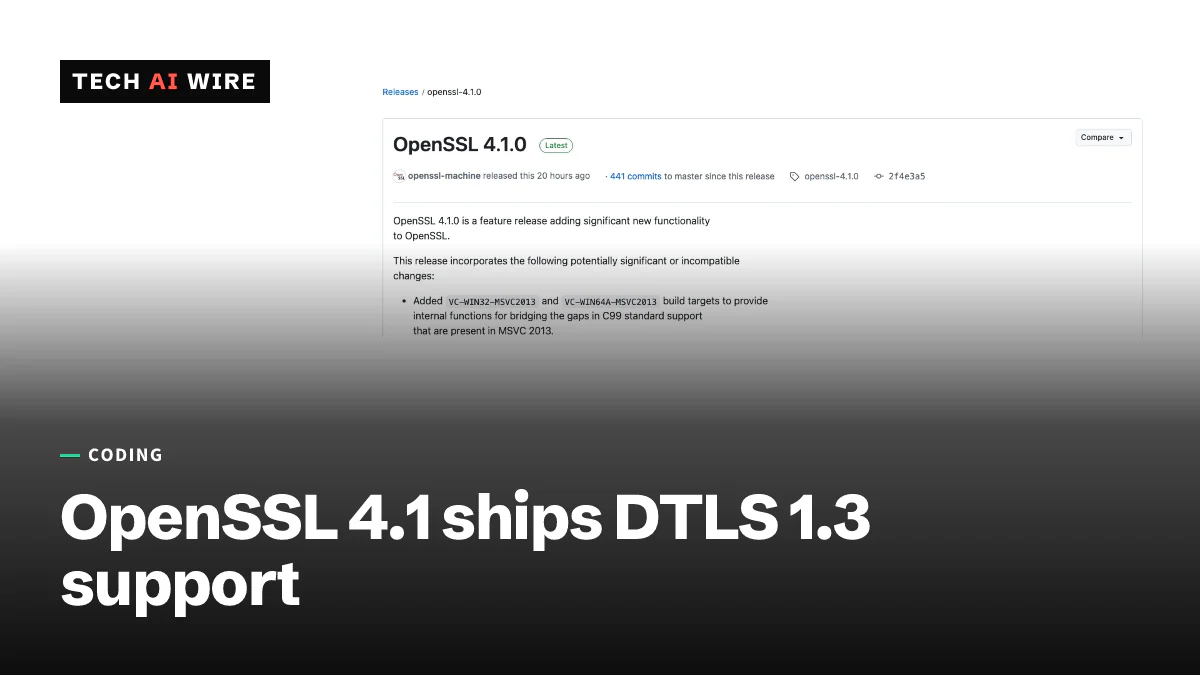
OpenSSL 4.1.0 shipped on October 23 with DTLS 1.3, GREASE and AVX-512 speedups, two weeks after DTLS security bugs held up the final tag.
3 min read
By the numbers
- OpenSSL 4.1.0 release date
- Oct 23
- end of support for 4.1
- Nov 2027
- known DTLS issues listed at release
- 4
OpenSSL 4.1.0 is out. The project tagged the release on October 23, 2026, and its headline feature is DTLS 1.3, the newest version of the encryption protocol for traffic sent as separate datagrams. Many apps get their encryption from OpenSSL, so support there decides when those apps can switch on DTLS 1.3 at all.
The GitHub release calls it "a feature release adding significant new functionality." Phoronix reported the stable release the same morning.
What is new in OpenSSL 4.1
DTLS is the version of TLS built for UDP, where packets can arrive late, out of order or not at all. TLS is the protocol behind the padlock in a browser. DTLS 1.3 follows RFC 9147, the standard published in April 2022, so OpenSSL support arrives more than four years after the spec.
The release notes list these changes:
| Change | What it does |
|---|---|
| DTLS 1.3 (RFC 9147) | Newest datagram TLS, with a new guide page, ossl-guide-dtlsv13(7) |
| DTLS in the listener API | One server socket can accept many DTLS clients |
| GREASE (RFC 8701) | Sends random dummy values to catch servers that break on unknown ones |
| IKEv2 KDF | Key derivation used by the IKEv2 VPN key exchange |
| Elbrus2000 (e2k) | Initial support for this CPU architecture |
| New MSVC 2013 targets | VC-WIN32-MSVC2013 and VC-WIN64A-MSVC2013 build targets |
GREASE needs one more line of explanation. Clients send made-up values in fields where future versions may add real ones. A server that crashes on them gets caught now, before a real extension ships.
Faster post-quantum math
Much of the speed work targets post-quantum cryptography. ML-DSA and ML-KEM are new signature and key-exchange algorithms designed to resist future quantum computers. Faster code for them lowers the cost of switching.
According to the release notes, 4.1 adds AVX-512 code for the SHAKE hashing that ML-DSA uses on x86_64 chips. It speeds up ML-DSA and ML-KEM math on ppc64le, IBM's POWER architecture. AVX-512 and VAES instructions also speed up AES-CBC decryption on x86_64.
What was removed
The release drops two old Windows platforms, Phoronix notes: Windows on Itanium (VC-WIN64I) and Windows CE (VC-CE). The no-ecdsa and no-ecdh build options are gone too; the replacement is no-ec. The tsget helper script now needs the Net::Curl::Easy Perl module instead of WWW::Curl::Easy.
Why the final release was late
The road to 4.1.0 was bumpy. According to Linux Compatible, 4.1.0-beta2 shipped on October 9 in place of the planned final release. Two DTLS security issues, #33172 and #33173, surfaced during the beta and held up the tag. The site says they appear to have been fixed before the October 23 release.
The release still ships with four known DTLS bugs. The biggest, #32878, involves key updates. After a DTLS 1.3 KeyUpdate, other pending records can drop out of the resend buffer. A lost session ticket may then never be sent again. A fix is planned for a later release. Linux Compatible also lists limits: no DTLS 1.3 Connection ID support, and DTLS 1.3 over SCTP falls back to older versions.
Support dates
OpenSSL 4.1 is not a long-term support release. The project's downloads page lists its end of life as November 2027. OpenSSL 4.0, whose latest patch is 4.0.3 from September 29, is supported until May 14, 2027. OpenSSL 3.5 remains the long-term release, supported until April 8, 2030.
The project's release policy rules out API or ABI breaks in a minor release. Linux Compatible says 4.1 keeps compatibility with the 4.0 line, so most apps built against 4.0 should not need recompiling.
What this means for developers
If you run UDP services that use DTLS, 4.1 is the first OpenSSL with 1.3. Try it in staging, not production. The four open bugs all sit in the new DTLS code, and #32878 can lose session tickets after a key update. Run your own key-update and packet-loss tests before relying on it.
Servers that accept many DTLS clients on one socket should look at the listener API. Linux Compatible says SSL_new_listener() now handles DTLS 1.3 and replaces DTLSv1_listen(), which only covered DTLS 1.0 and 1.2.
Most TLS-over-TCP users can upgrade on their normal schedule. The post-quantum speedups pay off on x86_64 servers with AVX-512 and on POWER systems.
Plan your support window. If your product needs a library supported past 2027, stay on the 3.5 long-term release and treat 4.1 as a short-lived track. Windows builds for Itanium or CE must stay on 4.0 or earlier.
Sources
- Release OpenSSL 4.1.0 - GitHub (openssl/openssl)
- OpenSSL 4.1 Released With More AVX-512 Optimizations - Phoronix
- OpenSSL 4.1.0 Released With DTLS 1.3 Support - Linux Compatible
- OpenSSL Downloads - OpenSSL Library
Related articles
Linux 7.4 adds TAINT_FORCED_BIND for forced driver binds
Linux 7.4 will taint the kernel with flag Y whenever driver bind or unbind sysfs files are used, after syzbot fuzzing produced piles of pointless bug reports.
Nix and Lix patch daemon flaws that allow local root
Nix and Lix disclosed flaws on October 13 that can be chained into root access. Fixes are in Nix 2.35.3 and Lix 2.95.4, among other patch releases.
Archinstall 4.5 adds AArch64 boot support and RT kernels
Archinstall 4.5, out September 29, 2026, sets up 64-bit ARM machines with GRUB or Limine, adds real-time kernels and turns on TLS verification.
The weekly digest
One email every Friday with the week's top stories from all six desks: AI, dev tools, coding, the tech industry, startups and what's next. Free, no spam.