Archinstall 4.5 adds AArch64 boot support and RT kernels
Archinstall 4.5, out September 29, 2026, sets up 64-bit ARM machines with GRUB or Limine, adds real-time kernels and turns on TLS verification.
3 min read
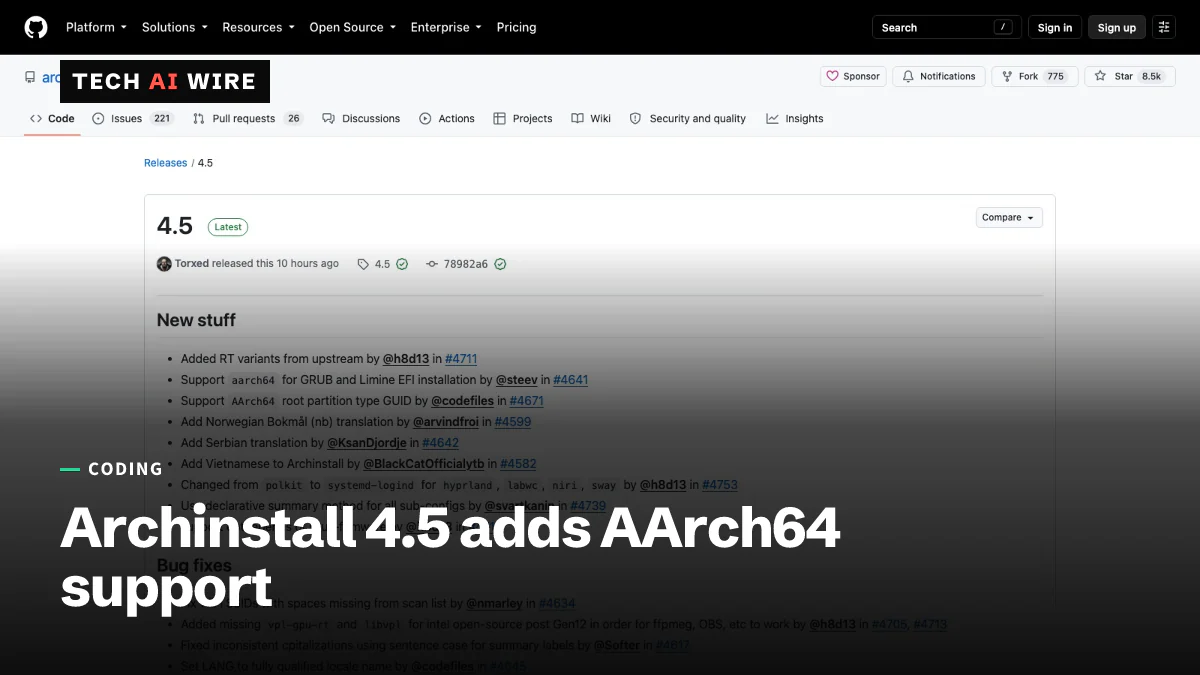
Archinstall 4.5 came out on September 29, 2026. It is the guided installer that Arch Linux offers for setting up a new system. The headline change is AArch64 support in the boot setup, which matters to anyone installing Arch on 64-bit ARM hardware. The release also adds real-time kernels and turns on TLS verification for the installer's network requests, according to the release notes on GitHub.
Arch Linux is a rolling-release distribution: it has no big version upgrades, just a steady stream of package updates. Installing it by hand takes many manual steps. Archinstall asks a series of questions instead and then does that work for you.
AArch64 support for GRUB and Limine
AArch64 is the 64-bit version of the ARM processor design. The release notes list two changes for it.
First, it can now install the GRUB and Limine boot loaders on AArch64 machines that start through EFI. A boot loader is the small program that runs before Linux and starts it. EFI is the firmware standard modern computers use to find and launch that program.
Second, it supports the AArch64 root partition type GUID. That is a standard ID written into the partition table. It marks which partition holds the main filesystem, so other tools can find it without extra configuration.
Real-time kernels and new languages
The release adds real-time (RT) kernel variants from upstream, the release notes say. A real-time kernel is a Linux kernel tuned to respond within tight, predictable time limits. It suits work where timing matters more than raw speed, such as audio recording or machine control.
Archinstall also gains three translations, 9to5Linux reports: Norwegian Bokmål, Serbian and Vietnamese.
What changed under the hood
Several smaller changes affect what a finished system looks like.
| Area | Change in Archinstall 4.5 |
|---|---|
| Security | TLS verification is enabled for network operations |
| Desktop profiles | Hyprland, Labwc, Niri and Sway switch from polkit to systemd-logind |
| Intel graphics | Adds vpl-gpu-rt and libvpl for open-source drivers after Gen12 |
| Printing | Adds Ghostscript to the print service packages |
| Cockpit | Uses cockpit-storaged instead of udisks2 |
| Configuration | Uses a declarative summary method for all sub-configs |
A few of these need a plain-words explanation. TLS verification means checking a server's certificate before trusting a download. Hyprland, Labwc, Niri and Sway are Wayland compositors, the programs that draw and arrange windows on screen. Polkit is a service that decides which programs may perform privileged actions. Systemd-logind is the systemd service that tracks user logins and hands out access to devices such as the keyboard and screen. Cockpit is a web-based tool for managing a server, and libvpl is Intel's video processing library.
The release also fixes bugs. 9to5Linux lists three: Wi-Fi networks whose names contain spaces were missing from the scan list, summary labels used inconsistent capitalization, and the disk menu had an import cycle.
When it reaches the install media
The new version will ship on Arch Linux's October 1, 2026 installation image, according to 9to5Linux. Anyone booting an older image can update the installer first with pacman, Arch's package manager, and then run it.
What this means for developers
If you have spare ARM64 hardware, test the new flow before you depend on it. That includes a single-board computer, an ARM server or an ARM virtual machine. AArch64 support is new in 4.5, so an early test on a machine that holds nothing important is the right place to find rough edges. Report what breaks upstream on GitHub.
If you automate installs with saved Archinstall configuration files, rerun them in a virtual machine before updating any pipeline that pins the installer. The move to a declarative summary for every sub-config is the kind of change that can shift what a scripted install produces.
Check your desktop setup if you use one of the four Wayland profiles. They now rely on systemd-logind rather than polkit. If your post-install scripts expect polkit to be present, for example for graphical password prompts, install it explicitly.
Watch for network failures behind a corporate proxy. A proxy that inspects encrypted traffic swaps in its own certificate. With TLS verification now enabled, the installer's downloads may fail unless the live system trusts that certificate. The same check is what stops a tampered download from slipping through, so fix the trust, not the check.
Sources
Related articles
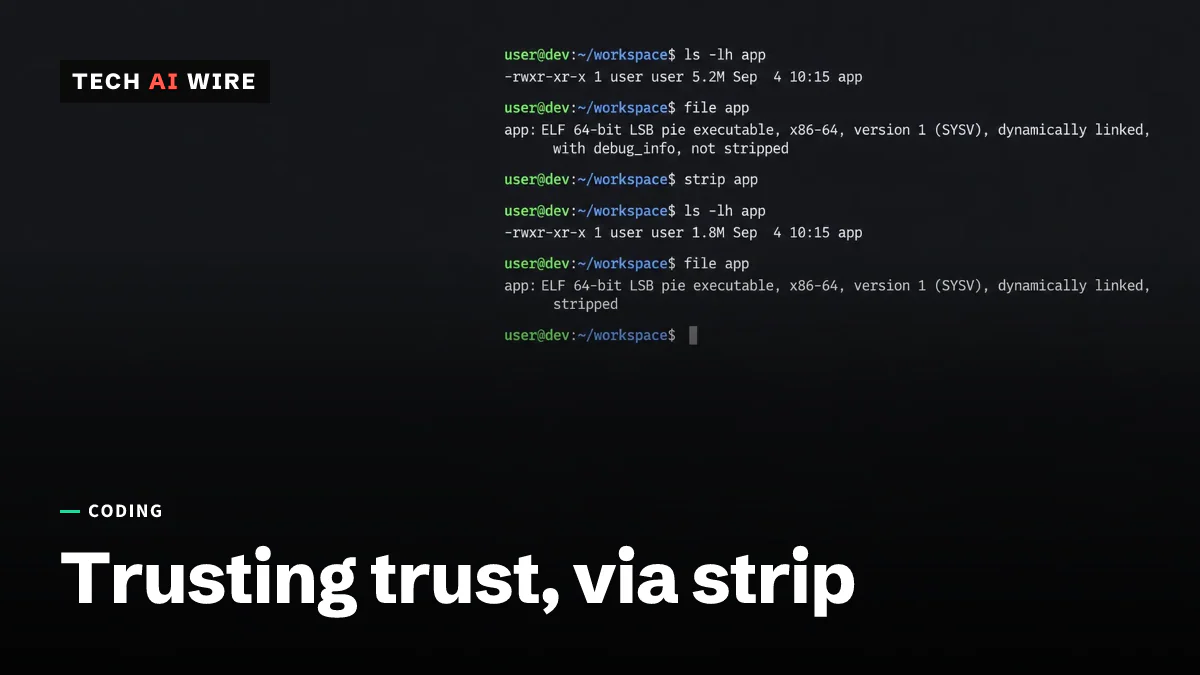
A tampered strip binary can backdoor all of NixOS
Researchers built Ken Thompson's trusting-trust attack out of GNU strip, not a compiler, and used it to backdoor almost every binary in a NixOS installer.
Gzip 1.15 fixes a wrong-file deletion race
Gzip 1.15 lands 119 commits from 75 weeks of work. It fixes a race that could delete the wrong file, plus a buffer overflow in .lzh decoding.

Fedora 45 beta swaps the kernel console for kmscon
Fedora 45 moves the text console out of the kernel. Three tools stop working, and the beta landed September 15 with an automatic fallback to fbcon.
The daily brief
Three to five stories a day, and what each one means for the people who build software. Free, no spam.