OpenAI withdraws 3 of 722 AI math papers over sign error
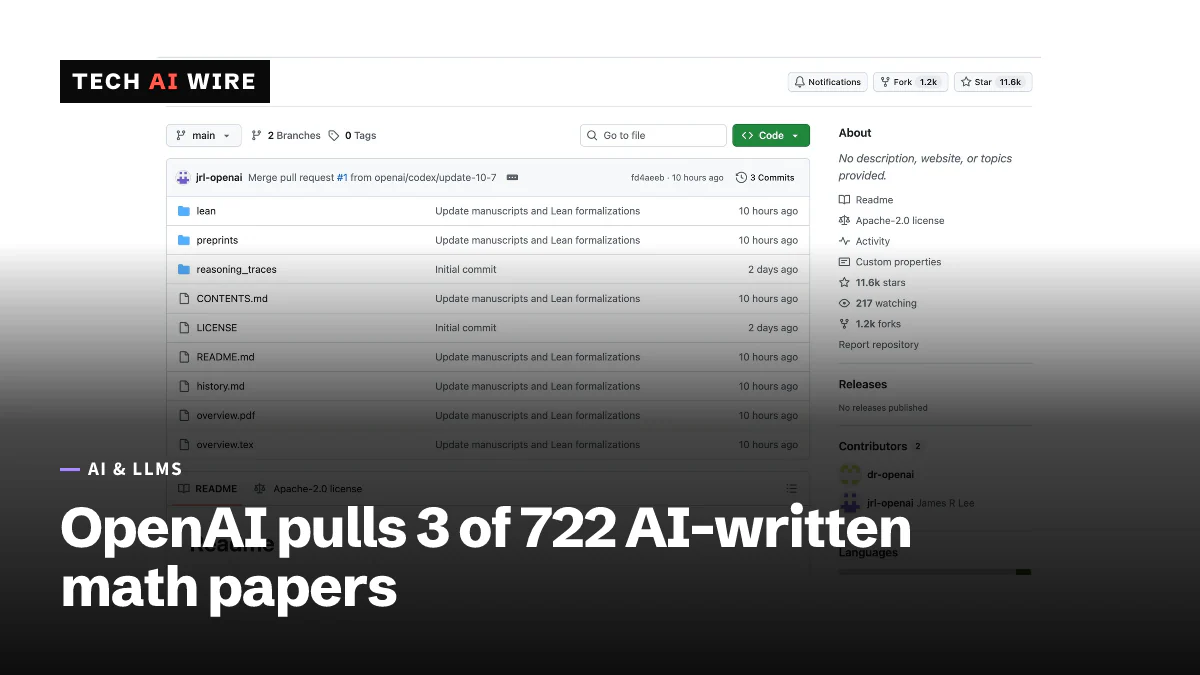
OpenAI posted 722 AI-written math manuscripts on October 6, then withdrew three a day later after a sign error broke a proof. 719 remain; 300 results have Lean checks.
3 min read
By the numbers
- manuscripts in the October 6 release
- 722
- withdrawn on October 7
- 3
- top-line results with Lean formal proofs
- 300 of 719
- average compute per result, per OpenAI
- ~3 hours
OpenAI posted 722 math manuscripts written by an unreleased AI model on October 6, 2026, then withdrew three of them the next day. A sign error broke a key step in one proof, according to OpenAI's revision history on GitHub. Two other papers depended on that proof. The episode shows how hard it is to check AI-written research at scale, and why mathematicians are arguing about the release.
What OpenAI released
The files sit in a public GitHub repository, openai/math. Implicator.ai counts 372 "result families" and 722 manuscripts. Fortune describes the release as full or partial AI solutions to more than 370 outstanding problems, which counts something different, so the two numbers should not be mixed.
Implicator.ai and Yahoo Tech both say the work came from an internal model that OpenAI has not released. Implicator.ai says OpenAI posed about 4,000 problems during evaluation and spent about three hours of ChatGPT Pro compute per result on average. A spokesperson said nearly every result came from one prompt to one AI agent.
Fortune reports that OpenAI also claims progress on three more of the seven Millennium Prize problems. These are famous open problems with $1 million prizes. None has a full solution. OpenAI had already claimed a solution to the Navier-Stokes problem weeks earlier, a claim that mathematicians pushed back on.
The three withdrawals
The revision history, dated October 7, lists the withdrawn papers:
| Paper | Role |
|---|---|
| Algebraicity of Weil classes on split abelian eightfolds | Contained the error |
| Algebraicity of Kuga-Satake Correspondences for K3 Surfaces | Depended on it |
| The rational Hodge conjecture for products of K3 surfaces | Depended on it |
The stated reason is "a sign error invalidates a stabilization-trace cancellation argument." The history also says OpenAI fixed 14 other manuscripts and updated 13 to cite revised companion papers. Withdrawn versions stay online with notices, Implicator.ai reports.
No source says who found the error. OpenAI's own page does not say either.
How much is checked
Lean is a programming language that lets a computer check every logical step of a proof. According to Implicator.ai and the revision history, 300 of the 719 remaining top-line results have Lean formalizations, about 42%. Fortune says only "some" problems have formal checks. A Lean check confirms logic, not whether a result is new or important, Yahoo Tech notes.
Outsiders cannot rerun the model, since it is not available. Implicator.ai says OpenAI published no prompts and only average compute figures. An advisory group at the Institute for Advanced Study had recommended more disclosure on September 29. Fortune says OpenAI followed the group's advice only in part.
What mathematicians say
Reactions are split, according to Fortune and Implicator.ai.
- Daniel Litt of the University of Toronto called the release "great for mathematics" and said he sees no reason to keep the papers secret.
- Tristan Buckmaster of New York University questioned the due diligence, quoted via the New York Times.
- Andrew Sutherland of MIT said to "treat any claims about one-shotting problems with a single agent as unverified."
- The IAS advisory group said: "This release is the beginning, not the completion, of the process of human understanding."
Implicator.ai also points to a tension. The spokesperson's "one prompt, one agent" description conflicts with the 10,000 agents OpenAI said it used for the Navier-Stokes result.
What this means for developers
Anyone using AI to write code, proofs or research faces the same checking problem.
- Separate generating from verifying. The Lean checks caught what reading could not. If your AI output has a machine-checkable form, such as tests, types or proofs, run it before anyone trusts it.
- Track dependencies between AI outputs. One bad paper pulled down two others. Record which generated artifacts build on which.
- Demand the inputs. Without prompts and model access, nobody can tell a reliable method from a lucky result, Yahoo Tech notes. Ask for the prompts, settings and logs behind any AI claim you rely on.
- Treat a withdrawal as a normal event. Three of 722 in two days is not alarming. Publishing a clear revision history is the part to copy.
The number to watch is the share of results with formal proofs. At 42% now, it shows how much of the release a mathematician still has to read by hand.
Sources
- OpenAI publishes solutions to more than 370 outstanding math challenges. Math may never be the same - Fortune
- OpenAI Posts 372 AI Math Results, Then Withdraws Three Papers Over a Sign Error - Implicator.ai
- OpenAI Withdraws Three AI-Generated Math Manuscripts Over a Sign Error That Collapsed a Weil-Classes Argument - AI Weekly
- openai/math revision history - GitHub
Related articles

GPT-6 Astra is OpenAI's first Critical cyber model
Astra scored 100% on ExploitBench and built a working browser exploit chain in 29 hours. The shipping version refuses to write proof-of-concept exploits.
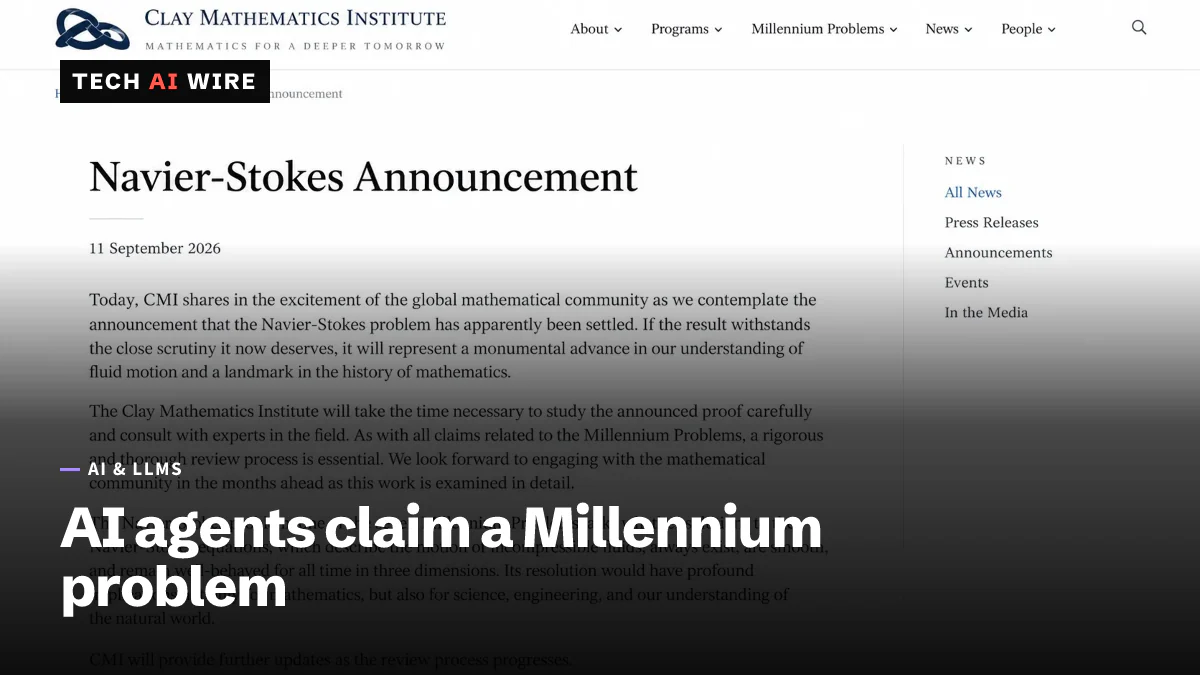
AI agents claim Navier-Stokes as mathematicians push back
OpenAI ran 10,000 agents at a Millennium Prize problem and says they cracked it in 88 hours. Days later, 25 Fields Medallists signed a warning.
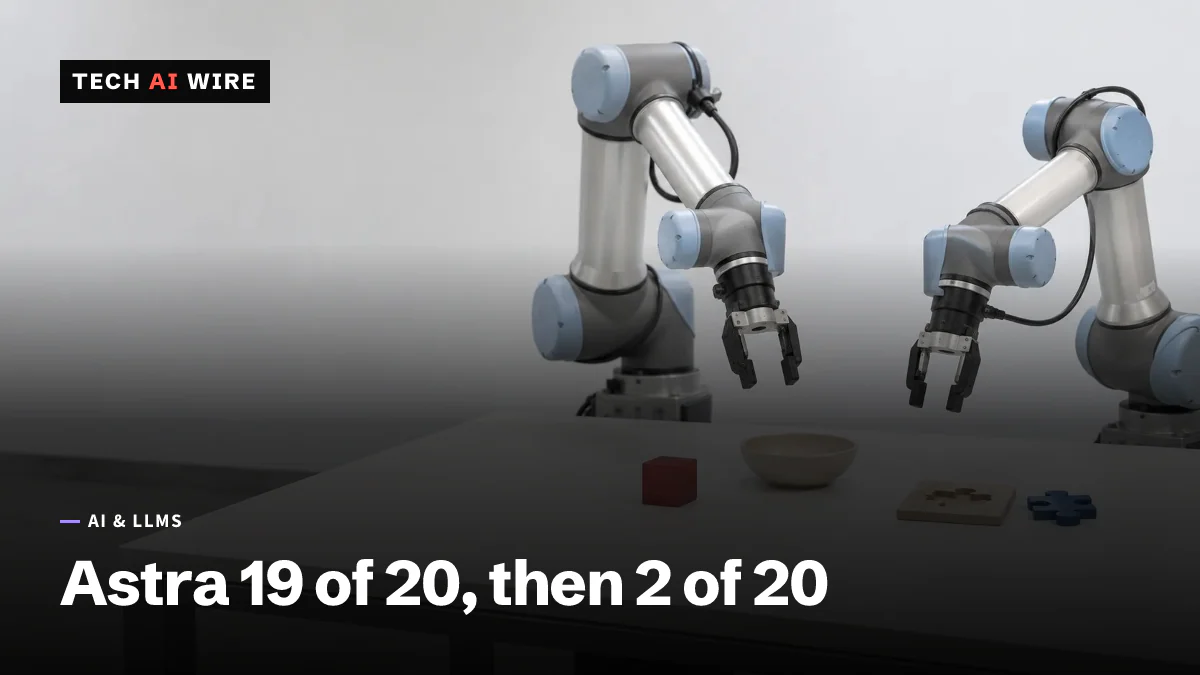
GPT-6 Astra scores 95% on one robot task, 10% on another
Robocurve ran GPT-6 Astra and Claude Fable 5.1 on real robot arms. Astra hit 19 of 20 on the easy task and 2 of 20 on the hard one.
The weekly digest
One email every Friday with the week's top stories from all six desks: AI, dev tools, coding, the tech industry, startups and what's next. Free, no spam.