Microsoft discloses Azure's $29.4B quarterly revenue
Microsoft will report Azure's exact quarterly revenue for the first time and redraw what counts as Azure starting fiscal 2027. Q4 alone was $29.4 billion.
3 min read
By the numbers
- when Microsoft's new two-segment reporting structure begins
- FY2027
- of Azure's FY2026 growth that Stifel estimates came from OpenAI
- ~50%
- of global turnover, the maximum EU fine under Azure's pending gatekeeper status
- 10%
- Q1 FY26
- 22.384B
- Q2 FY26
- 24.129B
- Q3 FY26
- 26.008B
- Q4 FY26
- 29.417B
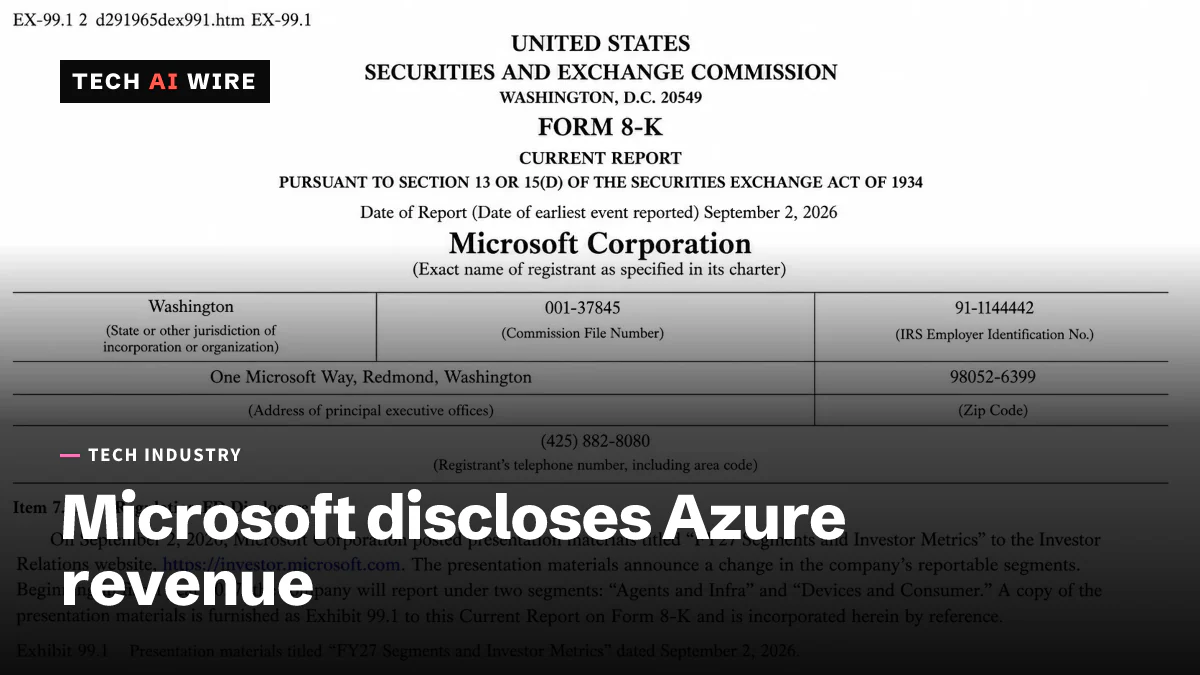
Microsoft disclosed exact Azure revenue for the first time on September 2, 2026, alongside a plan to reorganize its financial reporting into two segments starting in fiscal year 2027. Azure brought in $29.417 billion in the fourth quarter of fiscal 2026, according to Microsoft's own filing with the Securities and Exchange Commission. Investors have asked for this figure since Amazon started publishing AWS revenue back in 2015.
What Microsoft actually changed
For years, Microsoft told investors how fast Azure grew. It did not say how large Azure actually was in dollars.
Chief executive Satya Nadella framed the shift as matching the numbers to how the company runs itself today. "We are updating our financial reporting to mirror how the business is operating, how we allocate resources, and where we are headed," he said in the filing.
Starting in fiscal year 2027, Microsoft collapses its three current segments into two. The Next Web reports the first is called Agents and Infra, covering Azure, Microsoft 365 cloud services, productivity and server licensing, industry-specific software, and frontier AI infrastructure. The second, Devices and Consumer, covers search and advertising, Xbox, and Windows devices.
A narrower Azure, on purpose
The new Azure number is not the old Azure number with a price tag finally attached. It is a smaller, more specific figure.
The Next Web reports that several products move out of the Azure figure and into other lines. That list includes GitHub's cloud services, other developer cloud services, Security Copilot, and Microsoft's healthcare and life sciences cloud products. What remains, in Nadella's own words, is "a more purely...consumption-based platform and infrastructure business."
That distinction matters for anyone comparing cloud vendors. A narrower Azure number sits closer to how Amazon Web Services and Google Cloud already report their own infrastructure revenue, without a code-hosting platform or a security product mixed in.
The revenue Microsoft has already shown
Microsoft's filing includes four quarters of the new, narrower Azure figure for fiscal 2026, restated back to the start of the year.
| Quarter | Azure revenue |
|---|---|
| Q1 FY2026 | $22.384 billion |
| Q2 FY2026 | $24.129 billion |
| Q3 FY2026 | $26.008 billion |
| Q4 FY2026 | $29.417 billion |
The Next Web puts Q4's year-over-year growth at 42%, and says Azure now accounts for roughly a third of Microsoft's total revenue.
Where the growth is coming from
Analysts at Stifel estimate that about half of Azure's growth in fiscal 2026 traces back to Microsoft's partnership with OpenAI, The Next Web reports.
That concentration is worth naming plainly. If one customer relationship drives roughly half of a cloud platform's growth, the platform's trajectory depends on that one relationship more than a diversified customer base would suggest.
A regulator is already watching
The timing lines up with regulatory pressure in Europe.
The Next Web reports that the European Commission issued a preliminary gatekeeper designation for Azure in June 2026, under the EU's Digital Markets Act. A final decision is expected by the end of 2026. A gatekeeper designation brings interoperability duties and limits on self-preferencing. Failing to comply can bring fines of up to 10% of global turnover.
What this means for developers
If you compare cloud vendors by revenue or growth rate, throw out any Azure trend line built before this change. The number you were tracking bundled GitHub, Security Copilot, and healthcare products into one figure. That combined number no longer exists going forward, and Microsoft has restated fiscal 2026 under the new, narrower definition. Rebuild your own comparison from the four quarters in the table above, not from older reported figures.
Watch the OpenAI concentration number if your own infrastructure planning assumes Azure's AI capacity keeps expanding at its current pace. Half of a platform's growth resting on one partnership is a single point of failure in miniature. If that relationship changes, so does Azure's growth curve, and so does capacity planning for anyone counting on that curve continuing.
Read the DMA gatekeeper designation as an early signal, not a settled fact. It is preliminary, and the final decision is not due until the end of 2026. But if it lands, interoperability duties on Azure could open real integration points for tools that compete with or plug into Microsoft's cloud services. If you build developer tooling that depends on Azure APIs behaving a certain way, this is worth tracking over the next few months, before the decision lands, not after.
Sources
- Microsoft Form 8-K, September 2026 - U.S. Securities and Exchange Commission
- Microsoft Azure quarterly revenue disclosure and DMA gatekeeper designation - The Next Web
- Microsoft announces major overhaul of its financial reporting - Thurrott
Related articles

Microsoft-Decision-1 model scores choices, not text
Microsoft-Decision-1 returns a probability for each fixed option instead of writing text. It costs $0.042 per million input tokens in Microsoft Foundry.

Microsoft Maia 300 chip aims for 40% more tokens per watt
Microsoft unveiled Maia 300, its third-generation AI chip. It expects 40% more tokens per watt than leading GPU-based systems, with deployments in 2027.

Nasdaq falls 2.6% as AI spending doubts hit tech stocks
The Nasdaq fell 2.6% on October 22, its worst day since June, as doubts about AI spending hit Meta, Nvidia, AMD and Intel. Big Tech reports next week.
The weekly digest
One email every Friday with the week's top stories from all six desks: AI, dev tools, coding, the tech industry, startups and what's next. Free, no spam.