Margaret Hamilton, Apollo software pioneer, dies at 90
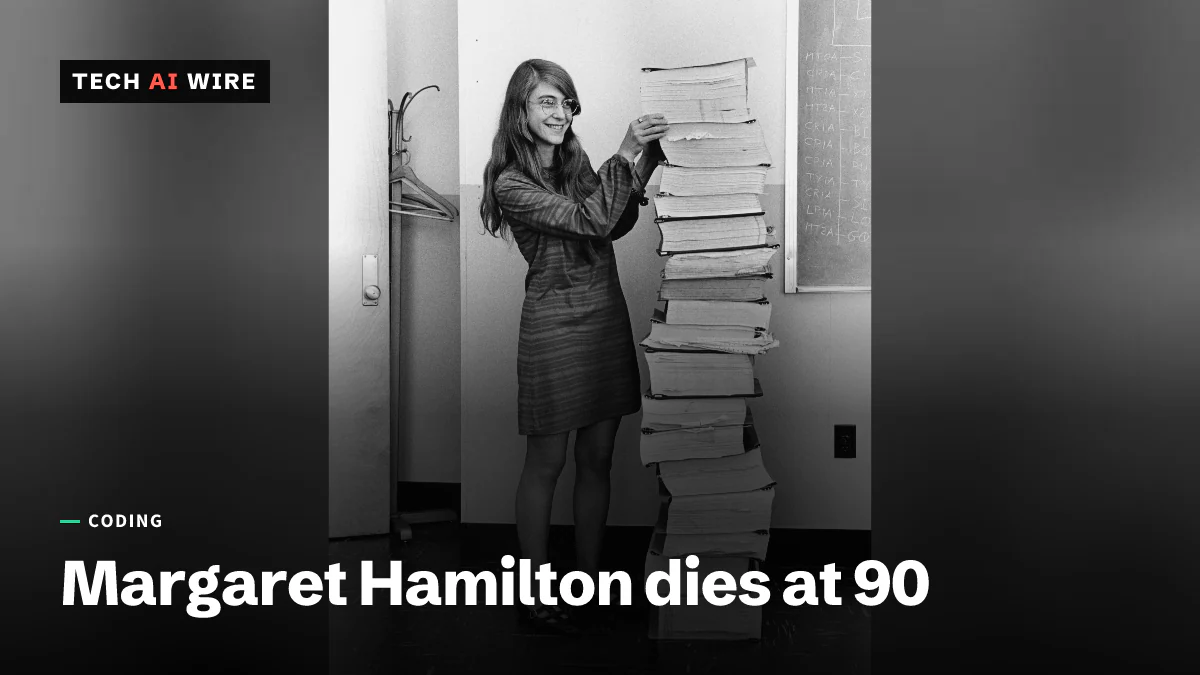
Margaret Hamilton died on September 30 at 90. She led the MIT team behind Apollo's flight software and is credited with coining software engineering.
3 min read
By the numbers
- her age when she died on September 30, 2026
- 90
- people who worked on Apollo software under her, per MIT
- 400+
- publications she wrote, per MIT
- 130+
- year she received the Presidential Medal of Freedom
- 2016
Margaret Hamilton, who led the team that wrote the flight software for NASA's Apollo moon missions, died on September 30, 2026, at age 90. MIT announced her death on October 7. She is credited with coining the term "software engineering," and her work helped turn programming into a discipline with its own methods.
Who Margaret Hamilton was
Hamilton led software development for the Apollo program at MIT's Instrumentation Laboratory. That lab designed the guidance computer that flew the Apollo spacecraft. According to MIT News, she was the first programmer hired for the Apollo project, in 1965. She was also its first female programmer.
The team grew large under her. MIT says more than 400 people worked on Apollo's software under her leadership. CNN's obituary describes her as running MIT's Software Engineering Division and leading 100 engineers who designed the mission software. The two outlets give different figures, so both appear here with their source.
Her route to the role was not direct. MIT News says she started at the University of Michigan in 1955 and earned her bachelor's degree from Earlham College in 1958. She moved to Boston in 1959 and began working at MIT. In 1961 she worked at MIT Lincoln Laboratory.
The software that landed Apollo 11
Hamilton's best-known idea was about priorities. Her team's software was built to run the most important jobs first. When the computer had more work than it could handle, it kept the critical tasks going and set the rest aside. MIT News says this priority-driven design prevented a mission failure during the Apollo 11 landing in July 1969.
MIT also credits her with early ideas in what is now called defensive programming. That means writing code that expects mistakes, by people or by other code, and catches them before they cause harm. She left the Instrumentation Laboratory in the mid-1970s. In 1976 she founded Higher Order Software, the first of two companies she built around preventing errors.
Naming a new field
CNN credits Hamilton with coining "software engineering." At the time, writing code was not widely treated as engineering. Olivier de Weck, a professor in MIT's Department of Aeronautics and Astronautics, said calling her a pioneer "would be a dramatic understatement," CNN reported.
Hamilton saw it as necessity. "There was no choice but to be pioneers," she said, as quoted by MIT News. Looking back on Apollo in a 2009 interview, she said, "we were the luckiest people in the world."
Honors and legacy
MIT News lists these honors among the awards she received:
| Year | Recognition |
|---|---|
| 2003 | NASA Exceptional Space Act Award |
| 2016 | Presidential Medal of Freedom, from President Barack Obama |
| 2017 | Computer History Museum Fellow Award, and a LEGO minifigure |
| 2019 | Intrepid Lifetime Achievement Award |
| 2022 | Induction into the National Aviation Hall of Fame |
The 2016 citation said Hamilton "defined new forms of software engineering and helped launch an industry." She wrote more than 130 publications, MIT says. MIT confirmed her death, and CNN reported that no cause was given.
What this means for developers
Read the source. MIT News notes that the Apollo flight software has been posted on GitHub. It shows how a team handled errors and hard limits on 1960s hardware. Reading even one module is a lesson in writing code that must not fail.
Decide what your system drops first. Hamilton's priority design is the idea behind load shedding, where an overloaded service keeps its critical path running and sheds the rest. Write that order down before an incident, not during one. Then test it, because an untested fallback is a guess.
Treat human error as an input, not a surprise. Defensive programming means checking inputs and state on the assumption that a user or caller will get something wrong. Input validation, safe defaults and clear error messages all follow that line of thinking.
Finally, the job title most readers hold is partly hers. Reviews, testing and documented failure modes are the practices that make software engineering a field. They are worth defending when deadlines push to skip them.
Sources
Related articles

Linux set_robust_list2 syscalls return in v7 for FEX-Emu
Igalia posted v7 of the set_robust_list2 futex syscalls on September 25, 2026, 10 months after v6, to help FEX-Emu run 32-bit x86 code on Arm64.

Vulkan 1.4.363 adds an Intel GPU version query
Vulkan 1.4.363 ships VK_INTEL_device_info, an Intel extension that reports a GPU's graphics IP version as three plain numbers.

Linux plans to remove 247k lines of old ARM code
A kernel branch would delete about 247,000 lines by dropping deprecated 32-bit ARM platforms and the drivers only they used.
The weekly digest
One email every Friday with the week's top stories from all six desks: AI, dev tools, coding, the tech industry, startups and what's next. Free, no spam.