Hugging Face opens pre-orders for $399 open-source Microduck robot
Hugging Face is taking $399 pre-orders for Microduck, a 25 cm walking robot. The full reinforcement learning stack ships under Apache 2.0, so you can retrain it.
3 min read
By the numbers
- base price, pre-orders opened 27 August 2026
- $399
- motors in the 25 cm robot
- 15
- behaviors pre-installed at shipping
- 7
- rate the trained policy runs at
- 50 Hz
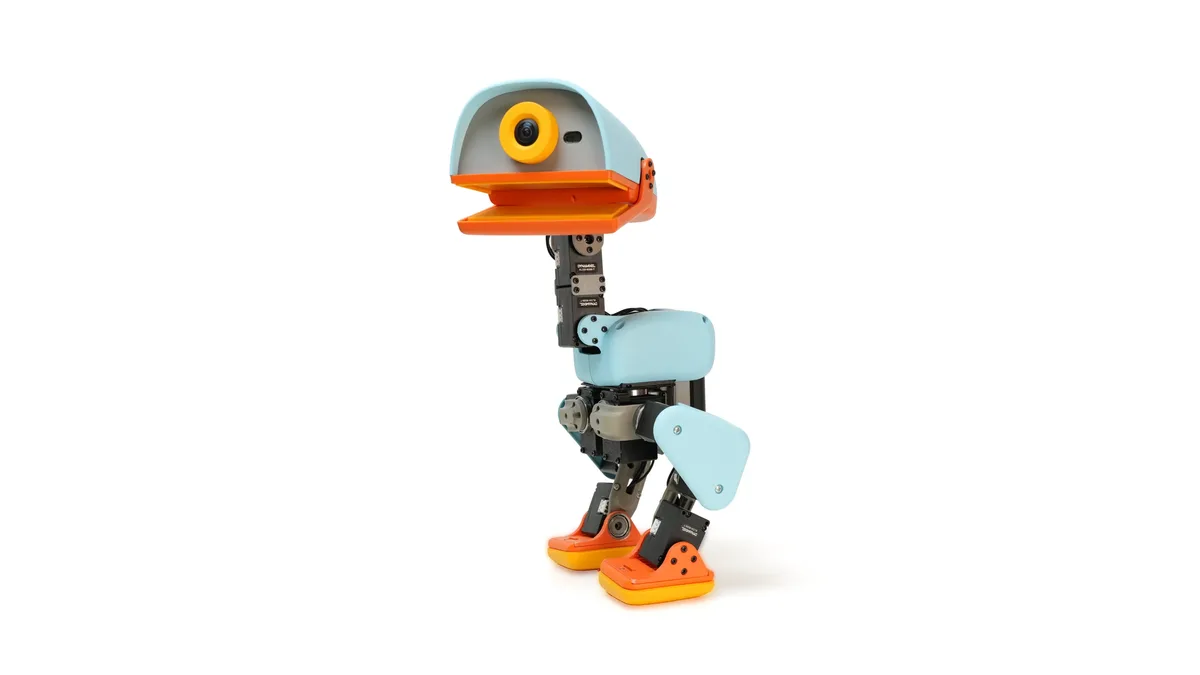
Hugging Face began taking pre-orders for the Microduck on 27 August 2026. The duck-shaped robot costs $399, it walks, and developers can retrain everything it does. Pollen Robotics, the Hugging Face hardware team behind it, publishes the full training stack on GitHub under the Apache 2.0 licence. That licence choice is the part worth noting. It makes the robot a programmable platform rather than a sealed toy.
Hugging Face acquired Pollen Robotics in April 2025, according to TechCrunch. The two teams then shipped the Reachy Mini desktop robot in July 2025. Microduck is the second product from that pairing, and the cheapest so far.
What the robot is, and what it costs
The Microduck stands 25 centimetres tall and weighs 800 grams. Fifteen motors drive it, per the Pollen Robotics product page. It senses the world with a camera, lidar sensors, and two IMUs. An IMU, or inertial measurement unit, is the chip that tells a robot which way is up and how fast it is turning.
TechCrunch reports the robot can waddle, pick objects up with its beak, recover from falls, crouch, and roller skate. Seven behaviors come pre-installed. The box includes a game controller, a USB-C cable, and a battery, so it works out of the box.
| Item | Price |
|---|---|
| Microduck, base unit | $399 |
| Dev pack | $119 |
| Charger pack | $39 |
| Accessory pack | $39 |
For comparison, TechCrunch notes that Reachy Mini sells for $499 and Reachy Mini Lite for $399. So Microduck arrives at the bottom of the range, not below it. Pollen Robotics expects units to ship before Christmas 2026. TechCrunch also puts Hugging Face's reported valuation at $13 billion.
How the training works
Behaviors are trained in software first, then copied onto the real robot. Engineers call that step sim2real, short for simulation to reality. Pollen Robotics says the simulation runs on MuJoCo, an open-source physics engine.
The training method is reinforcement learning. You do not write the walking code by hand. Instead you define a reward, let the software try millions of times in simulation, and keep the attempts that score well. The finished result is called a policy. On Microduck that policy runs at 50 Hz, meaning it chooses an action fifty times a second.
Pollen Robotics says every behavior can be retrained on your own machine, or on Hugging Face Jobs, the company's hosted compute service. The SDK, the simulation, and the reinforcement learning stack are all on GitHub. Hugging Face CEO Clem Delangue called it an "open-source robot you can teach new tricks with reinforcement learning". He added: "Welcome to the era of open-source affordable robots to democratize physical AI."
What this means for developers
Check the licence boundary before you plan a product on this. Apache 2.0 covers the reinforcement learning stack, which is permissive enough to fork and ship commercially. The published material does not say whether the firmware and the hardware design files carry the same terms. Ask before you assume the whole robot is as open as the training code.
Treat 50 Hz as a hard budget. Any perception or planning code you bolt on has to return an action in under 20 milliseconds. That rules out a round trip to a large cloud model inside the control loop. Put slow reasoning in a separate, slower loop and let the trained policy keep its own timing.
Expect to spend your time on the sim2real gap, not on the reward function. A policy that walks beautifully in MuJoCo often stumbles on a real carpet, because friction, motor lag, and sensor noise differ from the model. The seven shipped behaviors are useful here for a reason beyond demos. They give you a working baseline to compare your own trained policy against, which is the fastest way to tell a bad reward from a bad simulation.
Two numbers are missing from the announcement, and both affect planning. Neither source states the battery life, nor the compute needed to retrain a behavior from scratch. If you are costing out a classroom set or a research rig, those are the questions to send Pollen Robotics before you order.
Finally, mind the calendar. Pre-orders opened on 27 August 2026 and shipping is expected before Christmas. Any work that needs the physical robot is therefore early 2027 work. The simulation stack is on GitHub today, though, so you can start training against MuJoCo now and have policies waiting when the hardware lands.
Sources
- MicroDuck - Pollen Robotics
- Hugging Face is selling a cute $399 open-source duck robot, Microduck - TechCrunch
Related articles

Nvidia officially confirms its $12.9 billion Hugging Face deal
Nvidia confirmed its $12.9 billion purchase of Hugging Face and promised the platform stays open to non-Nvidia hardware. It turned down a $500 million offer just last year.
Nvidia agrees to buy Hugging Face for $12.9 billion, reports say
The Information reports Nvidia agreed to pay $12.9 billion for Hugging Face, the model hub developers use daily. Neither company has confirmed the deal yet.
Anthropic Cyber Mission: free scans for open-source code
Anthropic's Cyber Mission, launched October 8, gives open-source projects free Claude vulnerability scans and gives 11 security firms models and engineers.
The weekly digest
One email every Friday with the week's top stories from all six desks: AI, dev tools, coding, the tech industry, startups and what's next. Free, no spam.