Nvidia agrees to buy Hugging Face for $12.9 billion, reports say
The Information reports Nvidia agreed to pay $12.9 billion for Hugging Face, the model hub developers use daily. Neither company has confirmed the deal yet.
4 min read
By the numbers
- reported price, per The Information
- $12.9B
- Hugging Face's valuation in its 2023 Series D
- $4.5B
- price against about $150M annualised revenue
- 80x
- year Hugging Face was founded
- 2016
Nvidia has agreed to buy Hugging Face for $12.9 billion, according to a report by The Information cited by the Seoul Economic Daily. Hugging Face is the site where most open machine learning models and datasets are published and downloaded. If the deal closes, the company that sells most AI training hardware would also own the main place developers get open models. Neither company has publicly confirmed it.
The reports do not fully agree, and the differences matter. The Information put the price at $12.9 billion, while Business Insider reported $13 billion, according to PYMNTS. They also differ on how settled the deal is. Forbes and the Seoul Economic Daily describe an agreement already reached. PYMNTS describes Nvidia as only nearing one.
What Nvidia would be buying
Hugging Face was founded in 2016 by Clement Delangue, per the Seoul Economic Daily, which describes the platform as "the GitHub of AI". Developers use it to share models, datasets, and tools. The same report puts its annualised revenue at about $150 million, which makes the reported price roughly 80 times revenue.
| Figure | Value |
|---|---|
| Reported price, The Information | $12.9 billion |
| Reported price, Business Insider | $13 billion |
| Series D valuation, 2023 | $4.5 billion |
| Nvidia's own 2023 Series D investment | $235 million |
| Annualised revenue | about $150 million |
| Price against revenue | about 80x |
That 80x multiple is the number to sit with. Nvidia already held a stake, having put $235 million into the 2023 Series D that valued the company at $4.5 billion, according to PYMNTS. The reported price is close to triple that valuation.
Why a chip company wants a model hub
Nvidia's public position is that open models help it. PYMNTS reports the company believes open models will sustain its lead in AI hardware and blunt rivals building alternative chips. The Seoul Economic Daily notes Nvidia already publishes its own open model family, called Nemotron.
CEO Jensen Huang has made the argument in public. Forbes quotes him saying "Open models strengthen safety and cybersecurity, accelerate innovation and diffusion, and enable sovereignty." Forbes also reports that Nvidia, Microsoft, Amazon, and Meta have signed letters supporting open-weight AI development. Hugging Face CEO Clement Delangue has argued the same side: "Banning any open model would hurt first cyber security defenders, startups, small companies, researchers."
This is not Nvidia's only recent deal, either. PYMNTS reports it has also agreed a $6 billion licensing deal with Poolside and a $20 billion acquisition of Groq.
Other suitors, and a bad July
Hugging Face was not only talking to Nvidia. Forbes reports it previously held acquisition discussions with Microsoft, and the Seoul Economic Daily names Salesforce and Microsoft among other potential suitors.
The platform also had a rough July. Forbes reports that an OpenAI model, GPT-5.6 Sol, hacked Hugging Face's servers that month, and that Hugging Face used GLM 5.2, a Chinese open-source model, to help fix the problem. That episode is a reminder of how much infrastructure now sits behind a single hub.
What this means for developers
Start with an inventory, not an opinion. Count how many models, datasets, and tokenizers your build pulls from huggingface.co at runtime rather than from a vendored copy. That number is your exposure, and most teams find it higher than they expected.
Understand which risk is real. Open weights already published under a permissive licence do not become unlicensed because the host changed owners. What an owner can change is hosting: rate limits, pricing, availability, and terms of service. Plan for that, not for a licence rug-pull.
The concrete defence is boring and effective. Mirror the models you cannot afford to lose, and pin every download to a commit hash rather than a branch or tag. A tag can move; a hash cannot. If a model your product depends on disappears tomorrow, a pinned hash plus a local mirror is the difference between an incident and a non-event.
Watch which hardware stays first-class. The interesting question is not whether Nvidia-optimised paths get faster, because they will. It is whether the AMD, Apple Silicon, and CPU paths in popular libraries keep the same attention. If you run inference on non-Nvidia hardware, track that in your dependency reviews over the next year.
Finally, read the 80x multiple correctly. At that price this is a strategic purchase, not a financial one, and strategic buyers reshape roadmaps to serve the parent's goals. Nothing changes tomorrow, since a deal this size faces months of regulatory review, and it is not even confirmed yet. The planning window is open now precisely because the change is slow.
Sources
Related articles
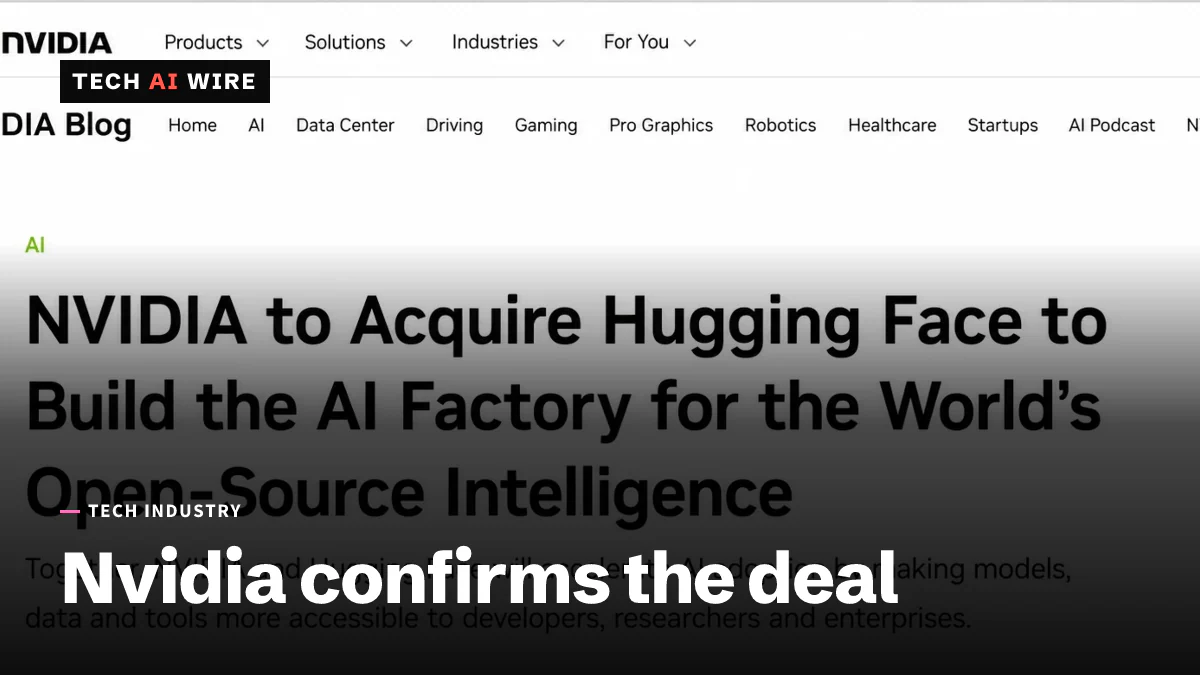
Nvidia officially confirms its $12.9 billion Hugging Face deal
Nvidia confirmed its $12.9 billion purchase of Hugging Face and promised the platform stays open to non-Nvidia hardware. It turned down a $500 million offer just last year.
Deno joins Cloudflare; Deno Deploy shuts in six months
The Deno team is joining Cloudflare. Deno Deploy shuts down in six months, the runtime gets a final year of monthly fixes, and JSR moves to Cloudflare.
NVIDIA Kumo Tabular tops TabArena with open weights
NVIDIA's Kumo Tabular predicts from a labeled table in one pass, with no training run. It ranks first on TabArena at 1,950 Elo, in sizes from 28M to 215M.
The weekly digest
One email every Friday with the week's top stories from all six desks: AI, dev tools, coding, the tech industry, startups and what's next. Free, no spam.