Firefox Enterprise launches with a self-hosted console
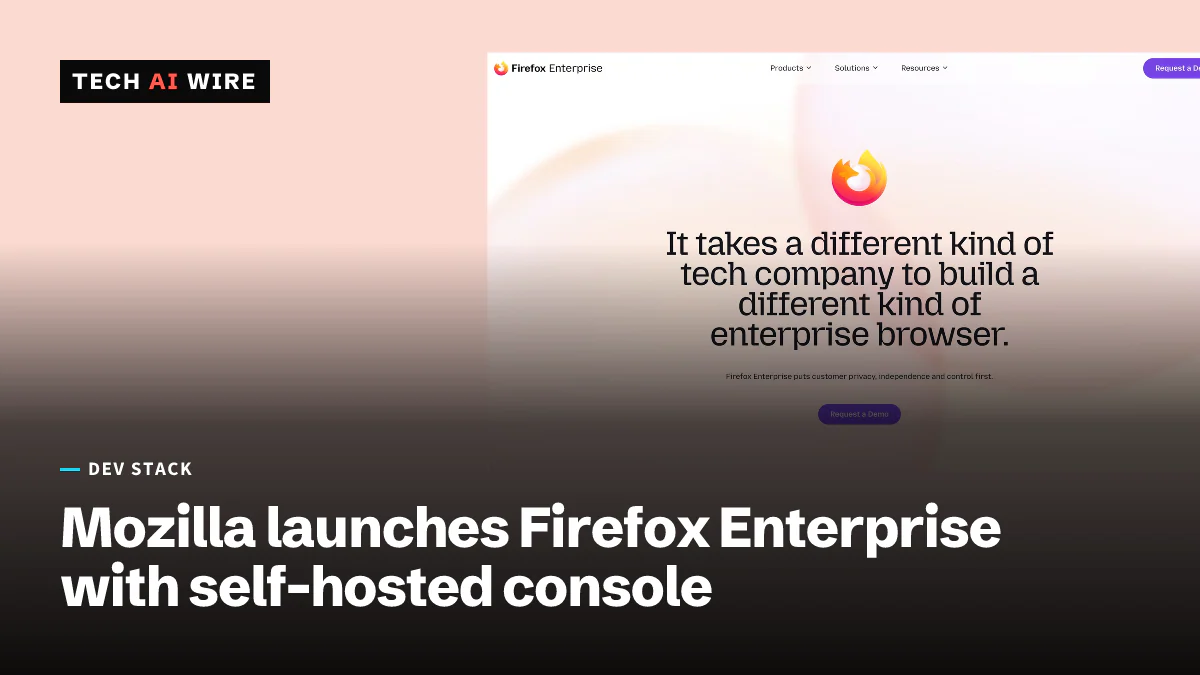
Mozilla launched Firefox Enterprise on October 12: a browser plus a console that companies run on their own servers, sold first in four European countries.
3 min read
By the numbers
- launch countries: France, Germany, Austria, Switzerland
- 4
- monthly Firefox users, per Mozilla
- ~200M
Mozilla launched Firefox Enterprise on October 12, 2026: the Firefox browser paired with a management console that organizations run on their own infrastructure. Sales start in France, Germany, Austria and Switzerland. It gives IT teams one place to set browser rules, control where data goes and decide which AI tools staff may use, without sending that control to a cloud vendor.
What Firefox Enterprise includes
Mozilla's announcement describes two parts: the browser and the console. The console lets IT teams manage browser policy and access, govern how data moves through the browser and set controls on AI use.
The Firefox Enterprise product page lists the console's main controls:
| Feature | What it does |
|---|---|
| Policy control | Sets browser policies centrally across every device |
| Data loss prevention | Warns about or blocks sensitive data actions, by website domain |
| AI controls | Allows, restricts or disables AI tools |
| Lockdown Mode | A locked-down mode for high-risk browsing |
| Extension governance | Allows or blocks add-ons across the organization |
| Connection controls | Limits the browser's outside callouts and telemetry |
| Audit export | Sends browser events and audit activity to a SIEM |
Data loss prevention, or DLP, stops staff from sending confidential material to the wrong place. A SIEM is the security system that collects logs from across a company. Telemetry is usage data a program sends back to its maker.
The page also describes identity-based access to internal apps for employees, contractors and staff on their own devices. It says this works without traditional remote-access infrastructure.
Built to sit beside existing tools
Mozilla says the product works alongside a company's existing identity providers, SIEM platforms and MDM systems, rather than replacing them. MDM is the software IT departments use to manage company devices. CyberInsider reports the same integrations.
The product page says Firefox Enterprise is built to help organizations meet DORA, GDPR, NIS2, ISO 27001 and SOC 2 requirements. These are European rules and international standards for security and data protection.
Mozilla has not published prices. The product page offers "Contact sales" and "Request a Demo" instead of a download. The Next Web reports that support is included in the package.
The pitch: one engine outside Google and Apple
Firefox runs on Gecko, which Mozilla calls the only major browser engine developed outside Google and Apple. Microsoft Edge, for example, is built on Google's Chromium, as The Next Web notes.
"If all your options are built with the same technology underneath, 'choice' is a lie. So is control," said Anthony Enzor-DeMeo, Mozilla's chief executive.
The Next Web ties the launch to Europe's push for digital sovereignty, meaning control over the technology a country or company depends on. Mozilla argues that browsers are an overlooked part of that debate, because staff use them to sign in, share files and reach AI tools.
Mozilla says Firefox has roughly 200 million monthly users and is already deployed in thousands of organizations. The company had flagged the product before launch. In an October 7 interview with diginomica, Firefox head Ajit Varma said an enterprise version was in beta with "expanded data loss prevention and managed visibility capabilities."
Firefox has also been adding AI features for regular users, such as running its Smart Window beta on Mistral Small 4. The new AI controls let a company switch such tools off.
Thunderbird is next
Mozilla says Thunderbird Enterprise is in development. It would bring the same customer-controlled model to email, calendar and contacts, managed from the Firefox Enterprise console. No date has been given.
What this means for developers
- Test internal apps in Firefox. A company that adopts Firefox Enterprise will push staff onto Gecko. Web apps tested only in Chrome may break in small ways, so add Firefox to your test matrix now.
- Expect AI tools to be blocked. The console can restrict or disable AI tools in the browser. Internal apps that rely on browser-based AI features need a fallback.
- Watch for data-loss rules. DLP can warn or block uploads and pastes by domain. If your app handles sensitive files, check how it behaves when an upload is blocked.
- Plan the hosting. The console runs on your own infrastructure, so someone has to deploy, patch and back it up. Factor that into the cost along with the unpublished license price.
- Outside the four launch countries, wait. Mozilla says more markets will follow but has not named them.
Sources
- Introducing Firefox Enterprise - Mozilla
- Firefox Enterprise - Firefox.com
- Mozilla launches Firefox Enterprise for companies in Europ - The Next Web
- Mozilla launches Firefox Enterprise with self-hosted browser management - CyberInsider
- Firefox's Ajit Varma on enterprise security, AI model choice and what open source makes possible - diginomica
Related articles
Firefox 157 ships a redesign and hardware AV1 for WebRTC
Firefox 157, out September 29, 2026, adds hardware AV1 decoding for WebRTC calls, a CSS at-rule() test and Mozilla's biggest visual refresh in years.
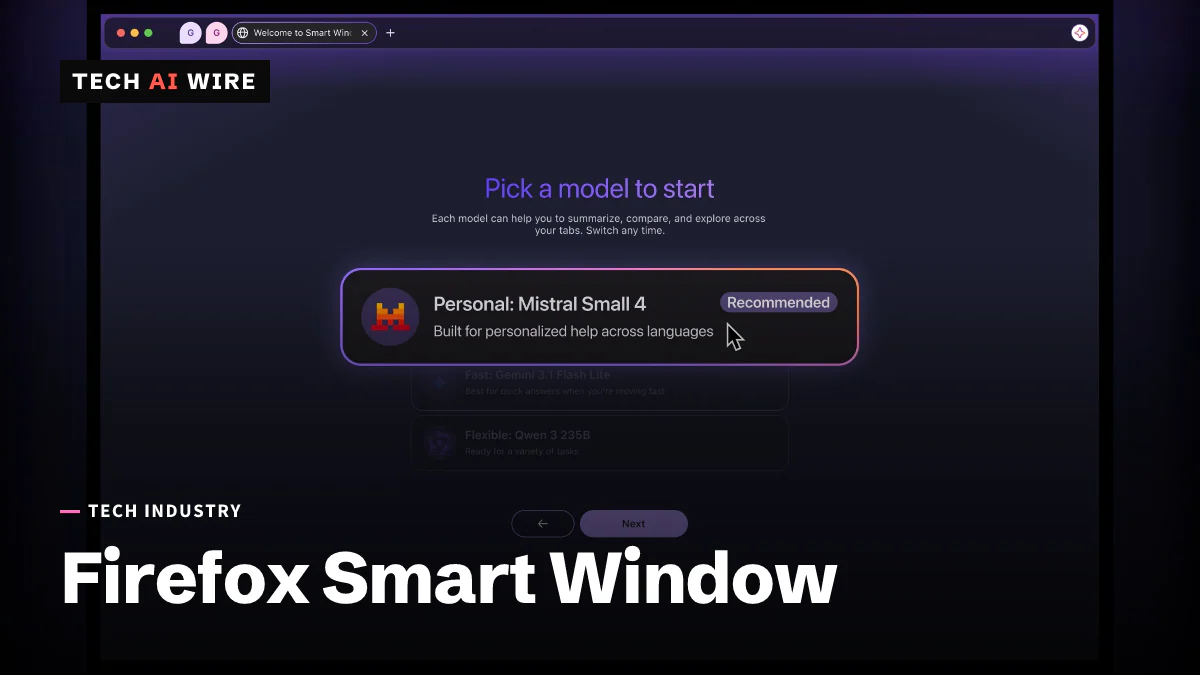
Firefox Smart Window beta now runs on Mistral Small 4
Mozilla says Mistral Small 4 powers the Smart Window beta in the US, Canada and France, and that users can still pick a different model.
Apple tightens macOS Full Disk Access over AI agents
Apple said on October 2 that Mac apps will need "very explicit user action" to get Full Disk Access, because AI agents make that access riskier.
The weekly digest
One email every Friday with the week's top stories from all six desks: AI, dev tools, coding, the tech industry, startups and what's next. Free, no spam.