Firefox 157 ships a redesign and hardware AV1 for WebRTC
Firefox 157, out September 29, 2026, adds hardware AV1 decoding for WebRTC calls, a CSS at-rule() test and Mozilla's biggest visual refresh in years.
4 min read
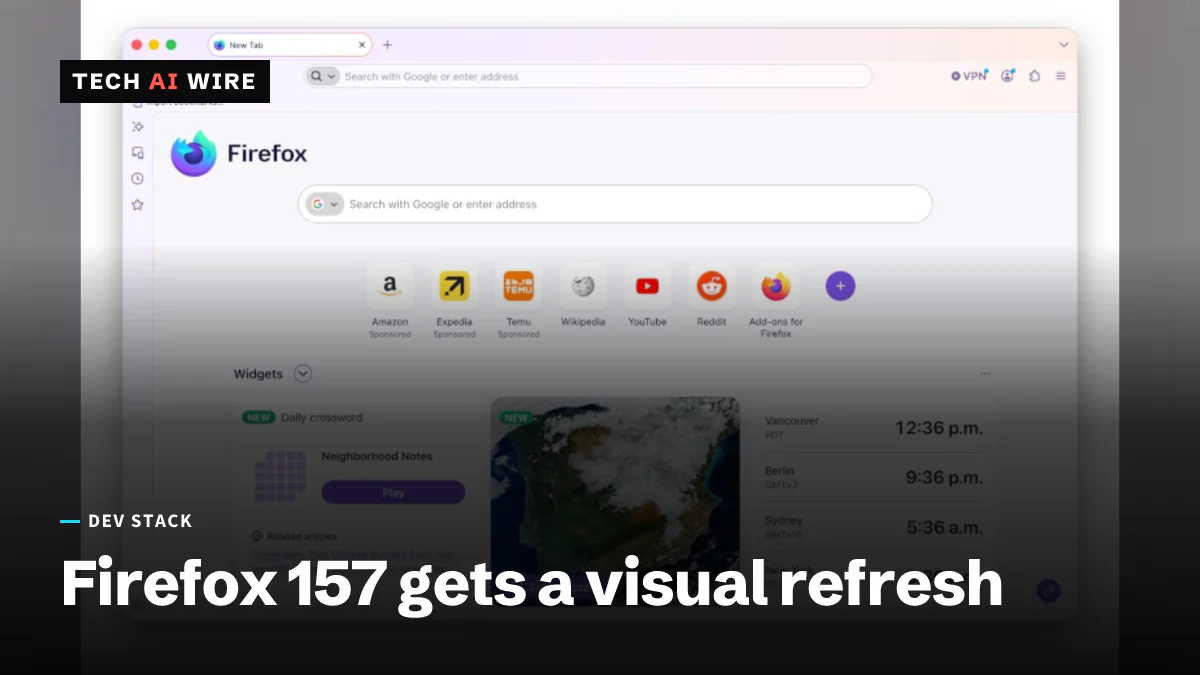
Mozilla released Firefox 157 on September 29, 2026. Its release notes call it "Firefox's biggest visual refresh in years." For web developers, the more useful changes sit underneath. WebRTC video calls can now use hardware AV1 decoding, and CSS gains a way to test whether the browser supports a given at-rule.
The release notes also leave something out. In August, Tech AI Wire reported Mozilla's plan to turn on JPEG XL images by default in Firefox 157. Neither of Mozilla's two release documents for this version mentions the format.
A new look, new themes and a compact mode
Mozilla's release notes describe a "modernized look" across the toolbars, sidebar, menus and individual features. It is built on Mozilla's updated design system. LWN's post points to the rounded corners and the redesigned tab groups.
Two options come with the new look. Firefox now has built-in themes, each with a light and a dark version. A new compact mode shrinks the spacing around toolbars and tabs to leave more room for the page itself. Mozilla says that helps on small screens and in split-screen layouts.
Hardware AV1 decoding for video calls
WebRTC is the browser technology that web apps use for live video and voice calls. AV1 is a modern video compression format. Until this release, Firefox always decoded AV1 video in software, on the computer's main processor.
Firefox 157 can hand that job to the device's video hardware instead. The release notes say this works "on devices that support it." On other machines, Firefox keeps decoding AV1 in software as before.
What web developers get in Firefox 157
MDN, Mozilla's developer documentation site, lists the changes that are switched on for everyone. An at-rule is a CSS rule that starts with @, such as @media or @scope.
| Area | Change in Firefox 157 |
|---|---|
| CSS | at-rule() inside @supports tests whether the browser supports an at-rule, for example @supports at-rule(@scope) |
| CSS | at-rule() also works in the supports() condition of @import |
| CSS | overscroll-behavior gets a chain value: scrolling passes to the next scrollable area, with no bounce at the edge |
| WebGPU | Supports the TRANSIENT_ATTACHMENT texture usage type |
| Animation | Animation.reverse() now plays even when playbackRate is 0 |
| WebDriver BiDi | browser.setDownloadBehavior requires destinationFolder when the type is "allowed" |
WebGPU is the browser API for running graphics and compute work on the graphics card. WebDriver BiDi is the protocol that test tools use to drive a browser. The download change matters most to anyone running automated browser tests.
Experimental features behind preferences
Some new features ship switched off. MDN's Firefox 157 notes list each one with the preference that turns it on.
- ML-KEM in Web Crypto (
dom.webcrypto.encapsulation.enabled). ML-KEM is a way for two parties to agree on a secret key that is designed to resist attacks by quantum computers. It adds methods such asencapsulateKey()anddecapsulateKey()and supports ML-KEM-512, ML-KEM-768 and ML-KEM-1024. It is on by default in Nightly, Firefox's daily test build. - Sanitizing while parsing (
dom.security.sanitizer.while-parsing).Element.setHTML()now removes unwanted elements and attributes as it reads the markup. Before, it parsed everything first and cleaned up afterward. - A
navigateoption for notifications (dom.webnotifications.navigate.enabled). A notification can carry a URL to open when clicked. When it does, theclickandnotificationclickevents no longer fire.
Other changes
Amazon is no longer a built-in search engine, though users can still add it by hand. The site information panel now warns when TLS key logging is on. That setting saves the keys for encrypted connections to a file, so anyone with the file can read the traffic.
Older systems move to a separate track. Windows 8.1 and earlier, and macOS 10.14 and earlier, now need Firefox ESR, the Extended Support Release, according to Mozilla.
What about JPEG XL?
JPEG XL is an image format built to replace JPEG with smaller files. Tech AI Wire's August report, based on Mozilla's intent-to-ship post, named Firefox 157 as the release that would enable it. Neither Mozilla's release notes nor MDN's page for Firefox 157 mentions "JPEG XL", "JXL" or "image/jxl". The notes do not say whether the plan has changed.
What this means for developers
If your web app makes video calls, test it on Firefox 157 with AV1 on hardware that can decode it. Compare processor load against Firefox 156. Keep other video formats available in the call setup, because Mozilla ties the new path to device support.
Use at-rule() to guard styles that depend on a newer at-rule. Write the fallback styles first, then add the at-rule version inside the @supports block. Browsers that do not understand the test simply skip the block.
Check your browser tests. Any call to browser.setDownloadBehavior that sets the type to "allowed" must now pass a destinationFolder. Fix those calls before a Firefox 157 runner starts failing downloads in your test suite.
Do not assume JPEG XL works. Test a .jxl file in Firefox 157 yourself before you serve one. Until the format shows up in the release notes, keep AVIF, WebP or JPEG as the fallback inside a picture element.
Treat ML-KEM as a preview. Try it in Nightly or behind its preference if your app handles long-lived secrets. Do not ship production code that depends on it until Mozilla turns it on for everyone.
Sources
- Firefox 157.0, See All New Features, Updates and Fixes - Mozilla
- Firefox 157 release notes for developers (Stable) - MDN Web Docs
- Firefox 157.0 released - LWN.net
Related articles

JPEG XL critique says AVIF now beats it on compression
A new benchmark puts AVIF ahead of JPEG XL across the fidelity range, and clocks a 1,918-byte JPEG XL file at 17.43 seconds to decode.
Chrome moves to a two-week release cadence
Chrome 153 starts a two-week milestone cycle, down from four. Google says Chrome 149 and 150 alone fixed 1,072 security bugs as LLMs find flaws at scale.
BragJack: one extension can hijack browser AI agents
BragJack lets one malicious extension take over the AI assistants in Chrome, Edge, Comet, Opera Neon and Claude in Chrome. Two CVEs, over $20,000 in bounties.
The daily brief
Three to five stories a day, and what each one means for the people who build software. Free, no spam.