Fedora 45 beta swaps the kernel console for kmscon
Fedora 45 moves the text console out of the kernel. Three tools stop working, and the beta landed September 15 with an automatic fallback to fbcon.
3 min read
By the numbers
- when the Fedora 45 beta arrived
- Sept 15
- how long kmscon has been in development, per LWN
- 10+ years
- tools named as incompatible: setfont, loadkeys, gpm
- 3
Fedora 45 replaces the text console that lives inside the Linux kernel with one that runs as an ordinary program. Red Hat's beta announcement on September 15, 2026 describes kmscon as "a modern userspace virtual terminal console," taking over from the in-kernel fbcon.
This is the black text screen you reach with Ctrl+Alt+F3, or the one you stare at when the desktop will not start. Moving it out of the kernel changes what happens on the worst day of your week.
Why the console is moving out of the kernel
The Fedora change proposal is blunt about the old one. It says fbcon is "not well maintained" and that it "lost scrolling support a few years ago due to a CVE." It also notes fbcon needs the kernel's fbdev emulation layer, while every current GPU driver uses the newer DRM interface instead.
So the code sat in the kernel, unmaintained, behind an emulation shim, with a feature removed for security reasons. The alternative is kmscon, which LWN describes as a userspace terminal emulator in development for more than a decade.
The gains named in the proposal are practical rather than grand. Keyboard layouts come from xkbcommon, the same library graphical sessions use. Unicode handling is wider. Scrolling works again. And a bug in a userspace program is a smaller problem than the same bug in kernel code.
What changes on a Fedora 45 system
The mechanics are small and worth knowing exactly.
| Item | Detail |
|---|---|
| Default console | kmscon, installed by default; kmscon-gl is a separate package |
| Wiring | The systemd autovt@.service symlink now points at kmsconvt@.service |
| Fallback | If kmscon fails to launch, the system falls back to getty and fbcon on its own |
| Opting out | Do not install kmscon, and the old path returns |
| Not affected | Installation, the boot process, and the disk-encryption passphrase prompt |
| Kernel plan | fbcon stays compiled in; the long-term goal is deprecating fbcon and fbdev emulation |
The fallback matters more than the feature. It's FOSS reports that if kmscon does not come up, the system reverts to the old getty and fbcon setup automatically, and that a user can switch back by hand. A console change that can strand you at a blank screen would be unshippable, so Fedora kept the old path compiled in.
What this means for developers
Three tools stop working, and they are named. The change proposal lists setfont, loadkeys and gpm as incompatible, along with starting graphical applications from kmscon without a wrapper script. If any of those appear in your provisioning scripts, your kiosk images or your recovery runbook, that is the specific thing to test on the beta.
Check your recovery path before you check the features. The console is what you use when networking is down and the desktop is broken, so it is also the one component you cannot debug remotely when it misbehaves. Boot the beta on hardware you can reach physically, switch to a virtual terminal, and try the things you would actually do in an outage.
Serial and headless setups deserve their own pass. The proposal scopes this change to the virtual terminal console, and it says the boot process and the encryption prompt are untouched. Confirm that on your own boxes rather than trusting the summary, because a server whose only console is a serial line has a different risk profile from a laptop.
The wider signal is about the kernel shrinking. The stated long-term goal is to deprecate fbcon and the fbdev emulation layer. That puts it in the same category as the kernel dropping 247,000 lines of old ARM platform code. It is maintenance debt getting paid down by deletion. Fedora is the distribution that usually takes that step first, and the rest follow once it holds.
Fedora 45 also carries a stack refresh worth planning around. Red Hat's announcement lists Python 3.15, Go 1.27, Ruby on Rails 8.1, LLVM 23 and Podman 6, plus enforced RPM signature verification and restricted unprivileged ptrace. The console is the interesting change, but the runtime bumps are the ones that will break a build.
Sources
- Changes/UseKmsconVTConsole - Fedora Project Wiki
- Fedora 45 Beta now available - Red Hat
- Fedora 45 beta drags the Linux console into the 21st century - LWN.net
- Fedora 45 is Replacing Decades-Old Kernel Console with a Safer, Modern Alternative - It's FOSS
Related articles
Ubuntu 26.10 moves cp, mv and rm to Rust coreutils
Ubuntu 26.10 hands cp, mv and rm to Rust. A 113-issue audit held those three back from 26.04 LTS, and stable arrives October 15.

Open-source firmware boots on a consumer AMD desktop board
Coreboot and AMD's openSIL now run on the MSI B850P, a real desktop AM5 board. It cuts closed-source firmware code by 79.1%, but it ships as a paid product, not a free download.
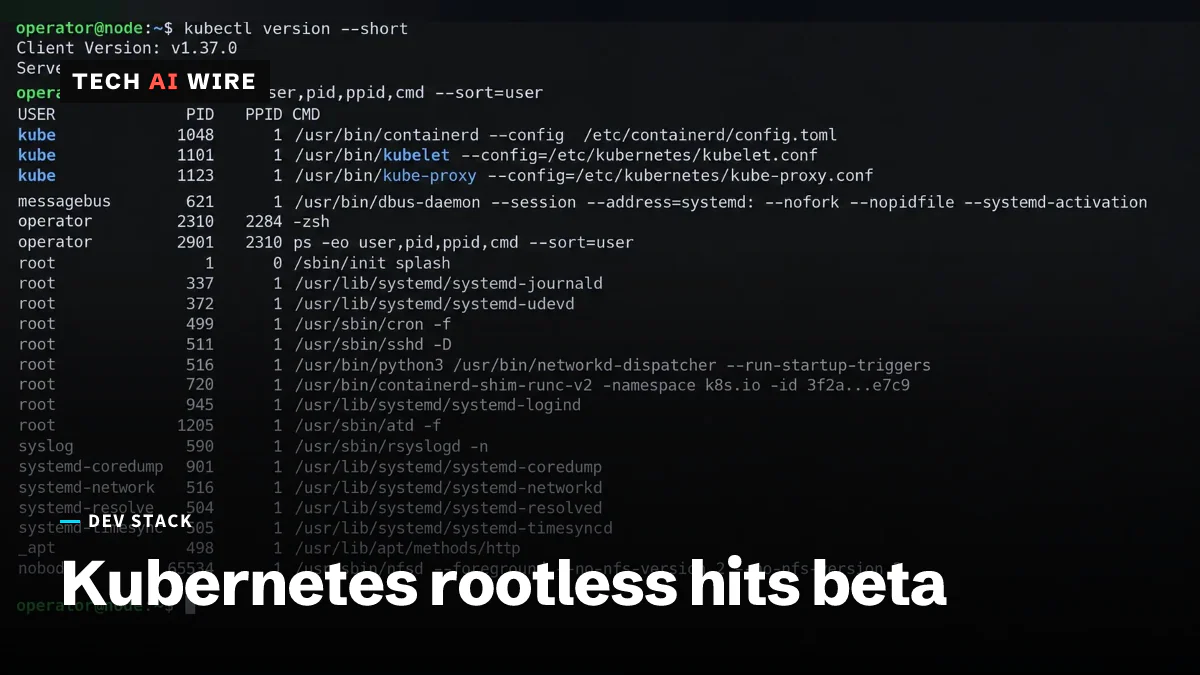
Kubernetes 1.37 promotes rootless mode to beta
Kubernetes 1.37 moves KubeletInUserNamespace to beta. The kubelet, container runtimes, CNI plugins and kube-proxy can now all run as a non-root user.
The daily brief
Three to five stories a day, and what each one means for the people who build software. Free, no spam.