Block's Dessa voice AI learned to talk without any text
Block's Dessa was trained only on recorded human conversation, no text, and runs on a MacBook Pro M4 Max. Safety researchers get it first; scam fears follow.
4 min read
By the numbers
- in Dessa's training data, only human conversation
- No text
- Nvidia GB200 NVL72 system used to train it
- 1
- minimum MacBook Pro chip to run it locally
- M4 Max
Block, the company behind Square and Cash App, has unveiled Dessa, a voice AI model trained only on recordings of people talking, with no written text at all. Block posted the research preview on October 23, 2026, and says the model runs on a MacBook Pro. If the claims hold up, Dessa points to voice assistants that hear tone and emotion instead of reading a transcript.
There is no public release yet. Block is giving early access to a small group of AI safety researchers first, with a waitlist for everyone else, according to Block's Dessa page.
How Dessa differs from today's voice AI
Most voice assistants work in steps. They turn your speech into text, let a text model write a reply, then read that reply aloud. Block argues that pipeline loses most of what a voice carries. "It turns your voice into text and throws away an incredible amount of information text alone can't carry," the company wrote, according to TechCrunch.
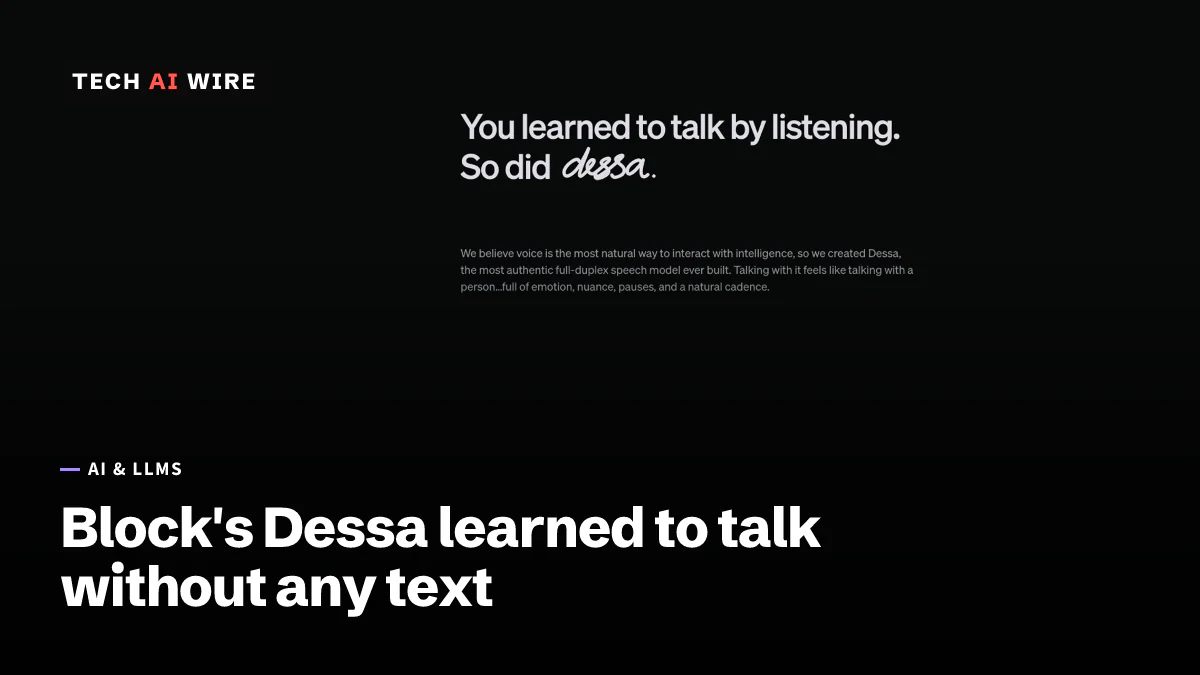
Dessa skips the text. Audio goes in and audio comes out. "We trained Dessa from scratch on nothing but human conversation," Block's page says, with no text and no pretrained language model underneath.
Dessa is also full-duplex. That means it listens and speaks at the same time, like a phone call rather than a walkie-talkie. It can cut in, react to interruptions, laugh, and give short replies such as "yeah!" while you are still talking. Block calls it "the most authentic full-duplex speech model ever built," a claim no outside tester has checked yet.
Training and hardware
Block says Dessa learned language from "hundreds of times fewer words" than a large language model needs. Its page notes that a spoken word takes thousands of times more bytes than the same word written down.
Training ran on one Nvidia GB200 NVL72, a rack-scale system with 72 Blackwell GPUs, according to Block's page and Notebookcheck. TechCrunch's report quoted Block as saying "a single NVIDIA GPU." Block's own page names the full GB200 NVL72 system.
Running the model takes far less. Block says Dessa works locally on a MacBook Pro with an M4 Max chip or better, faster than real time.
| What Block has said | What it has not said |
|---|---|
| Trained only on human conversation | How many hours, or where the recordings came from |
| Trained on one GB200 NVL72 | Model size or parameter count |
| Runs on a MacBook Pro M4 Max or better | Latency in milliseconds |
| Safety researchers get access first | Release date, price, license or weights |
Block has published no paper and no benchmark scores, CoinDesk and Notebookcheck note. Its demos are chosen by Block. One demo pairs Dessa with GPT-Live-1, an AI voice whose developer Block says is not affiliated with it.
Who built it
The lab is led by Ragavan Thurairatnam. Its members come from Dessa, a Toronto deep learning startup that Square bought in 2020 and whose name the model now carries, CoinDesk reports. "A model that learned to talk from sound alone is new territory, and we want outside eyes on it," Thurairatnam wrote on Block's page.
Jack Dorsey, whose company built the model, praised the result on X. "Talking with it feels like talking with a person…full of emotion, nuance, pauses, and a natural cadence," he wrote, as quoted by CoinDesk.
Scam fears
The same realism worries people. Filmmaker Justine Bateman asked whether the point was so "you can trick people into lowering their guard," CoinDesk reports. Journalist Shiv Aroor wrote: "Scam calls about to attain pandemic level."
Block's page frames safety differently. It argues that voice AI which cannot hear distress is the risk, and it wants researchers to test Dessa early. The page does not mention watermarks, limits on voice cloning or other misuse controls.
Dessa arrives in a busy month for voice models. Tech AI Wire covered ElevenLabs' Eleven Realtime voice agents and xAI's Grok Voice 3.0 in October.
What this means for developers
There is nothing to build on yet. Dessa has no API, no weights and no license. If you work on voice products, join the waitlist and wait for real access before planning around it.
Watch the on-device claim. A full-duplex voice model that runs faster than real time on a laptop would change the cost of voice apps. Calls would not need a cloud round trip for every reply. Check whether a smaller Mac can run it once Block publishes requirements.
Plan for a world where voices can't be trusted by sound alone. If your app handles payments, support calls or account recovery, do not rely on a voice that "sounds human" as proof of anything. Add callback numbers, in-app confirmation or other checks that a synthetic voice cannot pass.
Ask Block the open questions before you adopt it: where the training conversations came from, whether speakers consented, and what stops the model from copying a real person's voice.
Sources
- Dessa - the Conversation Model trained only on speech - Block
- Block's new voice model sounds eerily human - TechCrunch
- Jack Dorsey's new voice AI is impressing users and alarming fraud watchers - CoinDesk
- Jack Dorsey's new AI never read a single word, yet it can hold disturbingly human conversations - Notebookcheck
Related articles

Nvidia RTX Spark laptops go on sale from $2,599
Nvidia RTX Spark laptops from six makers went on sale on October 16 from $2,599, with up to 128GB of memory and a new 74B open model, Nemotron 3.5 Bolt.
Surface Laptop Ultra with RTX Spark starts at $2,599
Microsoft's Surface Laptop Ultra pairs Nvidia's RTX Spark chip with up to 128 GB of shared memory. It costs from $2,599.99, with preorders open and shipping October 16.
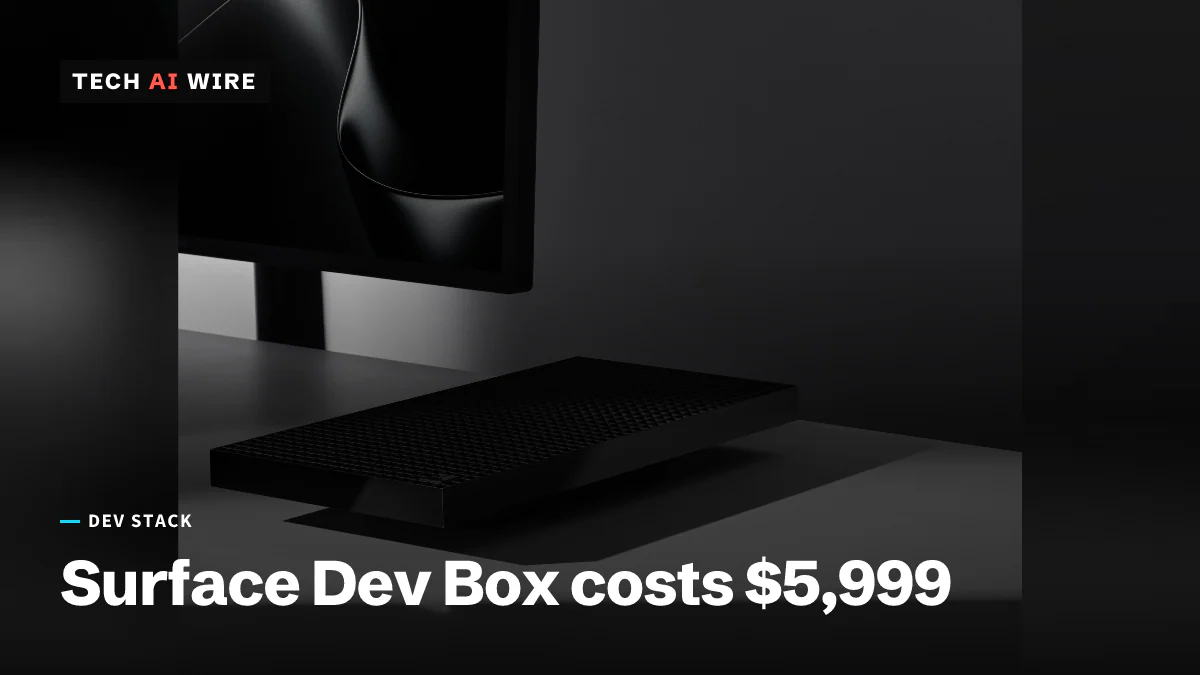
Surface RTX Spark Dev Box opens for preorder at $5,999
Microsoft opened US preorders for the Surface RTX Spark Dev Box at $5,999 on October 7, 2026, with 128GB of unified memory for local AI models.
The weekly digest
One email every Friday with the week's top stories from all six desks: AI, dev tools, coding, the tech industry, startups and what's next. Free, no spam.