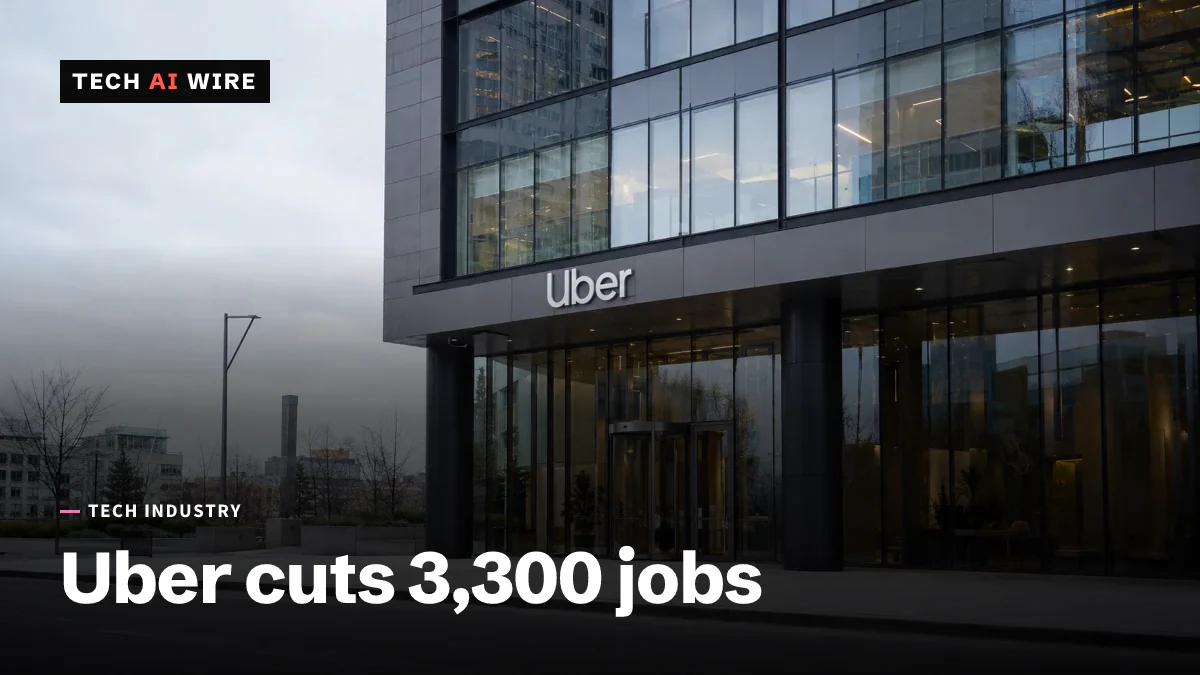
Uber cuts 3,300 jobs and nearly ends remote work in a re-org
Uber is cutting 3,300 jobs, about 10% of staff, and trimming management positions by 20%. Fewer than 1% of employees will be allowed to stay fully remote.
4 min read
By the numbers
- jobs cut, about 10% of global headcount
- 3,300
- reduction in management positions
- 20%
- of staff still allowed to work fully remote
- 1%
- End of 2025
- 34000
- Projected after cuts
- 30000
Uber is cutting about 3,300 jobs, roughly 10% of its global headcount, TechCrunch reported on September 2, 2026. The company is also nearly ending remote work, and that second change will reshape who can work there. Fewer than 1% of staff will be allowed to stay fully remote.
This is not a response to falling demand. It is a re-organization aimed at the shape of the company itself.
What is actually being cut
The cuts target the middle of the org chart, not one product line.
TechCrunch reports that management positions are being reduced by 20%. Teams made up of only one or two people are being cut by about 50%. Anyone sitting more than seven layers below the chief executive is being removed. Some managers are not leaving at all. They are moving into individual contributor roles, which means going back to doing the work rather than supervising it.
Whole functions are being merged. TechCrunch says engineering, science and delivery are being consolidated. Within delivery, the separate operations for restaurants, retail and white-label services are being combined into one.
Chief executive Dara Khosrowshahi framed the problem as an accumulation of structure. Growth "has also brought complexity: more layers, more coordination, more fragmented ownership," he said. He described structures "that made sense when businesses were smaller but no longer serve us well at our current scale."
The remote work change
The headcount number will get the attention. The location policy may matter more.
TechCrunch reports that less than 1% of the workforce will be permitted to remain remote. The Sunday Guardian puts the figure at about 1% and says the remaining staff will be concentrated around major hubs, naming San Francisco and New York. The existing three-day office requirement stays in place, according to both the Sunday Guardian and Tradingpedia.
That is a hiring change as much as a working change. A company that keeps fewer than one in a hundred people remote is a company recruiting from a handful of metropolitan areas.
Where the money is going
The Sunday Guardian connects the cuts to a spending shift toward driverless vehicles.
It reports that Uber has committed more than $10 billion to autonomous vehicle development over the coming years. It names three partners: Rivian, NVIDIA and Pony.ai. The Rivian partnership is planned to put up to 50,000 robotaxis on the road in San Francisco and Miami by 2028.
The same report puts Uber's headcount at roughly 34,000 at the end of 2025, falling to around 30,000 after the cuts. Investors read the news as cost discipline. Shares rose more than 2% in premarket trading, the Sunday Guardian reports.
| Change | Figure |
|---|---|
| Jobs cut | 3,300, about 10% of headcount |
| Management positions | Down 20% |
| Teams of one or two people | Down about 50% |
| Reporting depth removed | More than seven layers below the CEO |
| Fully remote staff allowed | Under 1% |
| Autonomous vehicle commitment | More than $10 billion |
What this means for developers
Read this as a span-of-control change, because that is what the numbers describe. Cutting one and two-person teams by half is not a cost decision, since tiny teams cost little. It removes the management slots those teams justified. If you manage two people at a large company, that structure is now a documented target.
The individual contributor detail is the useful signal. Uber is moving managers back into hands-on roles rather than removing them entirely. Engineers who took a management track for advancement should notice that the ladder narrowed at a company that grew fast for a decade.
For anyone job hunting, the location policy is the concrete thing to check. Under 1% remote means remote is an exception granted to specific people, not a category you can apply into. Ask where a role actually sits before you invest in the process, and treat "hybrid" job listings from large companies as three days in a named office until proven otherwise.
Watch the consolidation of engineering, science and delivery for what it implies about internal tooling. Merged organizations usually merge their platforms next, and duplicated services are the first thing to be reviewed. If you work somewhere that runs three versions of the same internal system for historical reasons, this is the pattern that ends that.
One caution about reading across. Uber is spending more than $10 billion on autonomous vehicles while cutting 10% of staff, so this is a reallocation, not a retreat. A company can shrink its headcount and increase its engineering ambition at the same time. Do not treat this as a signal that Uber is slowing down.
Sources
Related articles
Nevada approves thousands of paid robotaxis for Las Vegas streets
Nevada's Transportation Authority cleared Tesla, Waymo, and Uber to run paid robotaxis in Clark County - up to 5,000 for Tesla alone - within the next 12 months.

Volvo expands NVIDIA deal for eyes-off driving
Volvo will build its next automated driving system on NVIDIA Hyperion, Halos OS and Alpamayo. It should reach Volvo cars before 2030, with China excluded.
Waymo closes $5 billion loan, its first debt financing
Waymo closed a $5 billion term loan on October 8, its first debt deal, led by PIMCO, Blackstone and Sixth Street, to expand its robotaxi service abroad.
The weekly digest
One email every Friday with the week's top stories from all six desks: AI, dev tools, coding, the tech industry, startups and what's next. Free, no spam.