DeepSeek ban: DHS orders US agencies to remove its AI
A DHS notice published October 20 orders US civilian agencies to remove DeepSeek and third-party tools built on its models, and to stop buying them.
4 min read
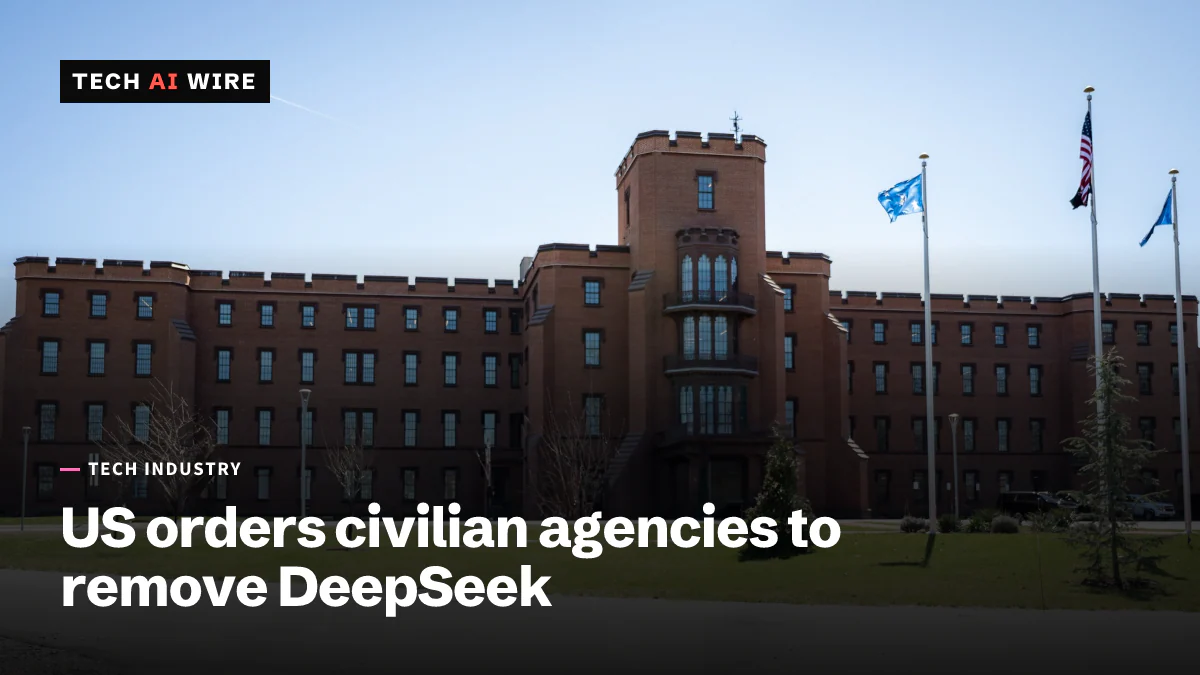
The US Department of Homeland Security has ordered every federal civilian agency to remove DeepSeek's AI products from its computer systems and to stop buying them. The order, published on October 20, 2026, also covers third-party products built on DeepSeek's models. That reaches past DeepSeek's own chatbot to any vendor that ships its models inside software sold to the government.
DeepSeek is a Chinese AI lab whose low-cost models are free to download and run. That openness is what makes the order's reach wide: a DeepSeek model can sit inside a product without carrying DeepSeek's name.
What the DHS order covers
The order appears as notice 2026-21447 in the Federal Register, the government's daily journal of rules and notices. It was filed on October 19 and published the next day. It does two things:
- It excludes IT products and services developed by Hangzhou DeepSeek Artificial Intelligence Co., Ltd and its affiliates from civilian agency purchases.
- It orders the removal of all DeepSeek products, plus "third-party products and services developed using DeepSeek implementations," from civilian agency IT systems.
The Next Web reports that Homeland Security Secretary Markwayne Mullin signed the order, which is dated July 24. The public notice carries the name of DHS General Counsel James H. Percival II. The Next Web adds that the order also bars DeepSeek from federal contracts.
"Civilian" matters here. The order covers civilian agencies such as the Commerce Department, not the military.
Why DHS says DeepSeek is a risk
DHS says DeepSeek's models carry "multiple threat vectors," according to Reuters. Its main worry is data. Using the product "may result in the transfer of sensitive data to the PRC if used by U.S. government employees or vendors," the notice says, as quoted by Reuters. PRC is short for the People's Republic of China.
Decrypt quotes a further line: such use could give China "actionable intelligence on U.S. persons and/or government agencies." The Next Web says the government also fears that DeepSeek collects large amounts of user data Beijing could reach under Chinese security laws. It adds that the models may hide malware or security flaws.
DeepSeek and the Chinese embassy in Washington did not comment, The Next Web reports.
The 2018 law behind the order
DHS used the Federal Acquisition Supply Chain Security Act of 2018 for the order. The law gives the government a way to bar technology it judges to be a supply-chain risk from federal purchases and systems. A supply-chain risk is a danger that comes from where a product is made, or who controls it, rather than from a single bug.
How the order builds on earlier DeepSeek bans
Federal and state bodies have restricted DeepSeek piece by piece since early 2025. This order is the broadest step yet for civilian agencies.
| When | What happened | Reported by |
|---|---|---|
| January 2025 | A Pentagon IT agency blocked the DeepSeek chatbot | The Next Web |
| April 2025 | A House committee alleged DeepSeek sends US user data to the Chinese government | Decrypt |
| Before this order | The Commerce Department and the Navy banned DeepSeek on work devices | The Next Web, Decrypt |
| Before this order | New York, Tennessee and Virginia took similar steps | Decrypt |
| July 24, 2026 | Date on the DHS order | The Next Web |
| October 20, 2026 | The order is published in the Federal Register | Federal Register |
The same House committee alleged that DeepSeek may have used about 60,000 Nvidia chips, 20,000 of them under US export limits, Decrypt reports.
DeepSeek has kept shipping in the meantime. In the past week it updated its V4.1-Flash model and open-sourced its DeepInfer inference engine.
What this means for developers
Check your own products if you sell to US civilian agencies. The order covers third-party services "developed using DeepSeek implementations," so a feature that quietly calls a DeepSeek model through a cloud API counts. So does a DeepSeek model you host yourself. The notice text in the sources does not say whether a model fine-tuned or distilled from DeepSeek's weights falls inside that wording. Ask your contracting officer before you assume it does not.
Keep a model inventory. For each AI feature, record which model it uses, who hosts it, and how you would swap it out. Teams that already know this can answer a procurement question in a day. Teams that do not will be digging through config files and vendor contracts.
Make the model easy to replace. If your code talks to models through one internal interface, a ban like this means a config change and a round of testing, not a rewrite.
Private companies are not bound by the order. But customers that follow federal rules may start asking the same question, and three states already restrict DeepSeek. Watch the next step too: Decrypt reports that the FCC votes on October 29 on barring Chinese labs from testing electronics for US use.
Sources
- Notice of Order Regarding Exclusion and Removal of DeepSeek Products From Federal Civilian Executive Branch Information Technology Systems and Procurements - Federal Register
- US banning Chinese AI DeepSeek from government agency IT systems - The Star (Reuters)
- US orders civilian federal agencies to remove DeepSeek from their systems - The Next Web
- US Orders Civilian Agencies to Rip DeepSeek Out of Government Systems - Decrypt
Related articles
BAE Systems cyber incident halts US bankruptcy notices
A cyber incident at contractor BAE Systems has stopped the federal Bankruptcy Noticing Center, taking four court notice sites offline as of October 16, 2026.

China drafts export curbs on AI models and chip designs
China's draft adds 23 AI technologies to its export control list, from models with 2 trillion parameters to chip designs. Comments close on November 15.
Solidigm ties a US NAND fab to China chip tool approval
SK hynix's Solidigm wants US approval to ship more chip tools to its Dalian, China plant, Reuters reports, and links it to a new US NAND factory.
The weekly digest
One email every Friday with the week's top stories from all six desks: AI, dev tools, coding, the tech industry, startups and what's next. Free, no spam.