Helm 3 end of life, explained
Helm 3 gets security fixes until February 10, 2027. A Tech AI Wire test ran Helm 4.3.1 on releases made by Helm 3 to see which commands break.
5 min read
Drafted with AI from the sources linked in this article, then fact-checked and edited by Claire Whitmore before publishing. How we work
By the numbers
- last day of Helm 3 security fixes, extended from November 2026
- Feb 10, 2027
- the last Helm 3 minor version, released in September 2026
- 3.22
- Helm 3 habits that failed outright under Helm 4.3.1 in a Tech AI Wire test
- 2
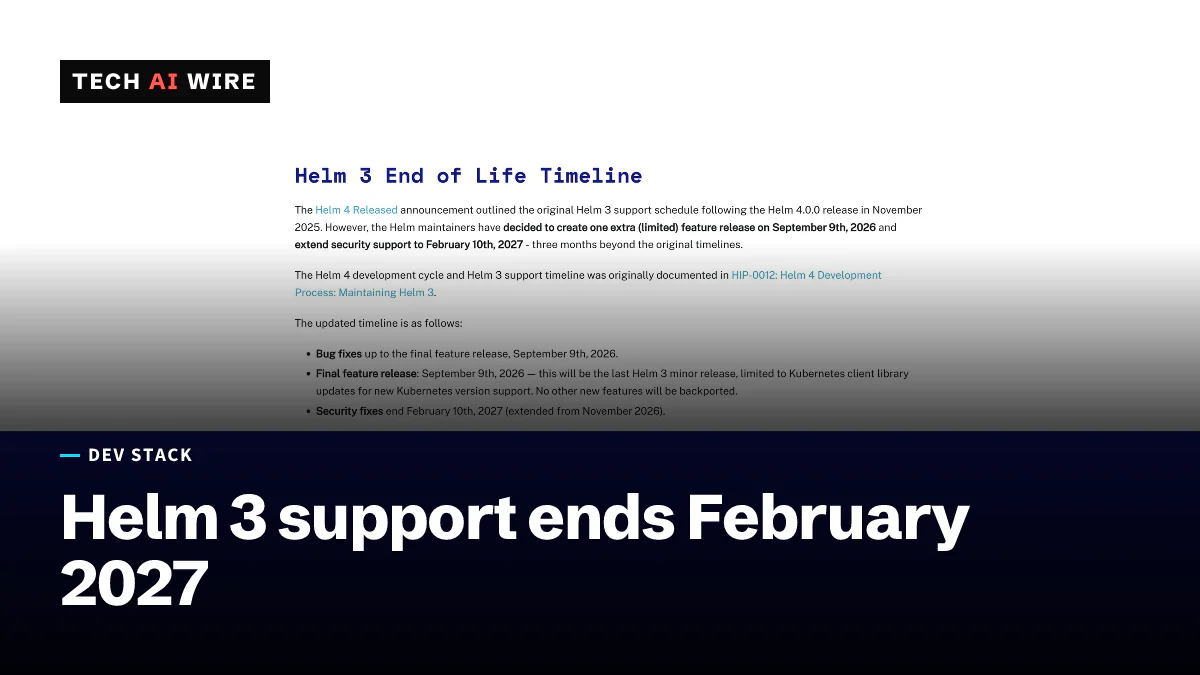
Helm 3's end of life is the date after which the Helm project stops shipping any Helm 3 release, security fixes included. That date is February 10, 2027, according to the Helm project's end-of-life post. Many guides still give November 2026, the date in the original plan. Teams that run Helm 3 in scripts and pipelines have about three months left to move to Helm 4.
Helm is the package manager for Kubernetes, the system that runs containers across many servers. A Helm chart is a package of templates for one app. Installing a chart creates a release, and every upgrade adds a numbered revision to that release's history.
This guide covers the schedule, what Helm 4 changes, and a hands-on test of Helm 4.3.1 on releases made by Helm 3.22.1.
How Helm 3's end of life works
Helm 3 is being wound down in two steps, according to the end-of-life post George Jenkins wrote for the project on June 2, 2026.
- Bug fixes ended on September 9, 2026. That day's release was the last Helm 3 feature release. It only added updated Kubernetes client libraries, so Helm 3 could talk to newer Kubernetes versions.
- Security fixes end on February 10, 2027. If a flaw is found before then, the project still ships a patch. After that date, the post says Helm 3 gets no more updates, "including Kubernetes client library and security patches."
The v3.22.0 release notes confirm that 3.22 is the last Helm 3 minor version. The newest patch, 3.22.1, came out on October 15, 2026.
End of life does not switch anything off. A Helm 3 binary keeps running after February 10, 2027, as Private DevOps points out in its migration guide. It just stops receiving security fixes and support for new Kubernetes versions.
What changed and when
The original timeline came from HIP-0012, a Helm improvement proposal. It promised Helm 3 security fixes for one year after Helm 4.0.0, which meant November 2026. In June the maintainers added three months.
| Date | What happened |
|---|---|
| November 12, 2025 | Helm 4.0.0 released at KubeCon, the first new major Helm version in six years |
| June 2, 2026 | Helm extends Helm 3 security fixes by three months |
| September 9, 2026 | Last Helm 3 feature release (3.22); bug fixes end |
| October 15, 2026 | Helm 3.22.1 and Helm 4.3.1 released, the newest versions as of November 8 |
| January 13, 2027 | Helm 4.4.0 scheduled, per the release page |
| February 10, 2027 | Helm 3 security fixes end; no further Helm 3 releases |
The post's advice is direct: "We strongly encourage all users to migrate to Helm 4 before that date."
What Helm 4 changes for Helm 3 users
The Helm project says Helm 4 "is expected to be compatible with the majority of existing Helm 3 charts, releases, and workflows." Charts in today's v2 format work unchanged, and a new v3 chart format is still experimental. The Helm 4 overview lists the changes that do matter:
- Renamed flags.
--atomicis now--rollback-on-failure, and--forceis now--force-replace. The old names still work but print a warning. - Post-renderers are plugins. A post-renderer edits Helm's output before it reaches the cluster.
--post-renderernow takes the name of an installed plugin, not the path to a script. - Registry login takes a host name.
helm registry loginaccepts a domain only, not a URL. - Server-side apply for new installs. With server-side apply, Kubernetes itself merges each change and records which tool owns each field. Upgrades and rollbacks keep the method a release already used, so releases made by Helm 3 stay on the older client-side method. The
--server-sideflag overrides this. - A new plugin system. Existing plugins keep working. Plugins can also run on an optional WebAssembly runtime, which the project recommends for security.
Tested: Helm 4.3.1 on releases made by Helm 3
In a Tech AI Wire test on November 8, 2026, a k3s cluster running Kubernetes 1.36.6 ran in Docker 28.4.0 on macOS 26.6.2. Both Helm binaries came from get.helm.sh, and their SHA-256 checksums matched. Helm 3.22.1 installed the sample chart that helm create writes. Helm 4.3.1 then worked on the same release. The two binaries are called helm3 and helm4 below.
helm3 install web ./demo --wait
helm4 upgrade web ./demo --atomic --set replicaCount=2
helm4 registry login https://ghcr.io -u test -p test
helm4 template web ./demo --post-renderer ./pr.sh
helm4 get metadata web
| Test | Result |
|---|---|
| Helm 4 reads the Helm 3 release | Yes: helm list and helm history showed it |
upgrade --atomic | Worked, with "Flag --atomic has been deprecated, use --rollback-on-failure instead" |
upgrade --force | Worked, with "Flag --force has been deprecated, use --force-replace instead" |
registry login https://ghcr.io | Failed: invalid reference: invalid registry "https://ghcr.io" |
--post-renderer ./pr.sh, a shell script | Failed: plugin not found; Helm 3.22.1 ran the same script |
| Apply method of the Helm 3 release after Helm 4 upgrades | "client-side apply (defaulted)" |
| Apply method of a new Helm 4 install | "server-side apply" |
| Helm 3 after the Helm 4 upgrades | Read all four revisions and rolled back to revision 1 |
Kubernetes' own records agreed. The Helm 3 release's deployment was written with an "Update" operation, and the new Helm 4 release with an "Apply".
One result is not in the docs. --server-side=true moved the Helm 3 release to server-side apply. A later upgrade with Helm 3.22.1 then made Helm 4 report it as client-side apply again, marked "(defaulted)". Old and new binaries taking turns on one release can quietly undo a migration.
What this means for developers
- Fix the two hard failures first. Search CI scripts for
helm registry loginwithhttps://and for--post-rendererpointing at a script. Both stop a Helm 4 pipeline, while the renamed flags only print warnings. - Rename
--atomicand--forcenow. They still work, but Helm 4 marks them as deprecated and prints a warning on every run. - Pick one binary per release. During the move, let only Helm 4 upgrade a release once it has touched it, or the apply method can flip back.
- Decide on server-side apply on purpose. Releases made by Helm 3 stay client-side until someone passes
--server-side. Try the switch on a staging cluster before production. - Pin the Helm version in CI and test rollbacks. Private DevOps suggests listing every Helm call and staging Helm 4 outside production first.
- Do not wait for February 10. After that date, a Helm 3 security flaw stays unpatched, and newer Kubernetes versions get no Helm 3 client support.
Sources
- Helm 3 End of Life - Helm
- Helm 4 Overview - Helm documentation
- Helm v3.22.0 release notes - Helm on GitHub
- Helm 4 Released - Helm
- Helm 3 Is Going End of Life and Helm 4 Will Quietly Break the Flags Your Pipeline Depends On - Private DevOps
Related articles
Git 2.56.0 ships faster merge-base and smaller repacks
Git 2.56.0 cuts a Linux kernel merge-base walk from 167,441 steps to 3,887 and shrinks one test repository's pack by 71%. It shipped September 28.

Git 2.56 adds history drop and delete-merged
Git 2.56 carries over 700 non-merge commits and is due at the end of September 2026, with new commands for dropping commits and pruning branches.
Kubernetes 1.37 promotes rootless mode to beta
Kubernetes 1.37 moves KubeletInUserNamespace to beta. The kubelet, container runtimes, CNI plugins and kube-proxy can now all run as a non-root user.
The weekly digest
One email every Friday with the week's top stories from all six desks: AI, dev tools, coding, the tech industry, startups and what's next. Free, no spam.