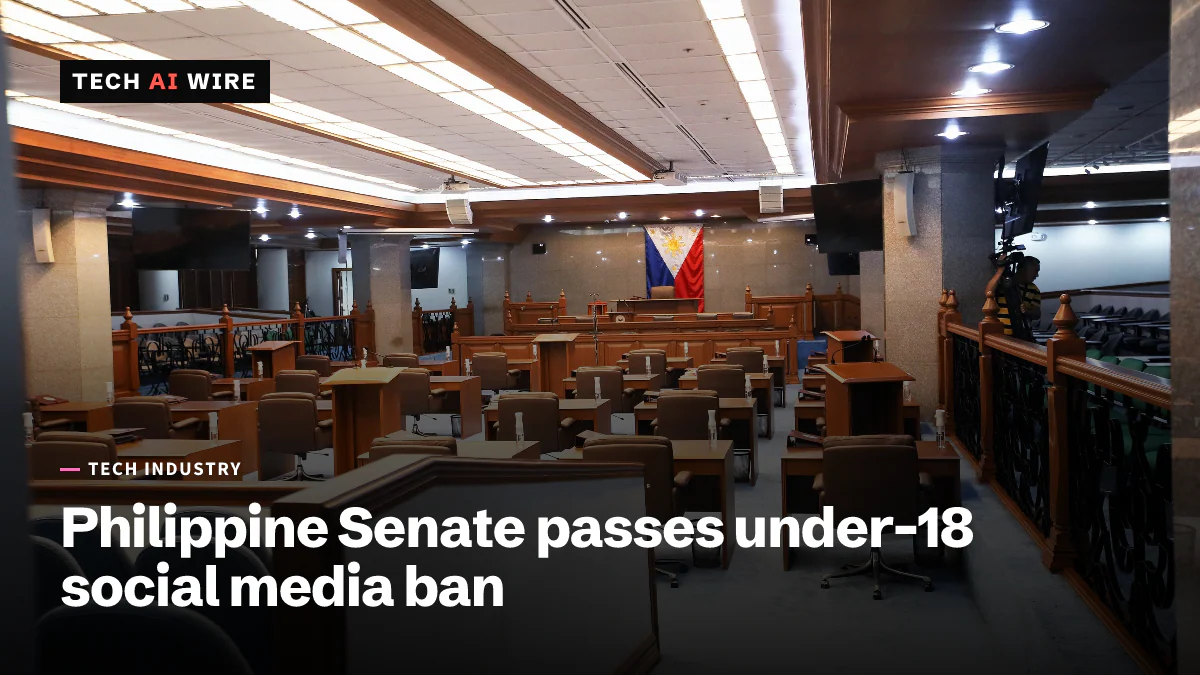
Philippine Senate passes under-18 social media ban bill
The Philippine Senate voted 16-1 for the SMART KIDS Act, which would bar under-18s from social media. The House version sets a lower age limit of 13.
3 min read
Drafted with AI from the sources linked in this article, then fact-checked and edited by Claire Whitmore before publishing. How we work
By the numbers
- Senate vote for Senate Bill 2424
- 16-1
- minimum age in the Senate bill
- 18
- minimum age in the House version
- 13
- top fine per violation, in Philippine pesos
- P20M
The Philippine Senate voted 16-1 on October 8, 2026 to bar children under 18 from social media and other age-restricted platforms. The measure, Senate Bill 2424, is called the SMART KIDS Act, short for Safe Media Access and Responsible Technology for Kids in Digital Spaces. Platforms would have to check users' ages and remove existing accounts held by minors. It is not law yet: the House of Representatives has passed a softer version with a minimum age of 13.
Senator Robin Padilla sponsored the bill and called it "an important step to strengthen the protection of children online," Daily Tribune reports. Senator Risa Hontiveros cast the only vote against it.
What the bill requires
The bill covers social media and other services it calls "high-risk" or "age-restricted." Under it, platforms would have to:
- make sure no one under 18 can open or use an account
- use age assurance, meaning a way to check a user's age, though neither report describes the method
- suspend, restrict, disable or remove existing accounts that belong to users under 18
Several kinds of service are left out. ID Tech Wire lists email, private messaging, online games not mainly for social networking, educational platforms, news services and professional collaboration tools. The Department of Information and Communications Technology would run a public platform for reporting suspected violations, ID Tech Wire adds.
The penalties
Fines are in Philippine pesos, written as P. The two reports give different figures:
| Detail | Daily Tribune | ID Tech Wire |
|---|---|---|
| Fine per violation | P1 million to P20 million | P5 million to P20 million |
| Daily fine until fixed | Not mentioned | P100,000 a day |
| Who can be fined | Platforms, age-verification providers, government agencies | Platforms |
| Parents who help a child get around the checks | Not mentioned | Up to P50,000, plus community service |
The final enrolled text will settle which figures stand.
Why lawmakers moved
The two reports stress different reasons. Daily Tribune says the push followed a series of deadly school shootings involving enrolled minors. Lawmakers blamed overexposure to social media and online gaming, and said groomers were exploiting the platforms. ID Tech Wire points instead to cyberbullying and unsafe online content.
Hontiveros agreed that "the risks and dangers are real." But she argued "the issue is how we can effectively protect them," Daily Tribune reports. She favored stricter safeguards, controls on recommendation algorithms and stronger platform accountability over an outright ban.
What happens next
The House took a different route. House Bill 11566 would bar children under 13 from creating or keeping social media accounts, and it passed second reading this week, ID Tech Wire reports. The Senate and House must reconcile their two versions before either can become law. The final age limit, 13 or 18, is the biggest gap between them.
What this means for developers
- Plan for age checks in the Philippines. If your app has social features and Filipino users, you may need age assurance and a way to remove under-18 accounts. Start mapping how you would do it now.
- Check whether you are exempt. Email, private messaging, gameplay-focused games, education and news services are excluded in the Senate version. Confirm where your product falls before you build anything.
- Choose vendors carefully. Daily Tribune says age-verification providers can be fined too. Ask any vendor how it would meet Philippine rules.
- Budget for fines that scale by the day. If the P100,000 daily fine survives, slow compliance gets expensive fast.
- Watch the 13-versus-18 fight. A limit of 13 would affect far fewer users than 18. Wait for the reconciled bill before final product changes.
The next step to watch is the bicameral talks that merge the two bills.
Sources
Related articles
Quad9 DNS will leave France on November 24 after a court loss to beIN
Quad9, the free 9.9.9.9 DNS resolver, will stop serving France on November 24, 2026, after a French court ordered piracy blocks for beIN Sports.
Meta ordered to pay New Mexico $25B for misleading users on privacy
A New Mexico judge ordered Meta on October 21, 2026 to pay $25 billion after a jury found over 43 million privacy violations. Meta will appeal.
Amsterdam police seize Autistici/Inventati server for the US
Amsterdam police seized a server of Italian email and hosting provider Autistici/Inventati at a US request and are copying its data for US authorities.
The weekly digest
One email every Friday with the week's top stories from all seven desks: AI, dev tools, coding, the tech industry, startups, what's next and tech travel. Free, no spam.