OpenAI claims AI disproof of Exponential Time Hypothesis
OpenAI says an internal model disproved the Exponential Time Hypothesis on October 16 and checked it in Lean a day later. Outside experts will review it.
4 min read
Drafted with AI from the sources linked in this article, then fact-checked and edited by Claire Whitmore before publishing. How we work
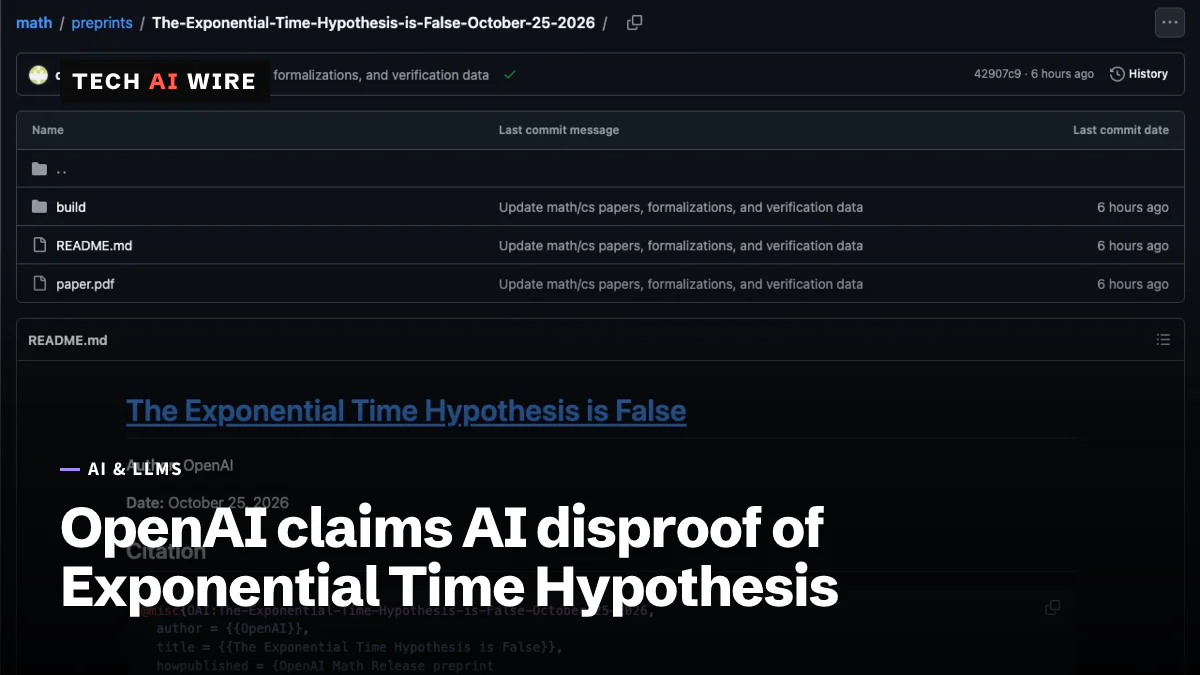
OpenAI said on October 26, 2026 that one of its internal AI models has disproved the Exponential Time Hypothesis. That is a central assumption in computer science about how hard certain problems are to solve. The company also claimed two results in mathematics and physics. If the computer science claim survives expert review, it would overturn an idea that a large body of research takes as true.
None of the three results has been confirmed yet. OpenAI has handed them to outside researchers who have not been paid and signed no confidentiality deals.
What the Exponential Time Hypothesis says
The hypothesis is about Boolean satisfiability, often shortened to SAT. A SAT problem asks whether there is a way to set a list of true-or-false values so that a logic formula comes out true. The hypothesis says the hardest versions of this problem cannot be solved much faster than by checking an exponential number of combinations. Exponential means the work roughly doubles with each extra variable.
The Next Web reports that OpenAI calls the hypothesis "widely believed to be true." Many results about which problems cannot be solved quickly are proven on the assumption that it holds. A disproof would mean those results need another foundation.
How OpenAI says the proof was found
According to Unite.AI, the timeline ran:
| Date | Step |
|---|---|
| October 16, 2026 | The model produces a written disproof |
| October 17, 2026 | The disproof is checked in Lean |
| October 25, 2026 | The accompanying manuscript is dated |
| October 26, 2026 | OpenAI announces the result |
Lean is a proof assistant: software that checks every step of a mathematical proof by machine. A Lean check shows the logic holds for the statement as written. Reviewers still need to confirm that the statement matches the real hypothesis. Unite.AI says the disproof concerns formulas known as k-CNF, with k of at least 2. The write-up and the Lean proof are public on GitHub.
Who will check it
Russell Impagliazzo and Ramamohan Paturi of UC San Diego and Ryan Williams of MIT will lead an independent review. In an open letter quoted by The Next Web, they wrote: "Our involvement should not be taken as certification of the claim." They added: "If the claim is correct, it will change an important part of theoretical computer science." Williams said the group signed no NDAs and will not be paid.
The other two claims
In mathematics, OpenAI says its models proved the local smoothing conjecture in every dimension. Christopher Sogge proposed it in 1991, and it was proved in two dimensions in 2019. A proof in all dimensions would also settle the Kakeya and Stein restriction conjectures, two long-open problems about shapes and waves.
In physics, OpenAI claims a rigorous proof that certain four-dimensional quantum field theories exist. These include quantum chromodynamics, the theory of the strong nuclear force, and pure Yang-Mills theory. The existence of Yang-Mills theory is part of one of the Clay Millennium Prize problems. Nobel laureate David Gross will lead the physics review. The Next Web says OpenAI is not releasing the physics material for now.
OpenAI says it will claim no academic credit for the work. It is also giving $5 million to the Simons Foundation, which funds basic science.
Why caution is warranted
OpenAI has made large math claims before. Earlier this month it withdrew 3 of 722 AI-written math manuscripts after a sign error. In September, AI agents claimed a Navier-Stokes result that mathematicians pushed back on. A machine-checked proof is stronger evidence than a written argument, but the reviewers' verdict is what counts.
What this means for developers
Nothing in day-to-day software changes today. SAT solvers, the tools that power chip verification, package-dependency resolution and scheduling, keep working exactly as before.
- Do not expect faster solvers yet. A disproof shows that a faster method exists in theory. It does not mean that method beats today's tools on real inputs.
- Watch the review, not the headlines. The UC San Diego and MIT group is the signal to follow. Their report will say whether the Lean statement matches the real hypothesis.
- Note the role of Lean. Machine-checked proofs are becoming the standard way to test AI-produced math. Teams that build proof or verification tools should expect more demand.
- Treat AI research claims as drafts. Even with formal checks, OpenAI's own withdrawals this month show that errors slip through.
If the result holds, textbooks on algorithms and complexity will need new chapters. If it fails, the review will show where the gap was.
Sources
Related articles

GPT-6.1 Terra halves OpenAI's mid-tier API price
OpenAI released GPT-6.1 Terra on October 26 at $1 per million input tokens and $5 per million output, half GPT-5.6 Terra's price, with computer use.

Grok 4.7 picks Republicans, GPT-6.1 Sol picks Democrats
Forced to pick in nearly 500 US midterm races through their APIs, Grok 4.7 chose the Republican 92% of the time and GPT-6.1 Sol the Democrat 97%.
OpenAI API retires GPT-4, GPT-4 Turbo, o1 and o3-mini
OpenAI shuts down GPT-4, GPT-4 Turbo, GPT-3.5 Turbo, o1, o3-mini and more in its API on October 23, 2026. Most calls should move to gpt-5.6-sol.
The weekly digest
One email every Friday with the week's top stories from all six desks: AI, dev tools, coding, the tech industry, startups and what's next. Free, no spam.