NASA releases over 800GB of Artemis II Moon data
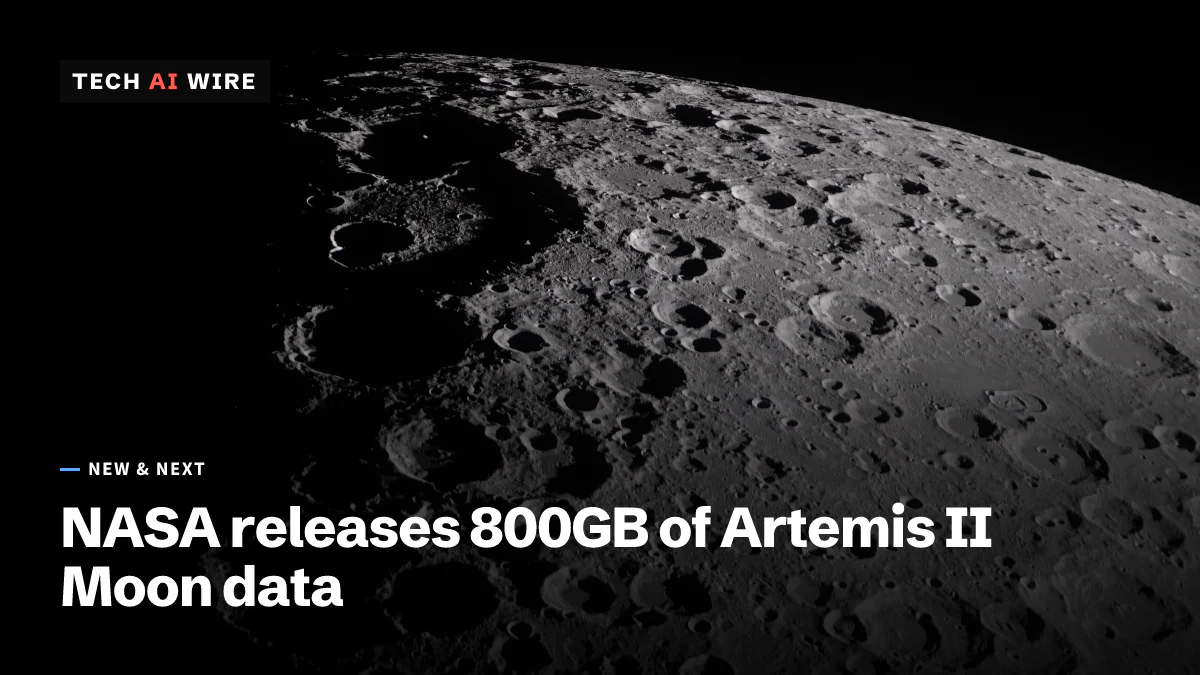
NASA put more than 800GB of Artemis II lunar science data online on October 7: over 11,000 images and videos, 8.5 hours of crew audio and their notes.
4 min read
By the numbers
- of lunar science data released
- 800GB+
- images and videos from the crew and Orion
- 11,000+
- of recorded crew observations
- 8.5 hours
- faint impact flashes seen on the Moon's far side
- 5
NASA released the full lunar science dataset from its Artemis II mission on October 7, 2026, and anyone can download it. The archive holds more than 800 gigabytes, including more than 11,000 images and videos and 8.5 hours of the crew describing what they saw. NASA calls it "the first planetary science dataset captured primarily by humans in more than half a century."
What NASA released
Artemis II flew four astronauts around the Moon in April 2026. NASA's announcement says the release covers images and video from the crew's handheld cameras and from the Orion spacecraft's cameras. It also includes crew audio, images the astronauts marked up by hand, and their notes. Some of this material had never been released before.
Martin Cid Magazine reports that the handheld photos came from Nikon D5 and Z9 cameras. Some camera files are in raw formats, which keep all the data the sensor recorded.
NASA also published three reports to go with the data:
| Report | Date | Size |
|---|---|---|
| Artemis II Preliminary Science Report | October 7, 2026 | 137.11 MB |
| Artemis II Lunar Science Operations Report | October 6, 2026 | 36.69 MB |
| Artemis II Data User Guide | October 6, 2026 | 7.93 MB |
Where the data lives
The files sit in NASA's Planetary Data System, or PDS, the public archive for the agency's planetary missions. The Artemis II collection is listed on the site of the PDS Geosciences Node. According to Martin Cid Magazine, the node recommends the Data User Guide as the place to start.
The same report lists several ways in. The PDS Image Atlas lets users filter photos by time, camera and processing level. A free PDS4 Viewer runs on Windows, Mac and Linux, and comes with its source code and a Python library. Each bundle of files has its own DOI, a permanent ID that researchers use to cite data.
NASA Science's report page hosts the reports as PDFs, along with selected audio and images. It says the crew audio there was lightly edited for length and clarity. The unedited recordings are in NASA's Artemis Audio Library.
Five flashes on the far side
The best-known finding is a set of five extremely faint flashes on the Moon's far side. NASA Science says Reid Wiseman and Victor Glover of NASA and Jeremy Hansen of the Canadian Space Agency saw them. Orion was about 46,000 miles from the Moon at the time.
The flashes came during a nearly hour-long eclipse, when the Sun was hidden behind the Moon. Martin Cid Magazine puts the eclipse at 54 minutes. It says the flashes came from rocky fragments no more than a couple of inches across hitting the surface. The science team confirmed them after ruling out cosmic rays and reflections from the spacecraft. The astronauts circled each flash on a tablet image, and those notes are in the archive.
The audio captures the crew's reactions. "The terminator is the most striking thing that I've seen so far," pilot Victor Glover says in one clip. The terminator is the line between the Moon's day and night sides.
One piece is still missing
Martin Cid Magazine notes a gap. The SPICE bundle, which records where the spacecraft was and which way each camera pointed, has been delayed. The PDS archive page says it will come "in the near future," with no date. Until it arrives, matching a crew photo to a spot on a lunar map has to be done by hand.
What this means for developers
This is a large, well-documented dataset that anyone can build with. A few practical points:
- Start with the user guide. It is under 8 MB and explains how the bundles are laid out. That saves downloading hundreds of gigabytes to find one image.
- Use the official tools. The PDS4 Viewer and its Python library read the archive's format directly, so a project does not need to parse it from scratch.
- Wait for SPICE before mapping. Apps that place photos on a Moon map, or match them to orbiter images, need the geometry bundle. Plan that feature for after it ships.
- Cite the DOI. Research papers and public projects should cite each bundle's DOI, so others can find the exact files used.
- Read NASA's usage rules. Martin Cid Magazine reports that NASA images, audio and video are generally free to use in the US with credit. Commercial use cannot suggest NASA endorses a product. Astronauts' names and faces cannot appear on commercial products. NASA's insignia cannot sit next to AI-generated images.
The annotated flash images are a small, concrete place to begin: five confirmed events, each marked by the astronauts who saw it.
Sources
Related articles
Tools This Week: October 10, 2026 - Python 3.15, Mold 3.0
Seven developer tools this week, led by Python 3.15.0 and the Rust rewrite of the Mold linker, with what each one changes and what it costs.
Python 3.15.0 ships with lazy imports and frozendict
Python 3.15.0 arrived October 9 with 5,643 commits from 1,012 contributors: lazy imports, a built-in frozendict, UTF-8 by default and a faster JIT.

Margaret Hamilton, Apollo software pioneer, dies at 90
Margaret Hamilton died on September 30 at 90. She led the MIT team behind Apollo's flight software and is credited with coining software engineering.
The weekly digest
One email every Friday with the week's top stories from all six desks: AI, dev tools, coding, the tech industry, startups and what's next. Free, no spam.